
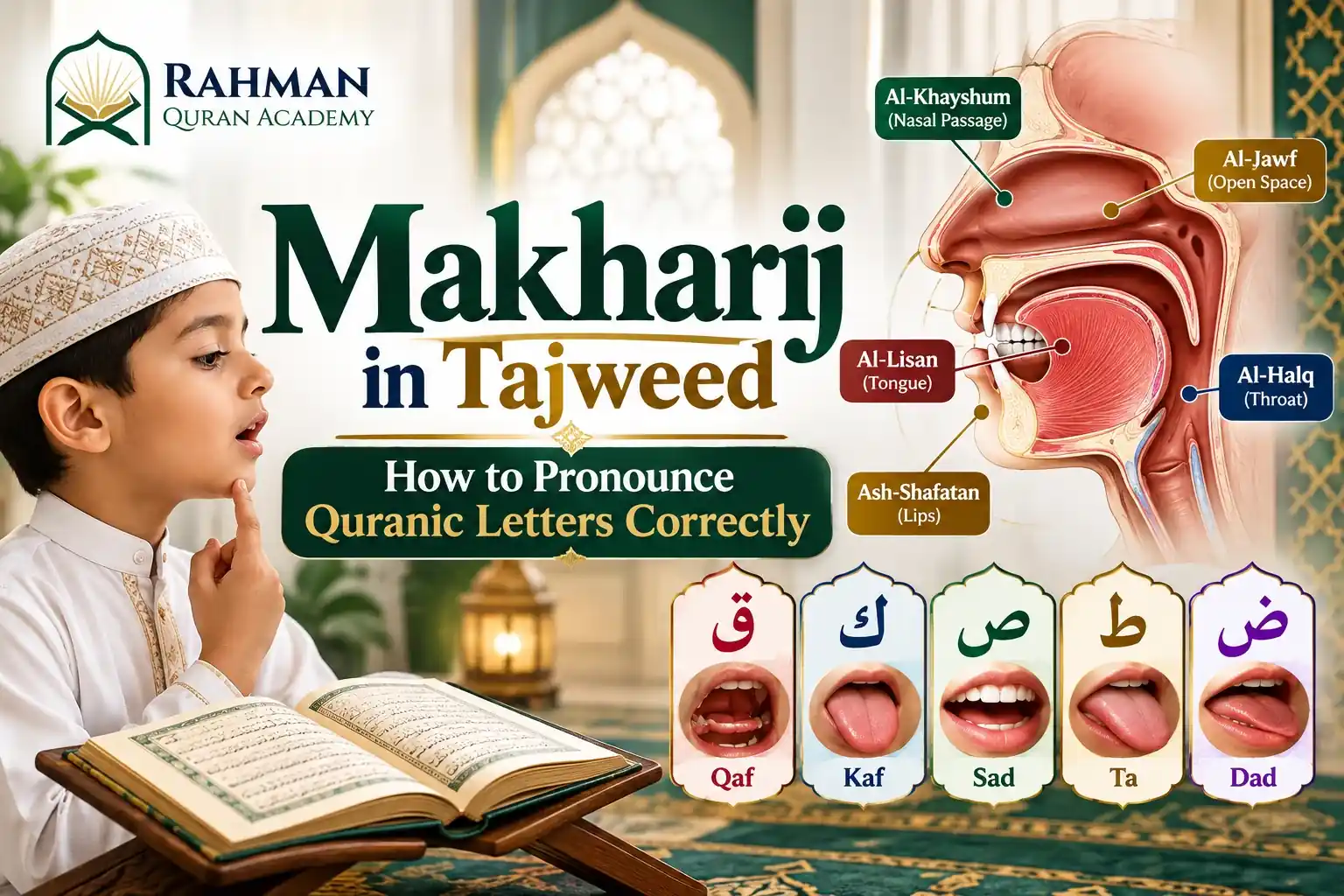
Makharij in Tajweed: How to Pronounce Quranic Letters Correctly
Makharij (singular: makhraj) are the points where Arabic letters are produced during Quran recitation: the throat, the tongue, the lips, the open space of the mouth, and the nasal passage. Knowing a letter’s makhraj tells you where its sound should come from. That is the foundation for pronouncing letters clearly and telling similar ones apart.
This guide explains the five main regions and the 17 detailed points. It then works through six difficult letters, gives you a practice order that carries over into real recitation, and shows you how to check yourself and when feedback helps.
What Is Makharij in Tajweed?
Makharij al-huruf (مخارج الحروف) means “the articulation points of the letters”. A makhraj (مَخْرَج) is the place where a letter’s sound is formed. Makharij (مَخَارِج) is the plural.
Many learners can recognise a letter on the page but are unsure where the sound should actually come from. Makharij answers that physical question. It is about the throat, tongue, and lips, not just the shape of the letter.
Makharij is one part of the wider system of Tajweed. If you are new to the subject, start with what Tajweed means or the complete guide to Tajweed. If you cannot yet read Arabic letters, learn Noorani Qaida first and come back.
Why Do Makharij Matter When Reading the Quran?
Correct articulation helps each letter come out clearly and separately from the letters around it. That is the practical reason Makharij sits near the start of most Tajweed learning orders.
- It separates similar letters. Pairs such as ص and س, or ط and ت, are easy to blur when you do not know where each one is made.
- It builds the base for other rules. A rule such as Ikhfa or Madd is hard to apply cleanly if the letters around it are pronounced wrongly. See Tajweed rules explained for how the pieces fit.
- It turns knowing into doing. Knowing a letter visually is not the same as producing it correctly. Makharij gives you something physical to practise.
Quran 73:4 instructs the believer to recite the Quran in a measured, deliberate way (tartil): وَرَتِّلِ ٱلْقُرْءَانَ تَرْتِيلًا (Quran.com, 73:4). The verse is the broader foundation for careful recitation. It does not list the articulation points. Scholars of recitation organised those later.
The 5 Main Makharij in Tajweed
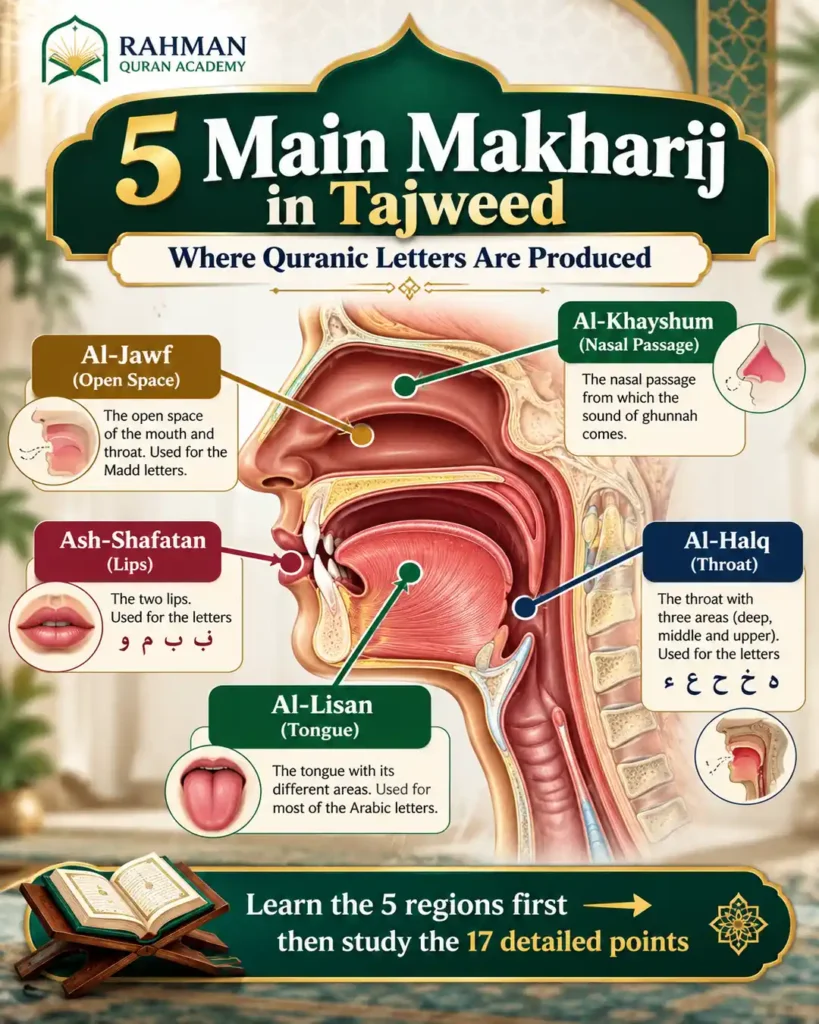
The five main Makharij are Al-Jawf (the open space of the mouth and throat), Al-Halq (the throat), Al-Lisan (the tongue), Ash-Shafatan (the two lips) and Al-Khayshum (the nasal passage). Start with these five. The 17-point classification later is just a closer look inside them.
| Makhraj | Arabic | Main area | Letters |
| Al-Jawf | الجوف | Open space of the mouth and throat | The three madd letters: ا و ي |
| Al-Halq | الحلق | Throat | ء ه ع ح غ خ |
| Al-Lisan | اللسان | Tongue | ق ك ج ش ي ض ل ن ر ط د ت ص ز س ظ ذ ث |
| Ash-Shafatan | الشفتان | Two lips | ف ب م و |
| Al-Khayshum | الخيشوم | Nasal passage | Ghunnah (the nasal sound of ن and م) |
Al-Jawf — The Oral Cavity
Al-Jawf is the open space of the mouth and throat. It is the source of the three madd (lengthening) letters. These are alif after a fatha, waw sakinah after a damma, and ya sakinah after a kasra.
There is no fixed contact point. The sound travels through open space rather than touching one spot. In practice, keep the mouth open and relaxed during these letters. For how long to hold them, see the Madd section in Tajweed rules explained.
Al-Halq — The Throat
The throat has three zones, and each produces two letters.
| Zone | Letters | Position |
| Deepest part | ء ه | Furthest from the mouth |
| Middle | ع ح | Middle of the throat |
| Nearest to the mouth | غ خ | Closest to the mouth |
Within each pair, one letter sits slightly deeper than the other (ء is deeper than ه, ع deeper than ح, غ deeper than خ).
A common slip is producing غ and خ from the mouth instead of the throat. They belong at the throat zone nearest the mouth, so keep them distinct from the mouth area.
Al-Lisan — The Tongue
The tongue produces 18 letters from ten points. It helps to group them by which part of the tongue is working:
- Back of the tongue: ق and ك, each against the upper palate. ق is further back.
- Middle of the tongue: ج ش ي against the palate above it.
- Sides of the tongue: ض from the edge against the upper molars; ل from the sides near the front against the upper gum ridge.
- Tip of the tongue: the largest group: ن ر ط د ت ص ز س ظ ذ ث. Where the tip lands decides which letter you make.
For the tip letters, the position changes only slightly. ط د ت touch the base of the upper front teeth. ص ز س sit near the lower front teeth with a narrow gap for air. ظ ذ ث meet the edges of the upper front teeth.
Ash-Shafatan — The Two Lips
The lips produce four letters from two points.
- ب and م: the two lips close together. ب closes more firmly.
- و (as a consonant): the lips are rounded and open, not closed.
- ف: the inner part of the lower lip meets the edges of the upper front teeth.
The lips are the easiest area to check in a mirror. A و that closes the lips, or a ف that does not touch the teeth, is easy to see.
Al-Khayshum — The Nasal Passage
Al-Khayshum is the passage connecting the nose to the throat. It produces Ghunnah, the nasal sound that accompanies ن and م. Ghunnah is a quality that comes from the nasal passage rather than a letter of its own, which is why Al-Khayshum is counted as a makhraj without a letter (surahquran.com). The rules that decide when Ghunnah appears belong to Noon Sakinah and Meem Sakinah, covered in Tajweed rules explained.
The 17 Detailed Articulation Points
A widely taught Tajweed classification counts 17 detailed articulation points inside the five main regions. This is the count in Ibn al-Jazari’s poem Al-Muqaddimah al-Jazariyyah, and the one most Tajweed courses follow.
It is not the only historical count. Some scholars counted 16 and others 14. The 16 count, associated with Sibawayh and al-Shatibi, does not count Al-Jawf as a separate point. So 17 is the standard teaching classification, not a count every scholar shared.
| No. | Region | Articulation area | Letters |
| 1 | Al-Jawf | Open space of mouth and throat | ا و ي (madd letters) |
| 2 | Al-Halq | Deepest throat | ء ه |
| 3 | Al-Halq | Middle throat | ع ح |
| 4 | Al-Halq | Throat nearest the mouth | غ خ |
| 5 | Al-Lisan | Back of tongue with palate | ق |
| 6 | Al-Lisan | Slightly forward of ق | ك |
| 7 | Al-Lisan | Middle of tongue with palate | ج ش ي |
| 8 | Al-Lisan | Edge of tongue with upper molars | ض |
| 9 | Al-Lisan | Sides of tongue with upper gum ridge | ل |
| 10 | Al-Lisan | Tip of tongue with upper gum ridge | ن |
| 11 | Al-Lisan | Tip, slightly further back | ر |
| 12 | Al-Lisan | Tip with base of upper front teeth | ط د ت |
| 13 | Al-Lisan | Tip near lower front teeth, narrow air gap | ص ز س |
| 14 | Al-Lisan | Tip with edges of upper front teeth | ظ ذ ث |
| 15 | Ash-Shafatan | Inner lower lip with upper front teeth | ف |
| 16 | Ash-Shafatan | Between the two lips | ب م و |
| 17 | Al-Khayshum | Nasal passage | Ghunnah |
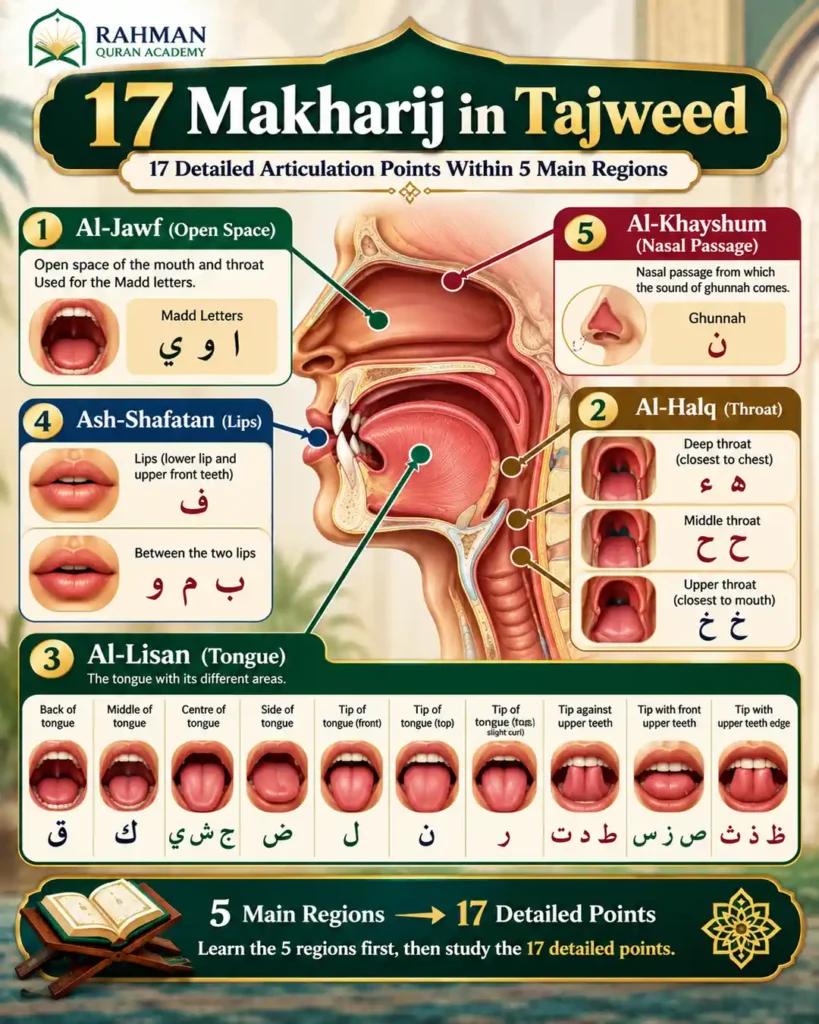
Source for the mapping: surahquran.com, which follows Ibn al-Jazari. Numbering varies between books, so the groupings matter more than the numbers. The letters و and ي appear twice because they come from Al-Jawf as madd letters and from the lips or tongue when they are consonants.
Do not try to memorise all 17 at once. Learn the five regions first. Then work through the 17 in the order the table follows, a few at a time.
How to Pronounce Difficult Quranic Letters Correctly
Some letters are hard because English has no matching sound. Others are hard because two letters sit close together. Do not try to map these sounds onto English letters. A familiar English sound can be a starting reference, but it will blur the difference you are trying to learn.
Two ideas help here:
- Some pairs have different makharij, such as ق/ك and ح/ه. The fix is position.
- Some pairs share the same makhraj, such as ص/س and ط/ت. They differ by a quality (Sifaat), mainly heaviness. The fix is how the back of the tongue behaves, not where the tip lands.
| Pair | Same makhraj? | Main difference |
| ق / ك | No | ق is further back; ق is heavier |
| ص / س | Yes | ص is heavy; س is light |
| ط / ت | Yes | ط is heavy; ت is light |
| ح / ه | No | ح is middle throat with tight friction; ه is deepest throat, a light breath |
| ع | Shares its zone with ح | Voiced and constricted; not the same as ء |
| ض | Its own point | Side of the tongue; heavy |
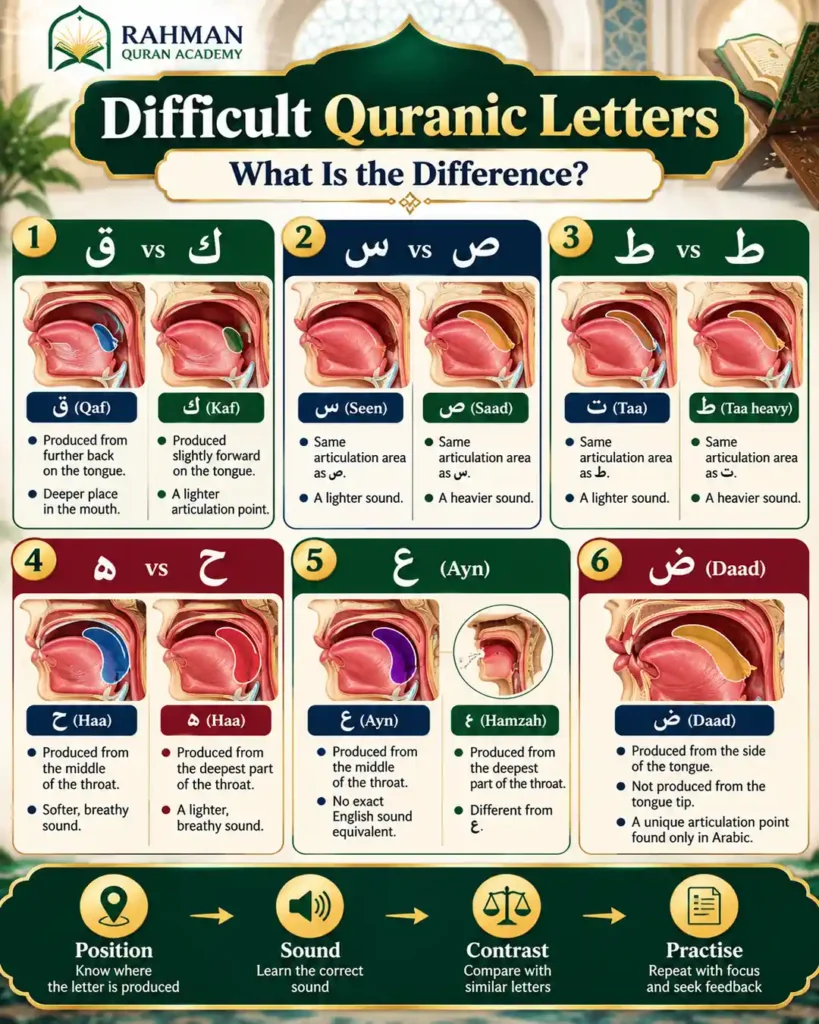
“Heavy” means the back of the tongue is raised towards the palate, which gives a fuller sound. “Light” means it is not.
A practice verse. Al-Fatihah 1:6, ٱهْدِنَا ٱلصِّرَٰطَ ٱلْمُسْتَقِيمَ (Quran.com, 1:6), contains ص, ط, س, ت and ق in one short verse. That makes it a useful place to practise these contrasts in a real Quranic context. Ask a teacher to listen to you read it.
ق vs ك
- Where: ق is made at the very back of the tongue against the upper palate. ك is slightly forward of it.
- What happens: the contact point moves forward for ك. ق is also a heavy letter, so it sounds fuller.
- Common confusion: many English speakers hear both as “k”. The result is a ق that sounds like ك.
- Practise: say قَ then كَ slowly, and feel the contact point move forward. Keep ق full and deep.
- In the Quran: ك in إِيَّاكَ (1:5) and ق in ٱلْمُسْتَقِيمَ (1:6).
ص vs س
- Where: both come from the tip of the tongue near the lower front teeth, with a narrow gap for the air to pass.
- What happens: this pair differs in heaviness, not location. For ص, the back of the tongue lifts, so the sound is full. For س, it stays down.
- Common confusion: ص slides into a thin س.
- Practise: alternate صَ سَ and listen for a fuller sound on ص. Keep the tip of the tongue where it is and change only the back.
- In the Quran: ص in ٱلصِّرَٰطَ and س in ٱلْمُسْتَقِيمَ (both 1:6).
ط vs ت
- Where: both touch the base of the upper front teeth with the tip of the tongue. ط sits further back than the three letters ط, د, and ت .
- What happens: ط is heavy and emphatic. ت is light.
- Common confusion: ط becomes a ت, with no added weight.
- Practise: alternate طَ تَ, adding depth to ط without changing the tongue-tip position.
- In the Quran: ط in ٱلصِّرَٰطَ and ت in ٱلْمُسْتَقِيمَ (both 1:6).
ح vs ه
- Where: ح comes from the middle of the throat. ه comes from the deepest part.
- What happens: ح is a tight, rough passing of air. ه is a light breath.
- Common confusion: ح softens into ه.
- Practise: say هَ as a soft exhale, then حَ with a narrower, rougher throat. Alternate them.
- In the Quran: ح and ه both appear in ٱلْحَمْدُ لِلَّهِ (1:2).
ع
- Where: the middle of the throat, in the same zone as ح.
- What happens: ع is voiced and constricted, so the throat narrows while the voice keeps going.
- Common confusion: ع becomes a short ء (a quick catch from the deepest throat) or just a vowel.
- Why English misleads: there is no everyday English sound to copy, so approximations tend to drift to the wrong place.
- Practise: say عَ عِ عُ and keep the sound flowing, then contrast عَ with ءَ.
- In the Quran: ع in نَعْبُدُ and نَسْتَعِينُ (1:5).
ض
- Where: the edge of the tongue against the upper molars. Many learners find the left side easier, and the left is the more common choice.
- What happens: it is a heavy letter produced from the side of the tongue, not the tip.
- Common confusion: ض drifts forward to the tip of the tongue, towards د or ظ. Teachers often describe this as a typical problem.
- Why it needs care: it is widely regarded as one of the hardest letters, and it has no simple English match. Do not trust any “it sounds like X” shortcut.
- Practise: locate the side of the tongue first. Then compare ض (side), د (tip at the base of the upper teeth), and ظ (tip at the edges of the upper teeth) slowly, one at a time.
- In the Quran: ض in ٱلضَّآلِّينَ (1:7).
Makharij vs Sifaat: What’s the Difference?
Makharij is where a letter is produced. Sifaat is the quality the letter carries once it is produced. Both are needed to say a letter correctly.
Think of it this way: the makhraj gives the location, and the sifah gives the character of the sound, such as heavy or light, or whispered or voiced. ص and س are a good example. They share a makhraj and differ by quality.
This article stays on location. For how Makharij and Sifaat fit into the wider set of rules, see Tajweed rules explained.
How to Practise Makharij Step by Step
Move from one letter to full recitation in stages. Knowing a chart is not the same as using it while you read. Many learners report that a rule makes sense when explained, then slips once they start reading connected text. The steps below are designed for that gap.
- Start with isolated letters. Say one letter at a time with a short vowel, such as بَ. Focus on where it is made, not how fast you can say it.
- Practise similar letters together. Contrast pairs: قَ كَ, صَ سَ, طَ تَ, حَ هَ. Change one thing at a time.
- Move from letters to syllables. Add the letter to simple combinations so it must hold its position next to other sounds. (These are practice drills, not Quranic words.)
- Practise words from the Quran. Choose short, familiar verses, such as Al-Fatihah. Read slowly and listen to the target letter only.
- Apply the sound during full recitation. This is where isolated accuracy often disappears. Keep the pace slow enough to hold the letter.
- Check and correct. Compare yourself with a trusted reciter, or get feedback from a teacher.
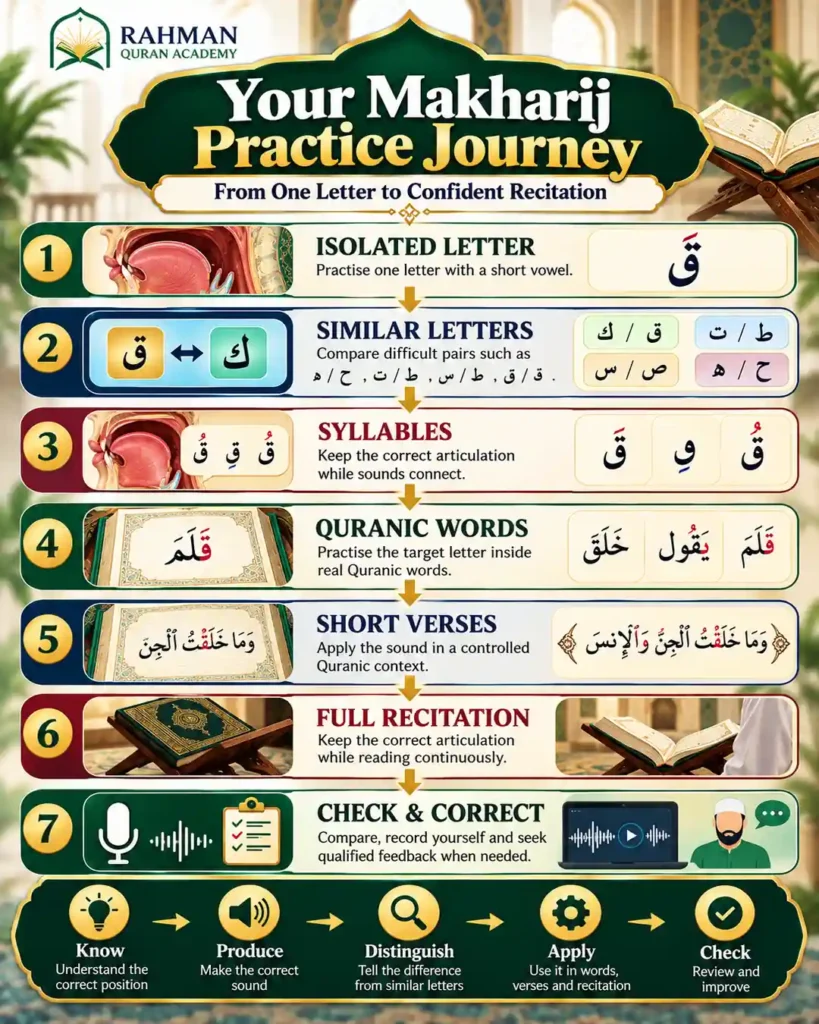
The principle: know the makhraj → produce the sound → tell it apart from its neighbour → use it in words → use it in recitation → check it.
Two cautions:
- No fixed timeline. Progress depends on where you start, how often you practise, and whether you get feedback. Be wary of any promise of mastery in a set number of weeks.
- Keep it small. Busy learners do better working on one letter or pair at a time than on the whole chart. For a wider beginner sequence, see how to learn Tajweed step by step. For a home routine, see how to practise Tajweed at home.
If you learned the Quran as a child and later noticed pronunciation habits, you are not unusual. Awareness plus slow, controlled repetition tends to help more than memorising another chart. The guide to learning Tajweed as an adult covers this situation in more depth.
How to Check Whether Your Makhraj Is Correct
Slow, deliberate practice combined with careful listening is the most reliable self-check. A recording can show that something sounds different, but it will not tell you what to change.
Useful methods:
- Slow it down. Say the letter on its own, and feel where the tongue or lips are touching.
- Listen to a trusted reciter. Pick one short verse and listen to the target letter only. Then read the same verse.
- Record yourself. Play it back against the reciter. You may notice a letter that sounds thinner, softer, or further forward than theirs.
- Use a mirror where it helps. Lip letters (ب م و ف) and the tongue-and-teeth letters (ظ ذ ث) are partly visible. Throat letters cannot be seen at all.
- Compare difficult pairs back to back. Say ق then ك, or ص then س, and listen for a real difference.
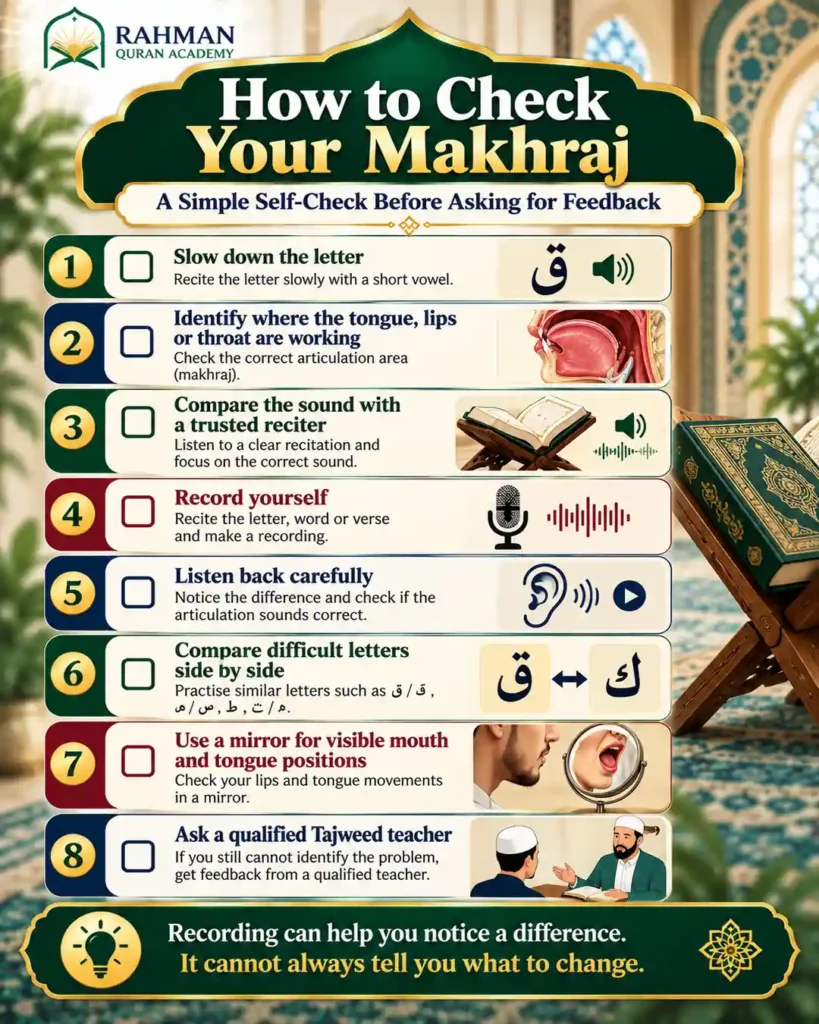
What recording cannot do. It can help you notice a gap. It cannot tell you why the sound is different or which movement to change. This is a common learner experience: you hear that something is off, but cannot say which part of the mouth is wrong. That is the point where a teacher who can hear you becomes useful.
These are practical methods, not a scientifically validated test.
Common Makharij Mistakes and How to Fix Them
Most Makharij mistakes come from approximation: reaching for a familiar sound instead of the correct position. Find the one that matches you and fix that first. For wider recitation errors, see common Tajweed mistakes.
| Mistake | Why it happens | Why it matters | Better approach |
| Using a familiar English sound for an Arabic letter | It is the closest sound the learner already knows | The letter ends up in the wrong place | Learn the position first; use English only as a rough starting point |
| Throat letters sound unclear (ع ح غ خ) | They are hard to feel and cannot be seen | They blur into neighbouring letters | Practise each pair slowly and contrast it with its neighbour |
| ق sounds like ك | Both are made at the back of the tongue | The heavy, deep quality of ق is lost | Move the sound back; keep it full |
| ص sounds like س | Same tongue-tip position, so only the heaviness differs | The fuller quality of ص is lost | Raise the back of the tongue; keep the tip where it is |
| Correct in isolation, wrong in words | Attention drops when letters connect | Accuracy does not carry into recitation | Practise in syllables, then words, then verses |
| Repeating the same error | The learner cannot hear what is wrong | Repetition reinforces the habit | Isolate the one letter and get external feedback |
| Memorising the chart but not applying it | Theory feels like progress | Knowledge stays separate from recitation | Spend more time on drills and short verses |
| Rushing through connected recitation | Wanting to sound fluent | Letters lose their position | Slow down until the letter holds |
Can You Learn Makharij Without a Teacher?
Yes, you can learn a good deal on your own, especially the concepts. The harder part is hearing your own pronunciation errors.
Self-study can realistically help with:
- learning the five regions and the 17 points;
- understanding which part of the mouth or throat each letter uses;
- practising isolated letters and pairs;
- recording yourself and noticing differences;
- repeated, controlled practice at your own pace.
The limit is feedback. Pronunciation is difficult to judge when you cannot hear or identify your own error. Some learners record themselves or share a recording because they sense something is off, but cannot say what. A well-chosen resource can build awareness, but it cannot listen back to you.
So the honest answer is: not everyone needs paid lessons at every stage, and self-study does work for concepts and practice. Feedback becomes especially useful when you cannot tell whether a sound is right. For more on this, see how to learn Tajweed from YouTube.
When Should You Get Feedback From a Tajweed Teacher?
Get feedback when you cannot tell whether your pronunciation is correct, or when the same habit continues despite repeated practice. This framework helps you decide what the problem is:
| If this describes you | Then |
| You do not know the concept | Study the concept |
| You know it but cannot produce the sound | Practise the articulation slowly |
| You can produce it alone but lose it in connected reading | Practise connected combinations |
| You can do it in a word but lose it while reciting | Practise the same letter in real Quranic context |
| You cannot tell whether the sound is correct | Get qualified feedback |
| You keep repeating the same error | Stop repeating; isolate the problem and get correction |
This is a practical guide, not a clinical test.
When you choose a teacher, look for someone who can hear your pronunciation and explain the physical correction. The guide to choosing the right Tajweed teacher lists what to check.
If you decide you want live correction, online Tajweed classes at Rahman Quran Academy are one-to-one and online, with three free trial classes so you can see whether the approach suits you. If your goal is wider recitation across the whole Quran, Quran recitation classes may be the closer fit.
Your next step. Understand the makhraj, practise the sound, compare it with its difficult neighbour, use it in words, apply it in recitation, then check and correct it. Pick one letter pair from this guide and work on it this week.
FAQs
What is Makharij in Tajweed?
Makharij are the points from which Arabic letters are produced during Quran recitation. The singular is makhraj. The main regions are the open space of the mouth, the throat, the tongue, the lips, and the nasal passage.
How many Makharij are there in Tajweed?
The most widely taught count is 17 detailed points, grouped into five main regions. Some classical scholars counted 16 or 14, so 17 is the standard teaching classification rather than a count every scholar shared.
What are the five main Makharij?
Al-Jawf (the open space of the mouth and throat), Al-Halq (the throat), Al-Lisan (the tongue), Ash-Shafatan (the two lips), and Al-Khayshum (the nasal passage).
Why is Makharij important in Quran recitation?
It helps each letter come out clearly and in its proper place, and it helps you tell similar letters apart. It also gives you a base for applying other Tajweed rules cleanly.
What is the difference between Makharij and Sifaat?
Makharij is where a letter is produced. Sifaat is the quality it carries, such as heavy or light. Some pairs, like ص and س, share a makhraj and differ by quality.
How can I improve my Arabic letter pronunciation?
Work on one letter or pair at a time. Learn the position first, then practise it in syllables, words and short verses. Compare yourself with a trusted reciter and get feedback if you cannot tell whether it is right.
Can I learn Makharij without a teacher?
You can learn the concepts and practise on your own. The harder part is hearing your own errors, so feedback becomes useful when you cannot tell whether a sound is correct.
Which Arabic letters are difficult to pronounce?
Learners commonly find ق, ك, ص, س, ط, ت, ح, ه, ع and ض difficult. Some have no English equivalent, and some sit close to another letter.
How can I practise Makharij at home?
Move from isolated letters to similar-letter contrasts, then syllables, short Quranic verses and full recitation. Use a mirror for lip and tongue-and-teeth letters, and record yourself to notice differences.
How do I know if I am pronouncing a Quranic letter correctly?
Compare slowly with a trusted reciter and listen for a real difference. If you cannot tell, or the same error keeps returning, ask a qualified Tajweed teacher to listen.