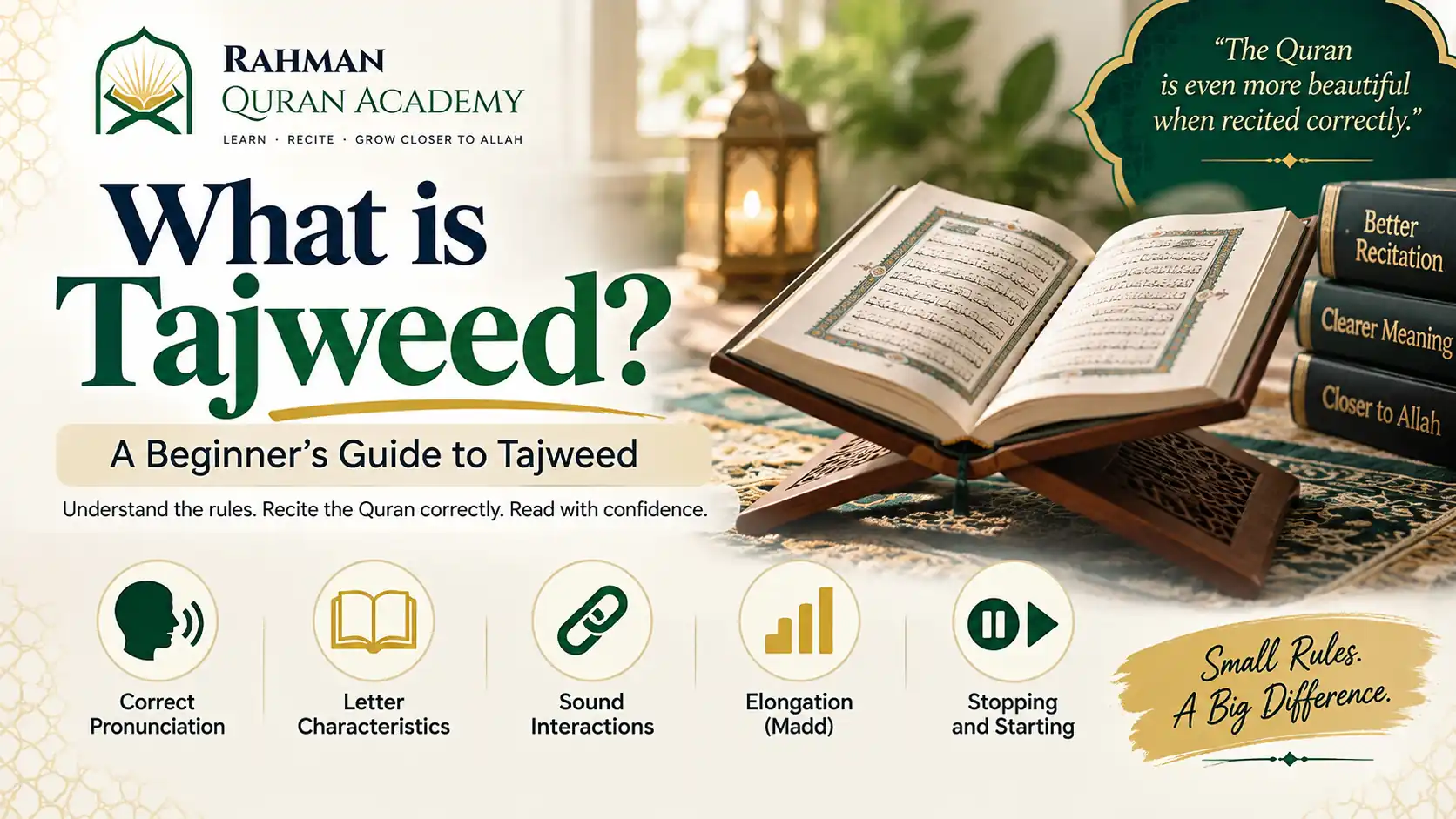
What Is Tajweed? A Beginner’s Guide to Tajweed
Tajweed is the set of rules and skills for reciting the Quran with each letter pronounced correctly. It covers where sounds come from, how they behave, how long they are held and where to pause. It is also the gap between recognising Quranic words and pronouncing them as they should be recited.
What Is Tajweed?
Tajweed is the discipline of reciting the Quran accurately: pronouncing every letter correctly and applying the recitation rules properly.
Linguistically, the word relates to doing something well, to a high standard. IslamWeb explains that in Arabic it carries the sense of beautification and of doing something in the best way.
In the sciences of the Quran, the same source describes two sides of Tajweed:
• Theoretical Tajweed: knowing the rules set out by Tajweed scholars.
• Practical Tajweed: pronouncing each letter with its correct manner and from its correct place of articulation.
For a beginner, that split is useful. It shows early on that Tajweed is not only something to know. It is something to do every time you recite.
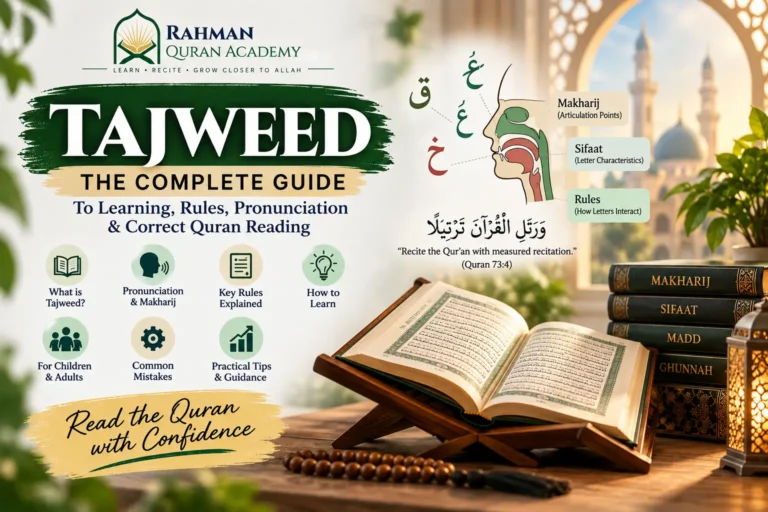
For a complete overview of Tajweed rules, pronunciation and how to learn Tajweed, see our [complete Tajweed guide].
Open the Quran and read a line aloud. Tajweed is the set of decisions behind every word:
• Where does this letter sound come from?
• Is this vowel short or long?
• Does this letter change the sound next to it?
• Should this sound be held, and for how long?
• Can I stop here, and where do I restart?
What Does Tajweed Actually Do?
Tajweed guides how the Quran is pronounced and applied while you read. At beginner level, it does five practical jobs:
• Pronunciation and articulation. Each letter is produced from its proper place, so similar-sounding letters stay distinct.
• Letter characteristics. Letters differ in qualities such as heaviness or lightness, and Tajweed describes how each should sound.
• Sound interactions. Some letters change or blend with the letters beside them, and Tajweed sets out how.
• Elongation. Some sounds are held longer than others, and short and long vowels stay clearly different.
• Stopping and starting. Tajweed guides where a reader can pause and how to begin again.
This is a practical process, not abstract theory. Each of these jobs happens while you read, often within a single word.
What Are the Main Areas of Tajweed?
Tajweed terms can look intimidating. Treat the table below as a map, not a rulebook. Each area has its own detailed rules, which this guide does not cover. The detailed Tajweed rules are explained separately.
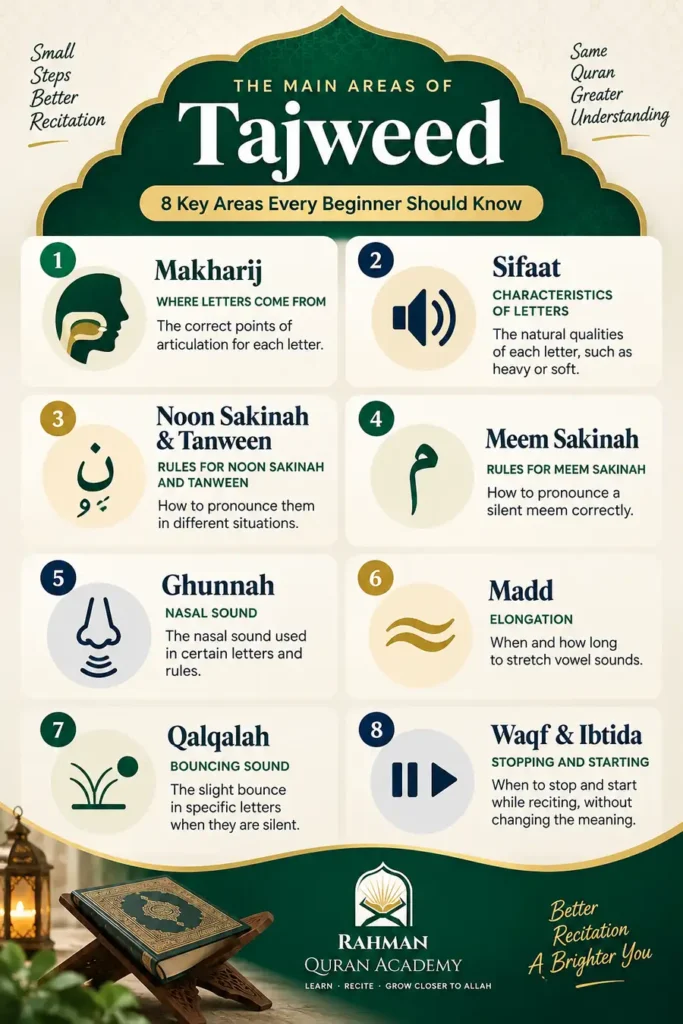
| Area | What it means in simple terms |
| Makharij | The places where letters are produced, such as the throat, tongue and lips. |
| Sifaat | The characteristics of each letter, such as how heavy, light or forceful it sounds. |
| Noon Sakinah & Tanween | What happens to the sound of a noon with no vowel, or a tanween ending, depending on the letter that follows. |
| Meem Sakinah | What happens to the sound of a meem with no vowel, depending on the letter that follows. |
| Ghunnah | A nasal sound, held briefly in certain letters and situations. |
| Madd | The lengthening of certain vowel sounds. |
| Qalqalah | A slight echo or bounce on certain letters when they carry no vowel. |
| Waqf & Ibtida | Waqf is stopping while reciting. Ibtida is starting or resuming. |
Why Is Tajweed Important When Reading the Quran?
Tajweed matters for four connected reasons:
• Accuracy. It helps you pronounce and apply Quranic sounds as they are meant to be recited, rather than approximating them.
• Measured recitation. Quran 73:4 instructs the reader to recite in a measured way. The Ma’arif al-Qur’an commentary explains this as unhurried, distinct recitation rather than reading in haste. Tajweed helps a reader recite clearly and with control.
• Meaning. Some pronunciation errors can affect a word or its meaning, depending on the error. Not every Tajweed mistake does, so it is best not to treat every slip as equally serious.
• Religious standing. Scholars discuss how binding Tajweed is. The answer has nuance, covered in the obligation section below.
Is Tajweed Only About Pronunciation?
No. Pronunciation is the foundation, but Tajweed also covers letter characteristics, how sounds interact, elongation, and stopping and starting.
It is also not the same as having a beautiful voice. Although the Arabic word relates to beautification, in Quran recitation, Tajweed concerns the accuracy of pronunciation and the application of rules. A reader with a lovely voice can still mispronounce letters. A reader with an ordinary voice can recite accurately.
Do You Need Tajweed If You Already Know How to Read the Quran?
Being able to read Quranic Arabic and applying Tajweed consistently are related, but they are not the same skill. Reading gets you through the words. Tajweed shapes how each one is pronounced.
The gap often sits between knowing a rule and applying it. A learner can move through three levels:
1. Knowing the rule: you can explain what it is.
2. Recognising it: you can spot it in the written text.
3. Applying it: you produce the correct sound while reading, without stopping to think.
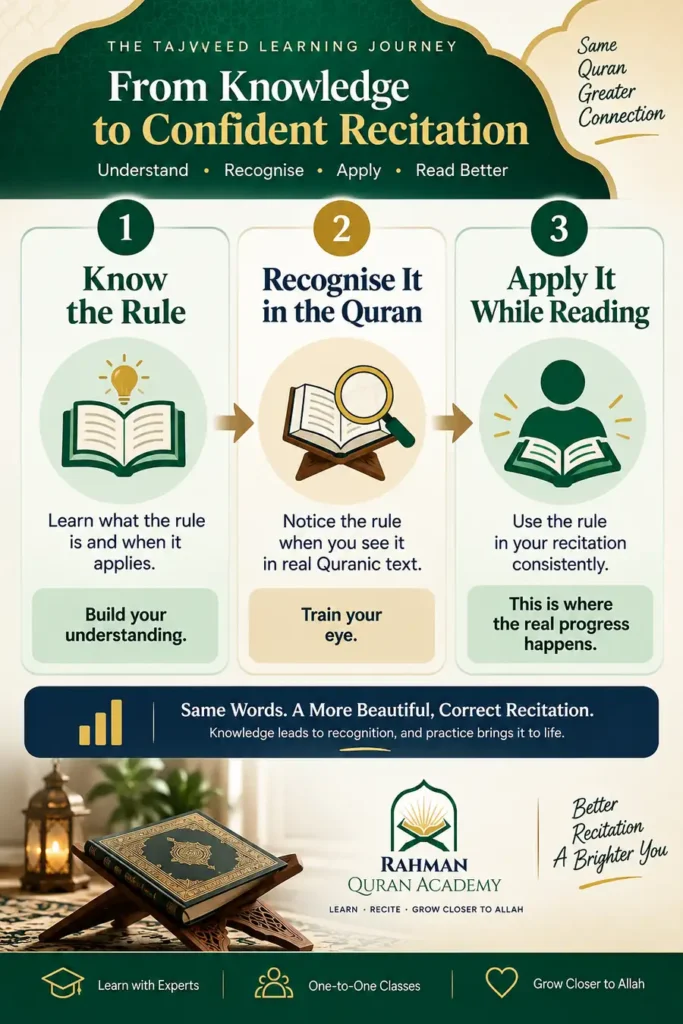
Learners often report feeling comfortable at levels one and two but slipping at level three, particularly when reading alone. Many also say they cannot hear their own mistakes, and that a listener picked up errors they had missed. This is a recurring pattern in learner experience, not a universal fact. It does explain why knowing the rules does not automatically make recitation accurate.
If you have experienced this, why Tajweed mistakes can continue after you know the rules explains the pattern in more detail.
So if you can already read, Tajweed is the next layer to check, not a step backwards. Some adult learners feel embarrassed or behind when they find gaps. That feeling is common enough to name, though not everyone shares it, and it is easier to handle once you have an honest picture of where you are.
Is Tajweed Difficult for Beginners?
It can feel difficult at first, mainly because of unfamiliar terminology. Words like Makharij, Sifaat and Ghunnah sound heavy, but the ideas behind them can be simple once you hear them demonstrated.
The workable approach is to learn progressively:
• Take one rule at a time rather than memorising everything at once.
• Hear each rule before you try to reproduce it.
• Revisit earlier rules as new ones are added.
How long this takes varies with your starting point, how often you practise and whether you get feedback, so no fixed timescale is realistic.
Can You Learn Tajweed Without a Teacher?
You can begin without one, and many people do. The more useful question is what self-study can and cannot do.
Books, videos, apps and self-practice can help you:
• Learn the terminology and understand what each rule is
• Hear examples of correct recitation
• Revise rules and repeat practice in your own time
Learners studying alone often report that resources feel scattered and that it is hard to know where to begin. Following a clear order, such as the framework in the next section, helps. For a closer look at the video route, see learning Tajweed from YouTube without a teacher.
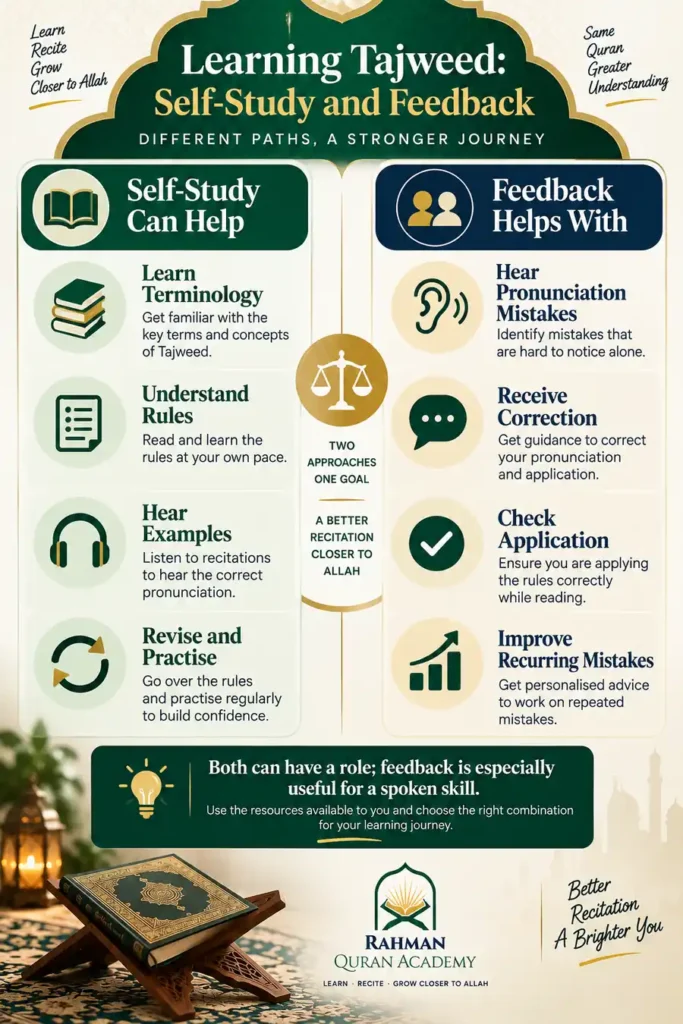
Where self-assessment falls short. Tajweed is a spoken skill, and it is hard to judge your own pronunciation. You may not hear a mistake you make consistently. Direct feedback from someone who can listen and correct you is the part that is hardest to reproduce alone.
That does not make a teacher mandatory in every circumstance. Time, cost and shyness are real reasons people study independently. It means feedback is valuable, and it can come from a teacher, a knowledgeable reciter or a structured course.
If you decide you want live correction, one-to-one online Tajweed classes let a teacher listen to your recitation and correct it as you read.
How Do Beginners Start Learning Tajweed?
Below is a practical learning framework, not a sequence prescribed by scholars. It focuses on the gap between knowing a rule and applying it. The step-by-step beginner roadmap goes into each stage in more depth.
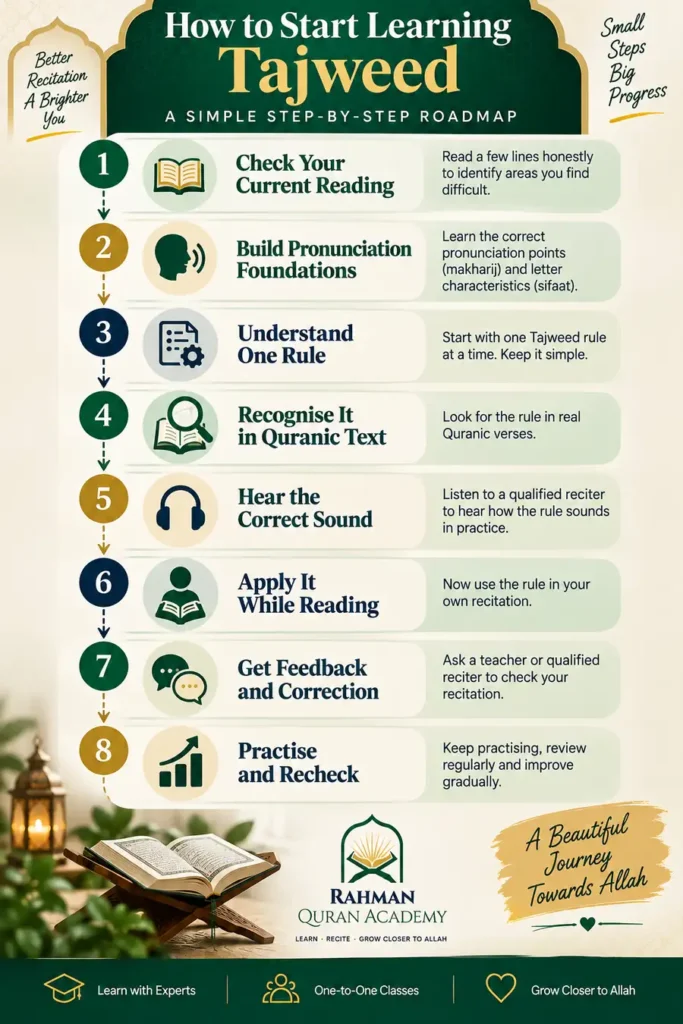
1. Check your current reading. Read a short passage aloud and record it. Note where you hesitate or feel unsure.
2. Build pronunciation foundations. Get comfortable with how Arabic letters are produced (Makharij).
3. Understand one rule at a time. Choose a single rule and learn what it says in plain language.
4. Recognise it in Quranic text. Find examples of that rule in the pages you read.
5. Hear the correct sound. Listen to the rule recited correctly before you try to copy it.
6. Apply it while reading. Read passages containing the rule aloud. This is where knowing becomes applying.
7. Get feedback and correction where possible. Ask a teacher or knowledgeable reciter to listen.
8. Practise and recheck. Return to recurring mistakes and test them again on new passages.
Where you join the framework depends on your starting point:
• If you cannot yet read Arabic script comfortably, start with reading basics. Noorani Qaida covers the letters and basic reading skills, and online Quran reading classes can help you build reading confidence before focusing on Tajweed.
• If you can read but are unsure about accuracy, begin at step 1.
• If you are an adult who feels you have left it late, the steps are the same. Work at your own pace, privately if you prefer. Learning Tajweed as an adult covers that question directly.
• If time is tight, one rule per session keeps the task small enough to fit around work and family.
Tajweed vs Quran Recitation: What’s the Difference?
Tajweed concerns correct pronunciation and the rules for applying it. Quran recitation is the broader act of reciting, which can include fluency, flow and style as well as correct reading.
The two overlap but describe different things. A reader can recite with good flow yet misapply certain rules. Another can apply rules carefully but read hesitantly. Tajweed is one part of good recitation, not the whole of it.
What Is the Relationship Between Tajweed and Tarteel?
Tarteel is the term the Quran uses for measured recitation. Quran 73:4 uses it when instructing the reader to recite in a measured way. The Ma’arif al-Qur’an commentary explains tartil as distinct, deliberate recitation rather than hasty reading, together with reflecting on the meaning.
That verse uses the word tarteel. It does not name the technical science of Tajweed.
The two ideas are related but not identical:
• Tarteel describes the manner of recitation: unhurried, clear and reflective.
• Tajweed is the body of rules and skills for pronouncing and applying Quranic sounds correctly.
Clear, distinct pronunciation is part of what the commentary describes as tartil, and it is also what practical Tajweed works on. That overlap is why the two are easy to confuse.
Is Tajweed Obligatory?
Scholarly discussion here is more nuanced than the yes-or-no answers often seen online. What follows summarises one source. It is not a ruling.
An IslamWeb fatwa reports that later scholars regard reciting according to the detailed rules known to Tajweed specialists as desirable, while earlier scholars regarded it as obligatory.
The same fatwa quotes the scholar Muhammad Makki al-Jarisy, who separates two categories:
• Religious obligation: what preserves the structure and meaning of the words.
• Technical obligation: the detailed rules found in Tajweed books, such as rules on merging or concealing sounds. On the later scholars quoted there, neglecting these is not sinful, while earlier scholars saw them as obligatory too.
Because scholars differ, this article does not claim that every technical rule is individually obligatory, nor that the subject can be dismissed. For a ruling on your own situation, ask a qualified scholar.
What Should You Learn After Understanding Tajweed?
With the overall picture in place, the next steps are more specific. Secure the letter sounds through Makharij first, then work through the detailed rules one at a time, starting with whichever areas in the table above your own reading shows you need most.
If you are a parent looking at a child’s next step, see Quran classes for kids.
If you want teacher-led correction, Rahman Quran Academy runs online Tajweed classes. Lessons are live and one-to-one, in 30-minute sessions, three days a week, for children, teenagers and adults, with three free trial classes.
Frequently Asked Questions About Tajweed
What is Tajweed in simple words?
Tajweed is the set of rules and skills for pronouncing the Quran correctly: where each letter comes from, how it sounds, how long sounds are held and where to stop and start.
Is Tajweed only about pronunciation?
No. Pronunciation is the foundation, but Tajweed also covers letter characteristics, how sounds interact, elongation, and stopping and starting. It is not about having a beautiful voice.
Do I need Tajweed if I already know how to read the Quran?
Reading ability and consistent Tajweed application are different skills. Many learners find that knowing a rule does not guarantee applying it correctly while reading, so it is worth checking your recitation.
Is Tajweed difficult for beginners?
It can feel unfamiliar at first, mainly because of the terminology. Learning one rule at a time helps, and how long it takes varies from person to person.
Can I learn Tajweed without a teacher?
You can start with books, videos, apps and practice. The limitation is self-assessment: it is hard to hear your own pronunciation mistakes, so feedback from a teacher or knowledgeable reciter is valuable, though not mandatory in every circumstance.
What are the main areas of Tajweed?
Makharij, Sifaat, Noon Sakinah and Tanween, Meem Sakinah, Ghunnah, Madd, Qalqalah, and Waqf and Ibtida.
What is the difference between Tajweed and Quran recitation?
Tajweed concerns correct pronunciation and the rules for applying it. Recitation is the broader act of reciting, which can include fluency, flow and style.
Is Tajweed obligatory?
Scholars differ. An IslamWeb fatwa reports that later scholars regard reciting with Tajweed as desirable, while earlier scholars regarded it as obligatory, and it distinguishes what preserves the meaning of words from technical rules. For a ruling on your situation, ask a qualified scholar.