

Why Do I Still Make Tajweed Mistakes When Reading the Quran Even Though I Know the Rules?
The Short Answer: Knowing Tajweed Is Not the Same as Applying It
Knowing a Tajweed rule and applying it during real recitation are two different skills. Knowing the rule does not make it automatic. If you are still building your overall understanding of Tajweed, start with our complete guide to Tajweed, which explains the wider learning process, pronunciation, and recitation foundations.
Most learners move through six stages:
Know → Recognise → Produce → Apply → Automate → Check
- Know: you can explain the rule.
- Recognise: you spot it in the text as you read.
- Produce: you can make the correct sound or length.
- Apply: you keep it in words, phrases and verses.
- Automate: it happens without conscious effort.
- Check: you can tell whether you got it right.
A recurring mistake usually means one of these stages is weak. It does not always mean you need to learn the rule again.
This article helps you find which stage is breaking down and what to do next. The stages are a practical learning framework, not a scientifically validated model.
Why You Can Know a Tajweed Rule but Still Make the Mistake
You Know the Rule but Do Not Recognise It Quickly
In a lesson, the rule is usually pointed out for you. In your own reading, nobody highlights it.
You have to notice the rule while your eyes are already moving to the next word. If recognition is slow, the moment passes, and you recite the word the way you always have.
Sign: you spot the mistake only after you have finished the line. What helps: read a short passage without reciting it aloud, and mark every place where the rule applies. Speed comes later.
You Recognise the Rule but Cannot Produce It Correctly
You may know exactly what should happen and still be unable to make that sound.
This is a physical skill. Arabic letters come from specific points in the mouth and throat, called Makharij (articulation points). Some sounds have no close equivalent in English, so the mouth has no ready-made habit for them.
Sign: you can describe the correct sound but cannot make it, or you make it only some of the time. What helps: work on the sound on its own before returning to the rule. Our guide to Makharij in Tajweed covers articulation points in detail.
You Can Apply It Slowly but Lose It During Recitation
Getting a rule right in a slow drill is easier than getting it right in connected reading. In continuous recitation, you are also managing word order, vowel marks, breath, and pace.
Features that learners commonly lose at this stage include:
- a nasal sound (Ghunnah) that fades;
- an elongation (Madd) that comes out shorter than required;
- a heavy letter that softens;
- two similar letters that blur together.
Sign: the rule works in a drill and disappears in a passage. What helps: build up gradually, from word to phrase to verse segment (see the step-by-step section below).
You Have Repeated an Old Pronunciation Habit
If you have read a certain way for years, learning the correct rule does not erase the old habit. The old way is simply what your mouth does when you are not concentrating.
That is why the same mistake can return even when you “know better”. Passive study does not tend to change a habit. Deliberate, targeted practice on one specific pattern is more likely to.
Sign: the mistake returns when you stop concentrating or get tired. What helps: isolate that one pattern and practise it on purpose until the correct version becomes your default.
You Are Trying to Correct Too Many Things at Once
Some learners report that watching for every rule, colour, and symbol at once makes reading slower and more stressful. This is a common complaint in learner discussions, not a proven universal effect.
The practical fix is simple. Pick one target at a time. While you work on it, accept that other imperfections will exist for now.
Sign: you finish a page feeling you fixed nothing. What helps: write down the one mistake you are working on this week.
You Cannot Reliably Hear Your Own Mistakes
You can only correct what you can detect. If your ear is not yet trained to the difference, your own recitation can sound fine to you.
Recording yourself helps with some things. You can notice pace, inconsistency and obvious differences from a reciter you are following. It does not automatically tell you whether a subtle articulation is right, or how to fix it.
Learners often ask others to review their recitation because they cannot judge it themselves. External feedback can help when you cannot confidently diagnose the problem alone.
Sign: you practise often, but the same error never changes. What helps: compare with a reliable reciter, and ask for feedback on the specific point you cannot judge.
How to Find Out What Is Actually Causing Your Tajweed Mistakes
Use this table to find your likely problem. It is a practical diagnostic framework created for this article. It is not a clinical or scientifically validated test.
| What is happening? | Likely problem | What to do |
| I do not know the rule | Knowledge gap | Learn the rule and its examples |
| I know it but do not notice it | Recognition gap | Practise identifying it in Quranic text |
| I recognise it but cannot produce it | Production gap | Isolate the sound or articulation and practise slowly |
| I can produce it alone but lose it in words | Transfer gap | Practise connected words and short phrases |
| I can do it slowly but lose it in recitation | Fluency/control gap | Slow the passage down and rebuild continuous application |
| I cannot tell if it is correct | Feedback gap | Compare with a reliable model and seek qualified feedback when needed |
| The same error keeps returning | Habit/consistency gap | Isolate the pattern and correct it deliberately |
If your problem is a knowledge gap, start with Tajweed rules explained.
Do I know the rule?
Decision tree
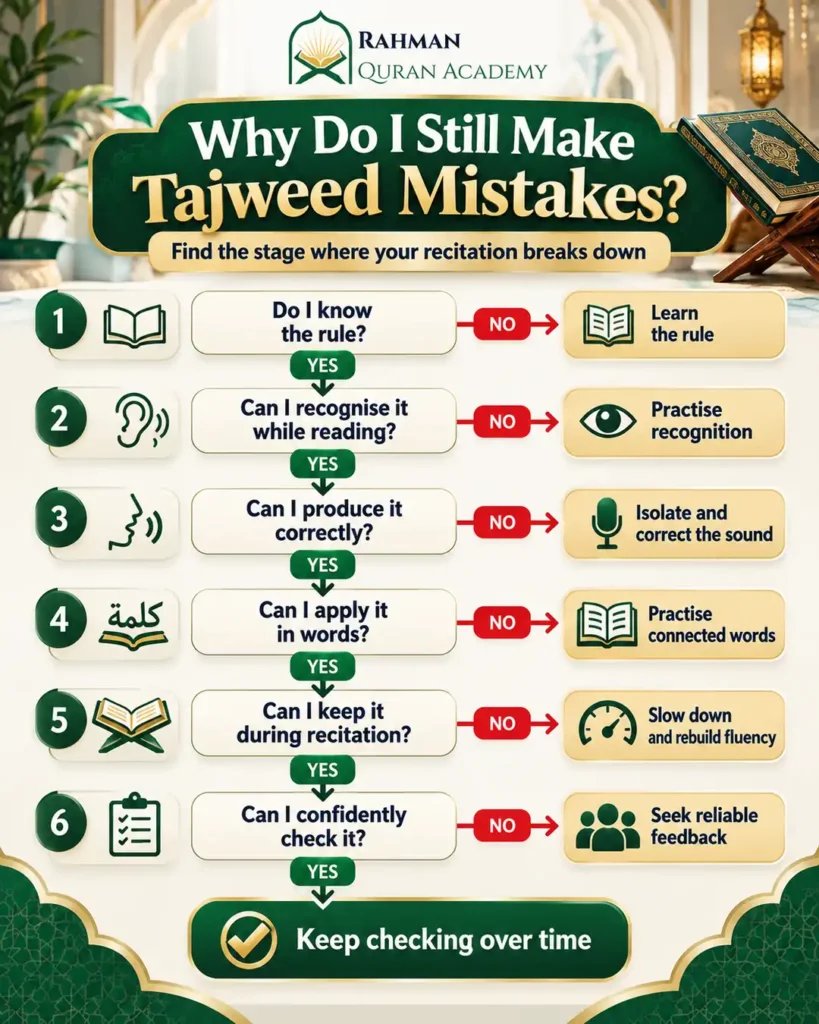
├─ No → Learn the rule
└─ Yes
Can I recognise it while reading?
├─ No → Practise recognition
└─ Yes
Can I produce it correctly?
├─ No → Isolate + correct the sound
└─ Yes
Can I apply it in words?
├─ No → Connected word practice
└─ Yes
Can I keep it during recitation?
├─ No → Slow down + rebuild fluency
└─ Yes
Can I confidently check it myself?
├─ No → Seek reliable feedback
└─ Yes → Keep checking over time
If more than one answer is “No”, fix the earliest one first. Later stages rarely hold up without it.
The Most Common Tajweed Problems That Keep Coming Back
This section shows how familiar problems appear in real recitation and why they persist. It is not a full rules guide.
Heavy and Light Letters
Some Arabic letters are pronounced with a full, heavy quality (Tafkheem). Others are light (Tarqeeq). The seven letters that are always heavy are خ، ص، ض، غ، ط، ق، ظ.
The usual problem is not knowing the list. It is keeping the heavy quality steady while moving quickly to the next sound. Heavy letters can lose weight, and light letters can pick it up from the sounds around them.
Makharij and Similar Letters
Learners often report difficulty telling apart pairs such as:
- ق and ك
- ص and س
- ط and ت
- ح and ه
- ع and ء
These are different letters made at different points, and in some pairs, with a different quality (heavy against light). English has no exact match for several of them, so avoid trusting English “sounds like” shortcuts.
This is usually a production problem, not a knowledge problem. See Makharij in Tajweed for how each point works.
Madd
Madd means elongating certain sounds for a required length. The common application problem is shortening or flattening the elongation during continuous reading, especially when it is not a long word or you are reading fast.
Knowing there is an elongation is not the same as holding it consistently. A teacher or a reliable reciter’s recording gives you the length to match.
Ghunnah
Ghunnah is the nasal quality in the letters noon and meem, most noticeable when they carry a shaddah. Learners can often explain it perfectly and still let it fade mid-recitation.
The difference between knowing and keeping it is usually consistency of length and quality, so practise it in connected words, not only in isolation.
Qalqalah
Qalqalah is the slight echo or bounce on five letters: ق، ط، ب، ج، د when they are sakin (carrying no vowel). A common problem is applying it in drills but forgetting it in connected reading, or making it too strong or too weak, particularly at stops.
Noon Sakinah and Tanween
These rules cover how a noon with no vowel, or tanween, is treated depending on the letter that follows. The four categories are Izhar, Idgham, Iqlab, and Ikhfa.
Here the issue is usually recognition: spotting the next letter fast enough to choose the right treatment. If you do not know these rules yet, start with Tajweed rules explained first.
Waqf and Reading Too Quickly
Waqf means stopping. Rushing makes stops, restarts, and every other weakness harder to control.
Speed is not automatically the cause of mistakes. It can multiply weaknesses that are already there. Learner discussions describe reciting familiar, memorised passages well but becoming slower and less polished on unfamiliar pages, which suggests that fluency does not always transfer between texts.
Slowing down is a tool, not the goal. See the section on practising without becoming too slow below.
How to Fix a Tajweed Mistake Step by Step
The correction loop is:
Identify → Isolate → Correct → Connect → Apply → Check
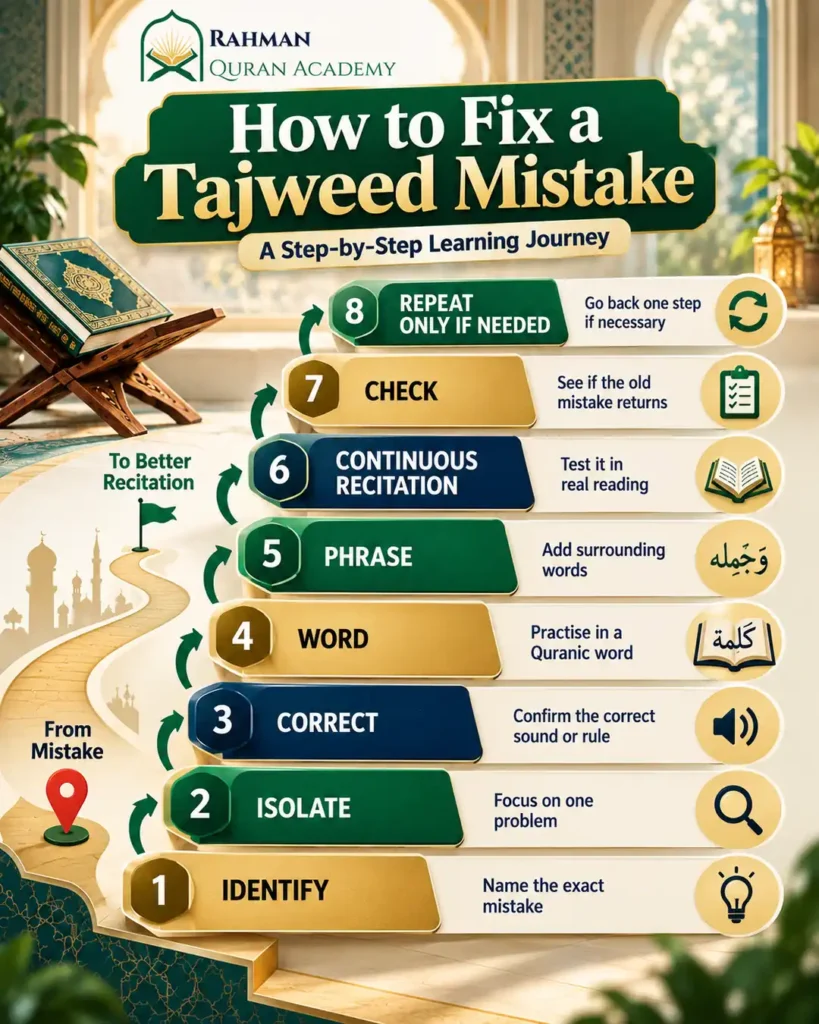
This is a practical framework, not a formally validated teaching protocol.
Step 1: Isolate the Problem
Name one specific, recurring error. For example, “I shorten the Madd at the end of this type of word”, not “my Tajweed is bad”.
Work on that one thing only.
Step 2: Correct the Sound or Rule
Confirm what should happen before you practise. Use a reliable source: a qualified teacher, a trusted learning resource, or a respected reciter’s recording.
Practising the wrong version more often only strengthens it.
Step 3: Practise It in a Word
Move from the isolated sound to a real Quranic word that contains it. Choose the word from a mushaf you trust, ideally from your own reading.
Step 4: Practise It in a Quranic Phrase
Add the words before and after. Keep your attention on the target and let everything else stay as it is.
Step 5: Return to Continuous Recitation
Read a longer passage and see whether the correction survives. If it disappears, go back one step. Do not restart everything.
Step 6: Check Whether the Mistake Has Returned
Come back to the same passage later and see whether the old habit has come back. If it has, repeat the relevant stage.
There is no reliable fixed timeline for this. People progress at different speeds, so measure by whether the mistake stops returning, not by days.
How to Practise Tajweed Without Making Your Recitation Too Slow
There is a difference between three things:
- Slowing down temporarily to isolate and fix a mistake.
- Staying slow permanently because you are afraid of getting it wrong.
- Rebuilding controlled fluency once the skill is steadier.
The first is useful. The second can hold you back. The third is the goal.
A practical progression:
Isolated sound → word → short phrase → verse segment → continuous passage
Increase the pace only when the correction holds at your current pace. The aim is accurate, controlled recitation at a pace that suits your current ability, not a particular speed.
For a fuller routine, see how to practise Tajweed at home.
Can You Correct Tajweed Mistakes by Yourself
Partly. Self-study is not useless, and not everyone needs paid lessons.
Self-practice can help with:
- learning and reviewing rules;
- recognising patterns in the text;
- listening to reliable reciters;
- recording yourself and comparing the same passage over time;
- repeating targeted drills;
- slowing down difficult passages.
Where it has limits: if you cannot reliably tell whether your pronunciation is correct, practising alone may repeat the same incorrect pattern. Recording helps most when you already know what you are listening for.
If you are weighing video-based study, read whether you can learn Tajweed from YouTube.
Does recording yourself help?
Yes, for some things. It can reveal pace, repeated patterns, and obvious inconsistencies, and it gives you something to discuss with a teacher.
It will not necessarily reveal subtle articulation problems or exact timing, and it does not tell you the fix.
[Optional hypothetical example, clearly labelled] Hypothetical example, not a real student: a learner records a short passage and notices it speeds up and some elongations sound shorter. The recording revealed a pattern, but they cannot tell exactly what to correct. That is the point at which a reliable model or feedback helps.
When Should You Get Feedback From a Tajweed Teacher?
Feedback is especially useful when:
- you know the rule but cannot produce the sound;
- you keep making the same pronunciation error;
- you cannot tell whether your sound is correct;
- a correction works in isolation but fails in recitation;
- you are not sure which mistakes matter most;
- you want someone to listen to continuous recitation and spot recurring patterns.
A teacher is one route, not the only one. But if several of these describe you, targeted feedback will probably save time.
If that applies, one-to-one online Tajweed classes offer live correction on your own recitation. If your main need is applying Tajweed across longer passages, Quran recitation classes may suit you better.
If you are still building basic reading skills, online Quran reading classes or Noorani Qaida are the better starting point.
Feeling shy about being heard is common. A good teacher expects mistakes, because correcting them is the job.
A Simple Tajweed Mistake-Fixing Checklist
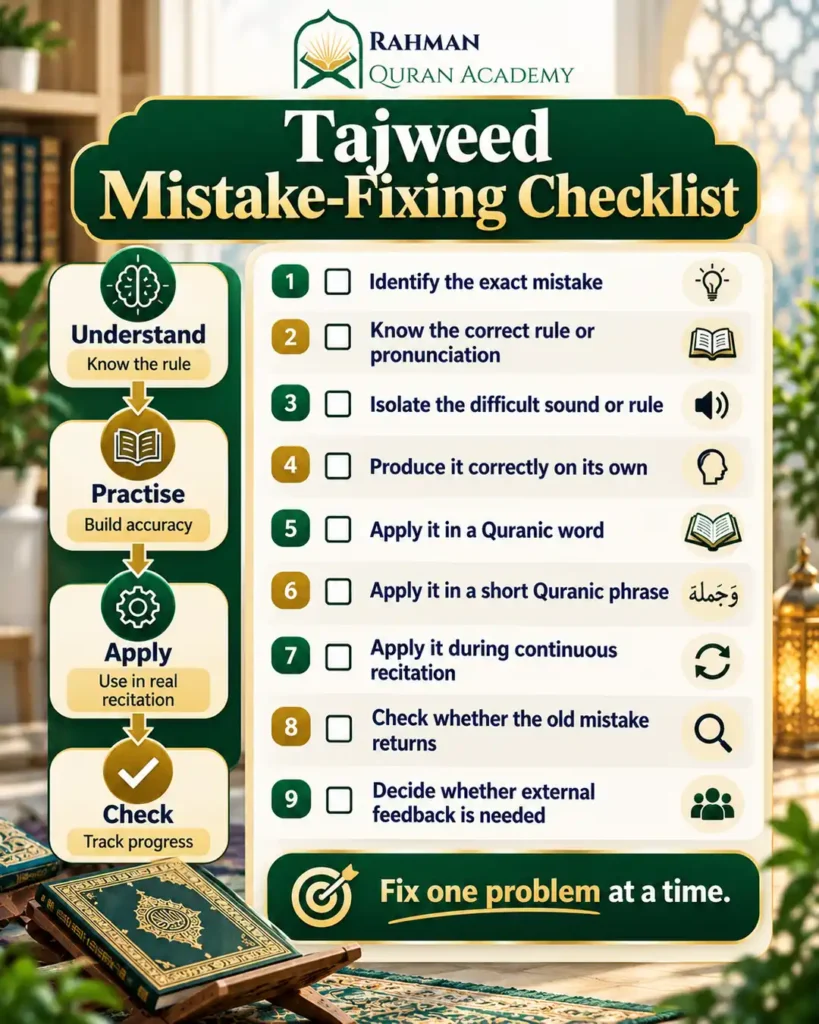
- [ ] I can identify the exact mistake.
- [ ] I know the correct rule or pronunciation.
- [ ] I have isolated the difficult sound or rule.
- [ ] I can produce it correctly on its own.
- [ ] I can apply it in a word.
- [ ] I can apply it in a short Quranic phrase.
- [ ] I can apply it during continuous recitation.
- [ ] I have checked whether the old mistake returns.
- [ ] I know whether I need external feedback.
FAQs
1. Why do I still make Tajweed mistakes even after learning the rules?
Because knowing a rule, recognising it, producing the sound and applying it during continuous reading are separate skills. A recurring mistake usually points to a weak stage, such as recognition, pronunciation, transfer, habit or feedback.
2. Why do I make more Tajweed mistakes when reading quickly?
Pace can exceed your current level of control. Speed is not always the cause, but it can expose weaknesses that were manageable when you read slowly. Slow down enough to keep the correction, then rebuild pace gradually.
3. Can I correct Tajweed mistakes by myself?
Often in part. You can review rules, listen to reciters, record yourself and drill a target. The limit is judging your own sound: if you cannot tell whether it is correct, outside feedback helps.
4. Does recording myself help me improve Tajweed?
It can help you notice pace and repeated patterns, and compare the same passage over time. It does not automatically diagnose articulation or timing, so pair it with a reliable model or feedback.
5. Which Tajweed mistake should I fix first?
Fix the earliest broken stage first. If you do not know a rule, learn it. Then work through recognition, production, and application. Among mistakes, start with the one you make most often.
6. Why do I keep making the same Tajweed mistake?
An old habit, a pronunciation you cannot yet produce, or no reliable way to hear the error are the usual reasons. Isolate that one pattern and correct it deliberately rather than reading more of the same.
7. When should I ask a Tajweed teacher for feedback?
When you cannot tell whether your sound is right, the same error keeps returning, or a fix works alone but fails in recitation. It is a signal that you need an outside ear.
8. Do I need to relearn Tajweed if I keep making mistakes?
Not necessarily. If you know the rule but cannot apply it, targeted practice is usually more useful than restarting. Relearn only the parts you do not actually understand.
