
When Should Children Start Learning Tajweed?
Short answer: children can hear and practise correct Quranic pronunciation from their first reading lessons. Structured Tajweed rule lessons usually work best once a child can read connected Arabic text with some accuracy and can copy a sound after a teacher demonstrates it. Neither the research nor the religious guidance reviewed for this article sets one ideal age.
So the better question for most parents is not “how old should my child be?” but “what can my child do now, and what should they work on next?”
When Is a Child Ready to Start Structured Tajweed Lessons?
A child is ready for structured Tajweed when their reading skills and response to correction suggest they can benefit from learning rules, not when they reach a particular birthday.
It helps to separate four things that are often blurred together:
- Early exposure: hearing correct recitation and imitating it.
- Reading foundations: recognising letters, applying vowel marks (Harakat) and joining letters into words.
- Applied correction: a teacher fixing sounds while the child reads.
- Structured rule study: learning named rules, such as Madd or Ghunnah, and applying them on purpose.
These overlap. A child does not finish one stage and then switch to the next. Teachers also use different terms and orders, so treat this as a guide to your child’s needs, not a fixed syllabus.
For general guidance on age, one Hanafi fatwa from Darul Iftaa in Leicester says there is no fixed age from an Islamic perspective, and that children differ in ability and maturity. That answer concerns learning the Quran generally, not Tajweed specifically. Our separate guide covers when children should start learning the Quran.
A practical readiness guide
The table below is an informal guide, not a validated test. A qualified teacher should assess your child in context.
| What you notice | What it may suggest | A reasonable next step |
| Knows most letters but guesses the vowel marks | Reading foundations are still forming | Strengthen letters and Harakat; the teacher keeps modelling correct sounds |
| Reads short words correctly but stops often | Decoding is developing | Guided connected reading with selective pronunciation correction |
| Reads short passages with manageable hesitation and can repeat a demonstrated sound | May be ready for a few applied rules | Introduce one rule at a time, using text the child already reads |
| Fixes a mistake when corrected, then repeats it later | Needs more repetition, not necessarily a different level | Ask the teacher which error keeps returning and how it will be practised |
| Reads steadily with specific, repeated errors in articulation or rules | Suited to more structured rule study | Teacher-led assessment of the next rule or sound |
For the full learning sequence, see a step-by-step guide to learning Tajweed.
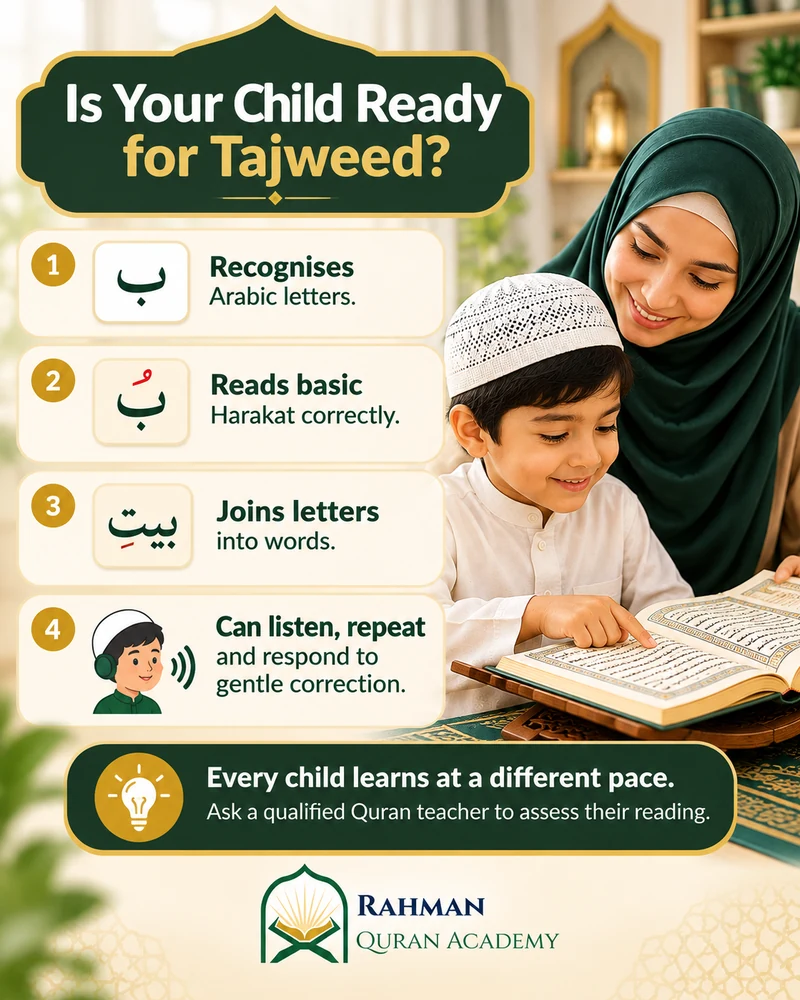
What Should a Child Be Able to Do Before Learning Tajweed Rules?
A child needs enough reading ability to engage with the text and benefit from explanation. Perfect reading is not required. Pronunciation correction can start long before that.
Foundational skills (worth checking first):
- Recognising letters, including when they change shape within a word.
- Applying the basic vowel marks accurately.
- Joining letters and reading short connected words.
- Listening, then repeating a sound the teacher has demonstrated.
- Accepting and applying feedback.
Skills that can keep developing during Tajweed lessons:
- Reading speed and smoothness.
- Confidence with longer passages.
- Accurate articulation of harder letters.
There is some research behind the focus on vowel marks, with limits. A 2022 scoping review in Frontiers in Communication looked at 16 studies of native Arabic-speaking school students in grades 1 to 12. It found that phonological awareness and phonemic diacritics (the short-vowel marks) were associated with reading comprehension in early grades. That study concerns Arabic reading comprehension, not Quran recitation or Tajweed, and its authors describe their findings as more suggestive than conclusive. It does not tell us when to begin Tajweed.
Where articulation is the issue, see how to pronounce Quranic letters correctly.
Does a Child Need to Finish Noorani Qaida Before Learning Tajweed?
Not necessarily. What matters is whether the child has solid reading foundations, not whether they have reached the last page of one book.
Noorani Qaida is a beginner’s primer. It gives children practice with letters, vowel marks, and early reading. Completing its pages shows progress, but it does not by itself show how accurately a child reads.
Example (hypothetical): two children have both reached the same page of a Qaida. One reads each line smoothly and corrects herself when a sound is off. The other recognises the page from memory and guesses at several vowel marks. The page number is identical. Their needs are not.
Curricula also differ. Some teachers introduce pronunciation correction and simple rules alongside Qaida. Rahman Quran Academy’s Tajweed course page says that for beginners, Tajweed rules are taught alongside Noorani Qaida from the first lesson, and that its dedicated Tajweed course is for students who already read fluently. Other teachers may sequence things differently, and that is acceptable if the teacher can explain why.
How Should Tajweed Learning Progress From Pronunciation to Rules?
A sensible progression is: model and correct sounds early, then introduce rules one at a time once the child can recognise and apply them.
Reading foundations → ongoing pronunciation correction → a few applied rules → more structured rule study when appropriate
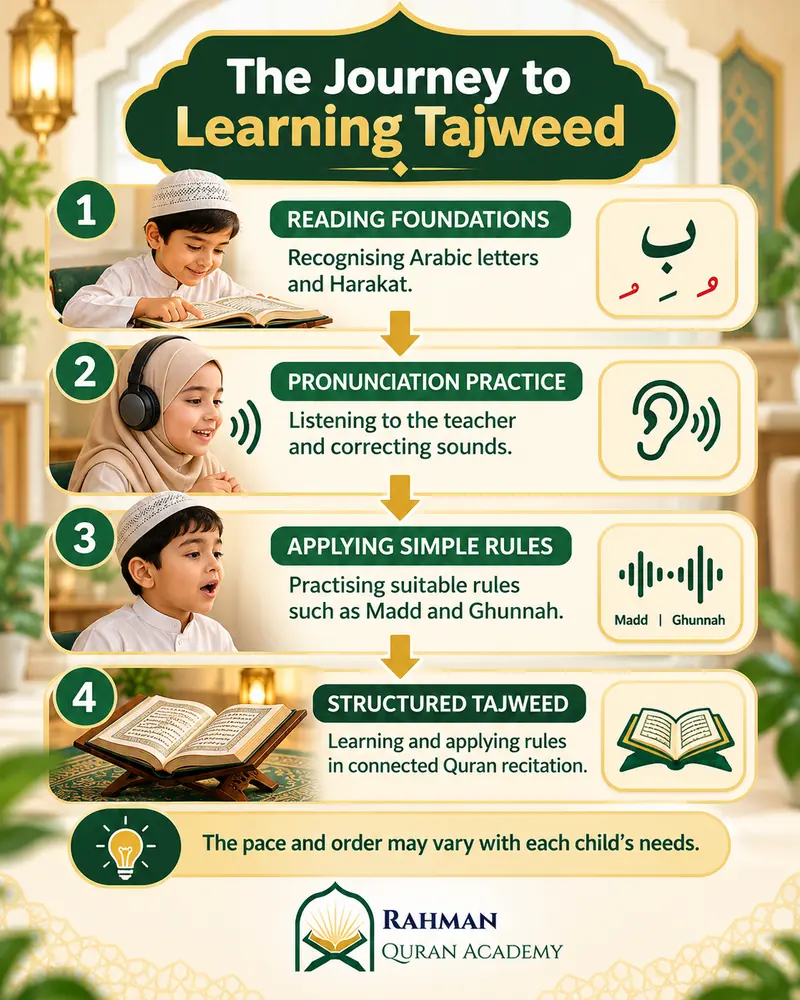
In practice, that often looks like this:
- Sound accuracy. The teacher demonstrates, the child repeats, and the teacher corrects. This is where Makharij (the points where letters are produced) first matter.
- Selected rules met in reading. When the child reads a word that needs elongation (Madd) or a nasal sound (Ghunnah), the teacher explains that one rule and has the child apply it straight away.
- Guided application in connected recitation. The child uses the rule across a line or short passage, not only in isolated examples.
- Structured study. When reading is steady, the teacher can teach rules in a planned order.
This is a general pattern, not the only valid order. For the wider picture, see our complete guide to learning Tajweed, its rules and Quran recitation, and for definitions of individual rules, Tajweed rules explained.
What If Your Child Is Still Struggling With Quran Reading?
Strengthen the specific skill causing the difficulty, and keep gentle pronunciation correction going. Your child does not have to wait for perfect fluency before receiving any Tajweed support.
Struggling with reading and struggling with pronunciation are different problems. A simple route:
- If letters or Harakat are still uncertain: focus on reading foundations first.
- If connected reading is developing: combine guided reading with suitable pronunciation correction.
- If reading is reasonably stable: ask whether your child is ready for more structured rule learning.
These are practical routes, not diagnostic categories. A child may sit between two of them, and the right step can change within a few weeks.
Two related reads: why children make Quran reading mistakes and how to help and how to help your child read the Quran more fluently.
How Can Parents Tell Whether Their Child Is Ready to Progress?
Look for improving accuracy, retention of feedback and growing independence, rather than counting finished pages or lessons attended.
You do not need to know the rules yourself or diagnose every error. Ask the teacher:
- Which reading skills are secure, and which are not yet?
- Which errors come up most often?
- Can my child apply a correction while reciting, not just when it is pointed out?
- Which sound or rule is the next learning goal?
- What short practice would help between lessons?
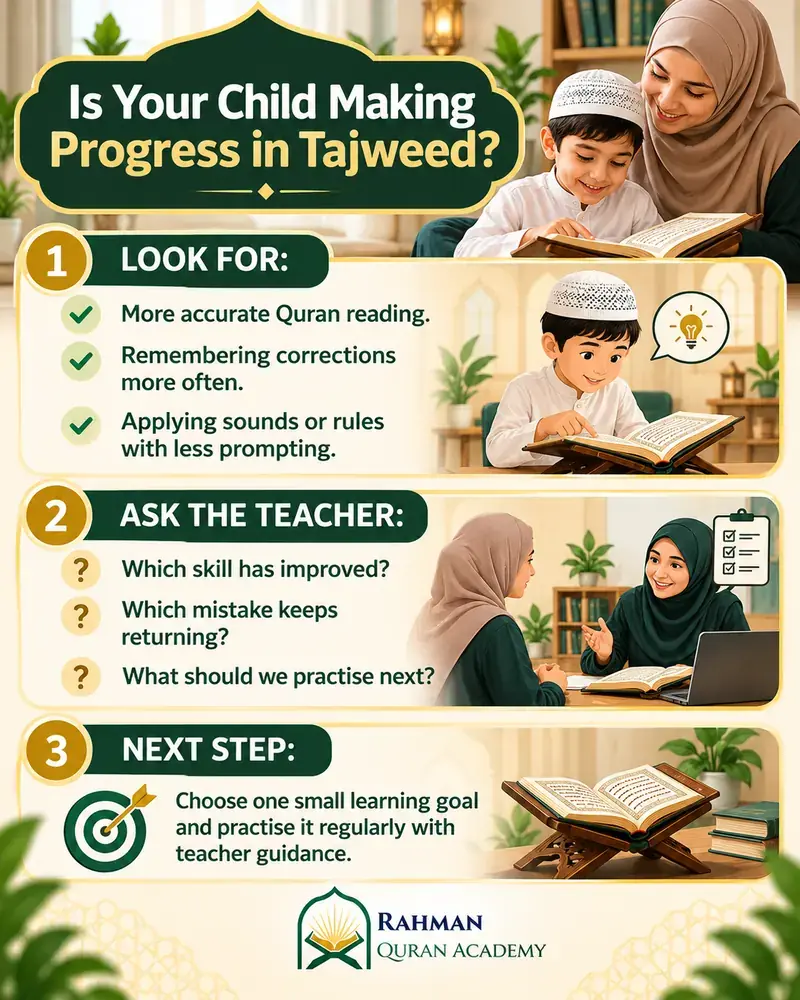
A good teacher should be able to answer these specifically. If you want to compare teachers, see what makes a good Quran teacher for children.
Frequently Asked Questions About Children Learning Tajweed
What is the best age to start Tajweed for children?
No single age has been established. Pronunciation practice can begin with early reading. Structured rule lessons depend on reading readiness, which varies between children of the same age.
Is it too late for an older child to start Tajweed?
There is no evidence in the sources reviewed for a cut-off age. An older child may begin with a quick assessment of current reading, which shows where to start. Teenagers who already read fluently may move to applied rules sooner than beginners.
Does a child need to understand Arabic to learn Tajweed?
Not to begin. Tajweed concerns how the text is pronounced and recited. Understanding the meaning is valuable, but it is a separate goal from learning to read and pronounce accurately.
Can a child learn Tajweed online?
Yes, if the teacher can hear the child clearly and correct them in real time. Sound quality and live feedback matter more than the platform. For comparison, see how to choose online Quran classes for your child in the UK.
Choose the Right Tajweed Starting Point for Your Child
The most reliable next step is to have a qualified teacher hear your child read and recommend what to work on.
Before booking, note three things: what your child can read now, which mistakes you or their current teacher keep noticing, and how much practice fits around school.
If you would like to explore one-to-one options, Rahman Quran Academy’s online Tajweed classes page lists free trial classes. Ask what the teacher will assess in a trial and how they decide which rule or sound comes next.