
Tajweed: The Complete Guide to Learning, Rules, Pronunciation & Correct Quran Reading
Tajweed is the science of pronouncing Quranic letters correctly, giving each one its proper articulation point, its correct characteristics, and the right treatment when it meets other letters during reading. This guide explains what Tajweed covers, why it matters, how it’s learned, and one of the reasons Tajweed can feel harder in practice than it looks in theory: the gap between knowing a rule and applying it automatically while reading. It’s written for parents deciding when to start their child, adults reading fluently but unsure if their pronunciation is accurate, and complete beginners working out where to begin.
What Is Tajweed?
Tajweed comes from the Arabic root j-w-d, meaning to improve or do something well. As a Quranic science, it refers to reciting each letter from its correct articulation point (makhraj), with its correct characteristics (sifaat), while applying the rules that govern how letters behave when they sit next to other letters or vowel marks, commonly summarised as giving every letter its due right in recitation.
In practical terms, Tajweed answers three questions every time you read a word of the Quran:
- Where is this letter produced- in the throat, the tongue, the lips?
- How does it sound heavy or light, with a nasal hum or without, with a bounce or without?
- What happens when this letter meets the letter next to it? Does the sound merge, hide, change, or stay clear?
This is different from simply being able to sound out Arabic letters and read words. A person can read every word of a page fluently, recognising the letters and moving through the text without hesitation while still mispronouncing several letters or missing rules that change how a sound should be produced. Fluent reading and technically correct reading are not automatically the same thing. Long-time readers sometimes describe discovering this gap for the first time only once someone else listens closely to their recitation.
Continue reading: [ What Is Tajweed? A Beginner’s Guide ]
Why Is Tajweed Important When Reading the Quran?
One starting point often cited is Quran 73:4, which instructs: “recite the Qur’an with measured recitation” (Sahih International translation). Classical commentary on this verse explains it as an instruction to recite slowly, distinctly and without haste, so that the words can be understood and reflected on, rather than a literal reference to the later, technical science of Tajweed, which was documented and formalised afterwards. The connection scholars draw is that Tajweed is the detailed, codified expression of what reciting slowly and distinctly requires letter by letter, not that the verse itself uses the word “Tajweed.”
There’s also a practical accuracy argument. Arabic has letter pairs that sound close to each other but are not interchangeable; for example, ق (qaf) and ك (kaf). Confusing letters like these can produce a different pronunciation, and in some cases a genuinely different word, which is one reason accurate articulation is treated as more than a stylistic preference. It would be an overstatement to say every Tajweed slip changes a word’s meaning; most pronunciation or rule mistakes affect how a letter or word sounds without turning it into an entirely different word, so this guide won’t claim that.
On the question of obligation, scholars genuinely differ, and a fair summary should reflect that rather than pick a side. Imam Ibn al-Jazari, one of the most cited authorities in the science, wrote in his Al-Muqaddimah al-Jazariyyah that applying Tajweed is a binding obligation and that whoever does not apply it to the Quran has erred a line. His own son’s commentary on the same text qualifies further, restricting the obligation to whoever is capable of it.
Beyond this specific statement, later scholars are commonly reported as dividing along two lines: avoiding major mistakes that change the meaning of a word, widely treated as an individual obligation to the extent of a person’s ability, and mastering the finer rules of the science, more often treated as recommended for the individual, while preserving the discipline itself is treated as a responsibility carried collectively by the community’s qualified teachers. Because positions genuinely vary by school and by which line of a text is being emphasised, this guide presents the range rather than declaring one position final. (IslamWeb fatwa: “Tajweed — Is It Obligatory or Only Desirable?”)
None of this should be read as a fatwa. If you have a specific personal question about obligation or a mistake in your own prayer, that’s worth asking a qualified local scholar directly; this guide is educational, not a religious ruling.
What Does Tajweed Cover?
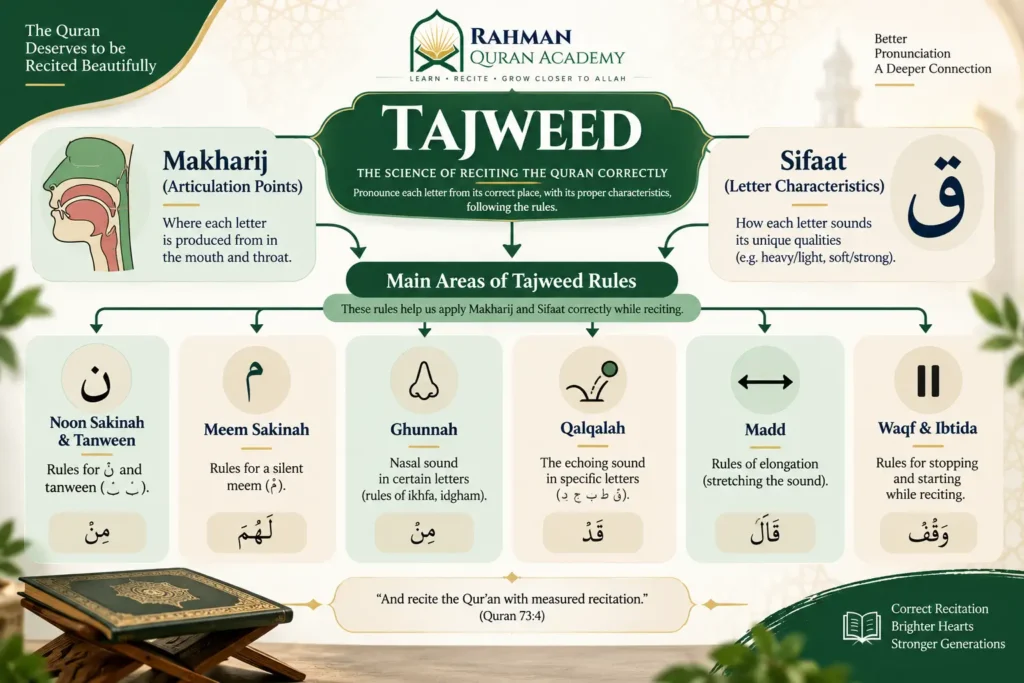
Educational sources group Tajweed rules in some lists around seven areas, others twelve or more, and there is no single count that every school of teaching agrees on. What’s consistent across almost all of them is a smaller set of underlying skills. As a practical learning framework, rather than a claim about a single universal scholarly classification, this guide groups them as follows.
Letter Production: Makharij and Sifaat
Makharij (articulation points) are the physical locations where each letter is produced: the throat, the tongue against different parts of the mouth, the lips, or the nasal cavity. Sifaat (characteristics) are the qualities that go with each letter regardless of context, for example, whether it’s pronounced heavy or light, with or without a puff of breath, or with a bounce.
As a practical learning foundation, most Tajweed teaching introduces Makharij and Sifaat first, on the basis that other rules assume a learner can already produce the individual letters accurately, but this is a teaching sequence rather than a claim that no other order is valid. The most widely cited classification of articulation points, associated with Imam al-Khalil ibn Ahmad and reinforced by Imam Ibn al-Jazari, groups them into 17 detailed points across 5 broad regions; some earlier scholars counted 14 or 16, depending on how certain tongue positions are grouped, so treat any specific number you see elsewhere as one classification among a few rather than the only one.
Noon Sakinah and Tanween
When a noon with no vowel (sukoon), or a tanween (the double vowel mark at the end of a word), is followed by certain letters, its sound is treated in one of four ways: pronounced clearly, merged into the next letter, converted to a meem sound, or partially concealed with a nasal hum. Noon sakinah and tanween occur very frequently throughout the Quran, which is part of why getting this rule right has a noticeable effect on overall reading accuracy.
Meem Sakinah
A related principle applies to meem with no vowel: depending on the letter that follows, it’s pronounced clearly, merged, or concealed with a nasal hum through the lips. It’s a smaller rule set than noon sakinah but works on the same underlying logic.
Ghunnah
Ghunnah is the nasal sound that accompanies certain letters and rule combinations, most noticeably a held nasal hum on noon and meem in specific positions. It’s a rule learners commonly need repeated correction on, since it’s easy to produce the surrounding letters correctly while still leaving the nasal quality out.
Qalqalah
Qalqalah is a slight bounce or echo produced on five letters ق ط ب ج د when they carry a sukoon (no vowel), particularly at the end of a word. Reading these letters flat, without the bounce, is a mistake beginners may make while they’re still building awareness of the rule.
Madd
Madd refers to elongating certain vowel sounds for a specific count, depending on the letter or condition involved. Elongation length varies by rule; some are held for a fixed short count, others can extend further depending on what follows. Because the exact counts and sub-categories of Madd differ across teaching traditions and specific rule types, this guide won’t assign a single fixed number of “Madd rules” or a universal duration that level of detail belongs with a teacher working through your specific riwayah (transmission) and reading material.
Waqf and Ibtida
Waqf is knowing where it’s appropriate to stop while reading, and Ibtida is knowing how to correctly resume from that point. Stopping in the wrong place can separate words that belong together grammatically or in meaning, so this is treated as a genuine Tajweed skill, not just a pause for breath.
Other Important Areas
Depending on the teaching tradition, you’ll also encounter Tafkheem and Tarqeeq (heavy and light pronunciation, particularly relevant to letters like ل and ر in different contexts), along with specific rules for how laam and raa behave in different words. These build on the same Makharij and Sifaat foundation rather than introducing new principles.
Tajweed Rules at a Glance
| Rule area | What it concerns | What to notice while reading |
| Makharij | Where each letter is physically produced | Whether a letter sounds “close but not quite right” compared to a correct model |
| Sifaat | The inherent qualities of each letter | Heaviness/lightness, breath, and other consistent letter qualities |
| Noon Sakinah & Tanween | Noon/tanween followed by specific letters | Whether the noon sound is clear, merged, converted, or concealed |
| Meem Sakinah | Meem with no vowel, followed by specific letters | The same logic as above, applied through the lips |
| Ghunnah | The nasal hum on certain letters/rules | Whether the hum is present and held, not dropped |
| Qalqalah | The bounce on ق ط ب ج د with sukoon | Whether the letter is bounced or read flat |
| Madd | Elongating vowel sounds | Whether elongation is rushed or held for the right relative length |
| Waqf & Ibtida | Where to stop and resume | Whether a stop breaks a phrase’s meaning |
Can You Know Tajweed Rules and Still Make Mistakes While Reading?
This is a genuinely useful thing to understand before you start, because it changes how you approach learning.
Knowing a rule and applying it consistently while reading fluently are different skills. You can explain exactly what Ghunnah is, recognise it correctly when someone else demonstrates it, and still leave it out of your own reading many times before it becomes automatic. This isn’t unusual, and it isn’t a sign Tajweed hasn’t been “learned properly”; it reflects how skill application tends to work more broadly. A useful way to think about the stages involved:
Know the rule → recognise it in text → produce the correct sound → apply it inside continuous, fluent reading → receive feedback on what was missed → correct it → repeat until consistent
This is presented here purely as a practical learning framework, a way of organising the stages of learning a skill, not as an established scientific or scholarly model specific to Tajweed.
It’s worth being precise about what general research does and doesn’t say here. A widely cited meta-analysis of 33 studies on corrective feedback in second-language learning found a medium overall effect on learner accuracy, and that the effect was maintained over time rather than fading immediately. (Li’s 2010 meta-analysis of corrective feedback ) That research focused on general second-language learning—not Tajweed, Arabic pronunciation, or Quran recitation specifically so it should not be read as proof that a particular Tajweed teaching method is necessary or superior. What it reasonably supports is the more general, non-Tajweed-specific point that corrective feedback tends to help learners improve accuracy in language-related skills, which is consistent with, though not direct evidence for, the same idea being useful in Tajweed learning.
This gap also matches a pattern that comes up in general online learner discussion: people report having studied Tajweed rules, sometimes more than once, but still finding actual reading harder than expected, not necessarily because they misunderstood the theory, but because applying several rules simultaneously, at reading speed, inside real verses, is a different skill from recognising rules in isolation. This is offered as a recurring theme in informal discussion, not as data from a formal study of Tajweed learners.
How Do You Learn Tajweed?
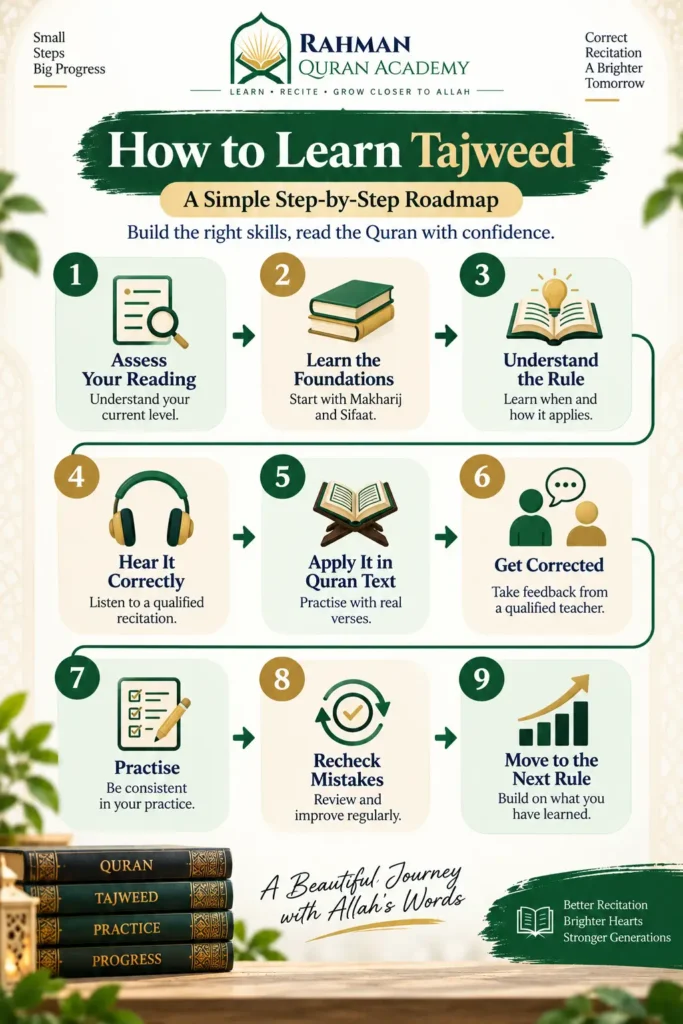
A practical progression, whether you’re a complete beginner or correcting existing reading, tends to follow this shape:
- Assess your current reading — can you already read Arabic script fluently, or do you need to start with letter recognition first?
- Learn or review the foundations — Makharij and Sifaat, as the practical starting point most teaching traditions use.
- Understand the rule — what it is, when it applies, why it exists.
- Hear it demonstrated correctly — reading a rule’s description isn’t the same as hearing the sound.
- Apply it in actual Quran text, not isolated examples, since real verses combine multiple rules at once.
- Get corrected — a step many learners describe as difficult to replace through self-study alone, since accurately assessing your own pronunciation by ear is not always straightforward.
- Practise between sessions, focused on whichever rule was corrected most recently.
- Recheck recurring mistakes rather than assuming one correction has fixed a habit permanently.
- Move to the next rule or a more complex passage once the previous one is consistent, not just understood.
If you’re starting from scratch, meaning you can’t yet read the Arabic script fluently, Tajweed is often introduced gradually alongside foundational reading (such as Noorani Qaida) rather than taught as a separate block of theory first.
Can Adults Learn Tajweed?
Yes. Age is not a barrier to learning Tajweed, and there’s no credible basis for treating adulthood as a cut-off point. What changes between adults and children is more the starting position and learning context than any general difference in capacity to learn.
Two common adult starting points look different in practice:
- Adults who are new to Quran reading typically need to build foundational reading skills and Tajweed together, similar in structure to a child’s learning path.
- Adults who already read fluently are often people who learned as children without formal correction, and sometimes discover, after their first lesson with a teacher, that specific rules like Madd counts or Ghunnah were never applied consistently in their reading. This is a reported experience for some adult learners rather than a claim that it happens to most or all of them, and it isn’t a sign of failure; it more often reflects how the reading was first taught than a lack of effort.
There’s no reliable universal timeline for “how long Tajweed takes”; progress depends on your starting reading level, how consistently you practise, and how many rules you’re correcting at once. Be cautious of any claim promising a fixed number of weeks that applies to everyone.
When Should Children Start Learning Tajweed?
There’s no single mandatory starting age that applies identically to every child, and claims suggesting otherwise should be treated cautiously unless they cite a specific source; this guide doesn’t have evidence for one. What matters more than age on its own is a combination of practical readiness factors:
- Basic letter recognition — a child generally needs some comfort recognising Arabic letters before Tajweed rules are meaningful to them.
- Ability to distinguish and repeat sounds — Tajweed depends on hearing and reproducing subtle sound differences, and children vary in how quickly this develops.
- Attention during structured lessons — shorter, simpler sessions tend to suit younger children better than long theoretical explanations.
- Willingness to practise — consistent, low-pressure repetition matters more than any single lesson.
- Existing Quran-reading foundation — a child already partway through foundational reading is in a different starting position from one just beginning.
In practice, many teaching approaches introduce Tajweed gradually and directly inside early reading lessons (such as Noorani Qaida) rather than treating it as a separate subject a child starts only once they can already read fluently. This lets correct letter pronunciation become a habit from the beginning, rather than something that has to be corrected later. This is a description of common teaching practice, not a claim that it’s the only valid approach or that a specific age is scientifically established as the right one to start.
For younger learners who need lessons adapted to their age, attention span and confidence, see our online Quran classes for kids.
Why Can Children Still Make Tajweed Mistakes After Learning Quran?
It’s common for a child to have covered Tajweed rules and still make recurring mistakes while reading. Several factors can contribute, and which one applies matters for how it’s addressed; this isn’t a single cause with a single fix:
- A rule that wasn’t fully understood in the first place, as opposed to one that was understood but not yet applied consistently.
- Difficulty physically producing a specific sound, which needs targeted practice on that sound rather than a general reminder about the rule.
- Inconsistent application — correctly applying a rule sometimes but not others, often because it hasn’t become automatic yet.
- Insufficient practice on real Quran text between corrections.
- Limited real-time feedback — a child reading independently, without someone listening closely, can repeat the same mistake for a long time without realising it.
- Rushing, which can override careful application of rules the child otherwise knows.
- Difficulty maintaining a rule during continuous, fluent reading, even after applying it correctly in slower, isolated practice.
Because the underlying cause differs from case to case, the right response also differs: a child struggling to physically produce a sound needs different practice from a child who understands a rule but forgets to apply it while reading quickly. A teacher who’s heard the specific mistake is generally better placed to identify which of these is happening than a general article can be.
Can You Learn Tajweed Without a Teacher?
This deserves a genuinely honest answer rather than a simple yes or no.
Books, structured videos and apps can teach you what the rules are: definitions, examples, and which letters are involved. Where self-study runs into a practical limit is independent feedback: it can be harder to know, on your own, whether you personally are producing a sound correctly, since judging subtle differences in your own pronunciation by ear isn’t always straightforward. This is a recurring theme in general learner discussion around self-taught Tajweed, where people describe studying independently and still feeling unsure whether they’re applying rules correctly.
That’s a practical limitation of self-study, not proof that self-study doesn’t work. A reasonable middle position:
- Self-study resources are genuinely useful for learning what the rules are and building initial familiarity.
- They tend to be weaker for catching your own pronunciation errors, since self-assessment of subtle sound differences is difficult for most learners without an outside check.
- Many learners use a mix of self-study for initial understanding, then a teacher or another reader for the correction stage that self-study struggles to provide on its own.
It would be an overreach to claim self-study “never works,” or that a teacher is proven necessary for every learner; the general language-learning research referenced elsewhere in this guide isn’t Tajweed-specific evidence and shouldn’t be used to make that comparison directly. What can fairly be said is that outside feedback addresses a specific, genuine limitation of learning entirely alone: the difficulty of checking your own pronunciation without another person listening.
Self-study can help you understand the rules, but if you need individual feedback on how you actually apply them, our online Tajweed classes provide one-to-one correction.
How Can You Practise Tajweed Between Lessons?
Practice between lessons matters more than the length of any single session. A workable structure:
- Focus on one or two rules at a time rather than trying to fix everything at once.
- Practise on short, real Quran passages, not isolated example words, since that’s the context you’ll actually be reading in.
- Slow down specifically where a recurring mistake happens, rather than reading the whole passage at a uniform pace.
- Listen to a reliable model recitation of the same passage before practising it yourself.
- Record yourself occasionally if that helps you notice patterns, and compare carefully rather than judging by feel alone.
- Keep a simple note of recurring problem letters or words so you and your teacher can target them specifically.
- Ask directly about mistakes that keep coming back, rather than assuming repetition alone will fix them.
- Repeat corrected passages rather than always moving on to new text.
How Do You Know If You Need Tajweed Correction?
An article can’t assess the actual pronunciation that genuinely requires someone listening to you read. But certain patterns are worth paying attention to as a signal that a closer check might help:
- You’re regularly unsure about specific letters, particularly ones with similar-sounding pairs (like ق/ك).
- You’ve been corrected on the same sound or rule more than once, in different sessions.
- You can explain a rule accurately when asked, but forget to apply it during normal, fluent reading.
- You struggle to tell two similar sounds apart, even when they’re demonstrated side by side.
- You’re not confident about when a rule applies versus when it doesn’t.
- You find it hard to know where to stop naturally without breaking a phrase’s meaning.
- You read fluently and confidently, but have never had anyone listen closely and confirm your pronunciation is accurate a position some long-time readers describe finding themselves in.
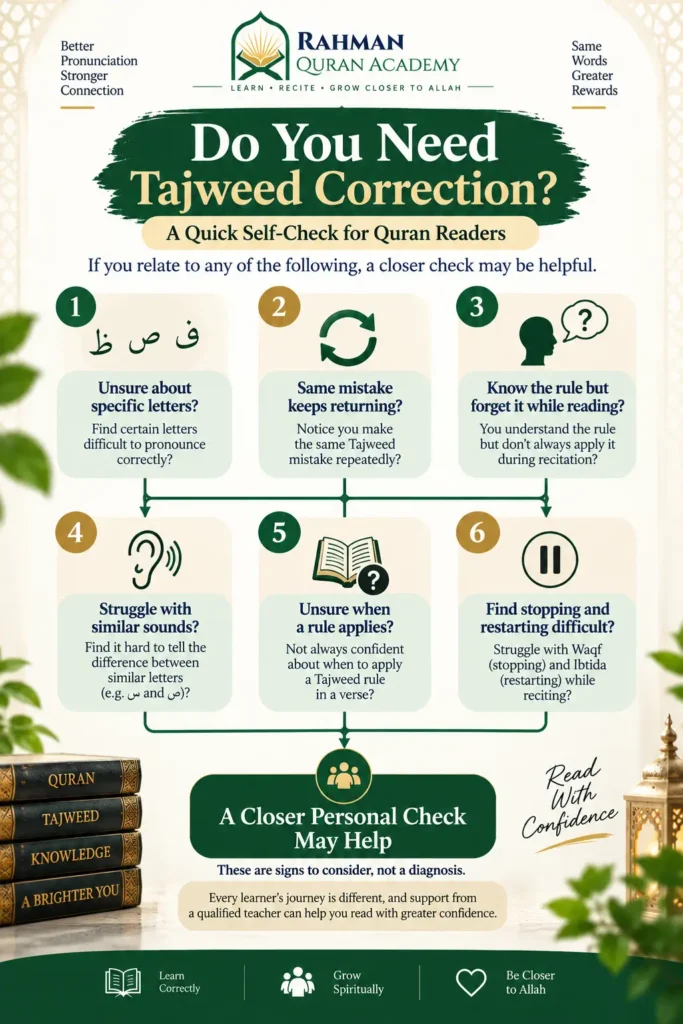
None of these confirms a specific problem on their own. They’re reasons to get a closer, personal check rather than a diagnosis in themselves.
What Should You Do Next If You Want to Learn Tajweed?
Where to start depends on where you’re starting from:
If you’re a complete beginner who can’t yet read Arabic script fluently, foundational reading generally comes first; see Noorani Qaida or Online Quran Reading Classes, with Tajweed introduced gradually alongside it.
If you can already read the Quran but want to check or correct your Tajweed, an assessment-led approach where a teacher first listens to your existing reading and identifies specific gaps is one option worth considering rather than starting from the beginning of a generic rules list.
If you’re a parent deciding when and how to start your child, consider their current reading ability, attention span and comfort with structured lessons over their age alone. See Quran Classes for Kids.
If you prefer self-study, it’s a reasonable way to build initial understanding; just be aware of the limitations covered above around checking your own pronunciation, and consider pairing it with at least periodic feedback from a qualified reader or teacher.
If you’re looking for structured online learning in the UK, useful things to check when comparing options include whether correction happens in real time, whether lessons are one-to-one or group-based, how flexible the timing is around your schedule, and whether there’s a free trial that lets you judge the fit before committing.
Rahman Quran Academy’s Online Tajweed Classes are currently offered as one-to-one lessons with a Hafiz-certified tutor, with rules applied directly inside real Quran reading and corrected in real time rather than taught as standalone theory. Both male and female tutors are available, timings are flexible for UK schedules, and the course offers three free trial classes for both children and adults before enrolling. (Lesson length and weekly frequency can vary by plan; check current pricing and scheduling on the course page before booking.)
Frequently Asked Questions About Tajweed
What is Tajweed in simple words? Tajweed is the set of rules for pronouncing Quranic letters correctly, including how each letter is produced, how it should sound, and how it behaves next to other letters.
Can I learn Tajweed if I already know how to read Quran? Yes. Being able to read fluently and reading with fully correct Tajweed are different things, and some fluent readers discover gaps in their pronunciation only once someone checks it closely.
Can adults learn Tajweed? Yes, at any age. There’s no credible evidence that age itself is a barrier, though starting points and learning context can differ between adults and children.
What are the main areas of Tajweed? Broadly: articulation points (Makharij), letter characteristics (Sifaat), Noon Sakinah and Tanween, Meem Sakinah, Ghunnah, Qalqalah, Madd, and Waqf and Ibtida. Different sources group these into different numbers of “rules,” but they cover the same underlying skills.
Do I need a teacher to learn Tajweed? You can learn what the rules are through books, apps or videos, but checking whether you’re personally producing sounds correctly is harder to do alone, since self-assessing your own pronunciation by ear isn’t always straightforward.
Can children learn Tajweed? Yes, usually introduced gradually once a child can recognise letters and manage short structured lessons, rather than at one fixed age for every child.
Why do I still make Tajweed mistakes after learning the rules? Knowing a rule and applying it automatically during fluent reading are different skills. General research on corrective feedback in language learning suggests feedback can support accuracy, though that research isn’t Tajweed-specific, and consistent correction on real reading is generally considered more useful than re-reading the rule alone.
How long does it take to learn Tajweed? There’s no single reliable timeline; it depends on your starting reading level and how consistently you practise. Be cautious of any claim promising an identical timeline for everyone.
Can I learn Tajweed online? Yes. One-to-one online lessons can provide live teacher feedback, depending on the teacher, platform and lesson setup, and let you compare options without committing before trying a trial lesson.
What is the difference between Tajweed and Quran recitation? On this site, Tajweed refers specifically to correct pronunciation, articulation and the rules governing individual sounds and letters. Recitation is used more broadly to cover the overall quality, flow, confidence and style of reading once the underlying Tajweed is in place. This is how the terms are used for navigation on this site, not a claim that every source draws the line in the same place.