

How to Learn Tajweed as a Beginner: A Step-by-Step Roadmap
Learning Tajweed isn’t about memorising every rule before you start reading. Tajweed is the discipline of reciting the Quran with correct pronunciation and articulation. A practical approach is to identify where you’re starting, strengthen your reading foundations if you need to, build pronunciation and Tajweed knowledge step by step, apply it directly in the Quran, and get feedback on what you can’t hear in your own recitation. This article sets out that roadmap.
Where Should a Beginner Start Learning Tajweed?
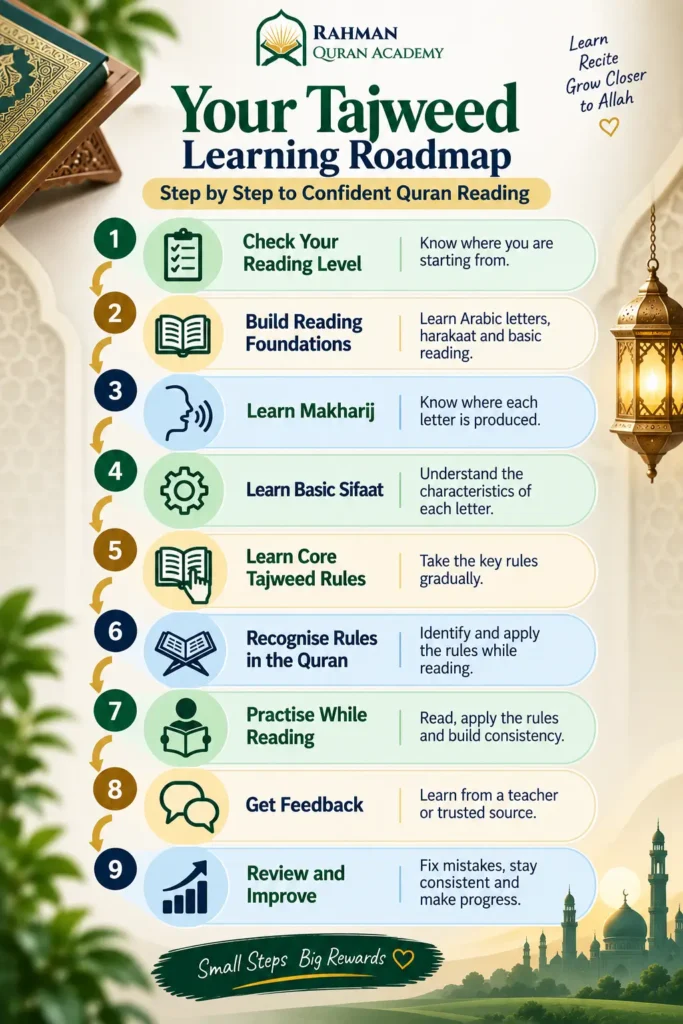
First, check your current Quran-reading level
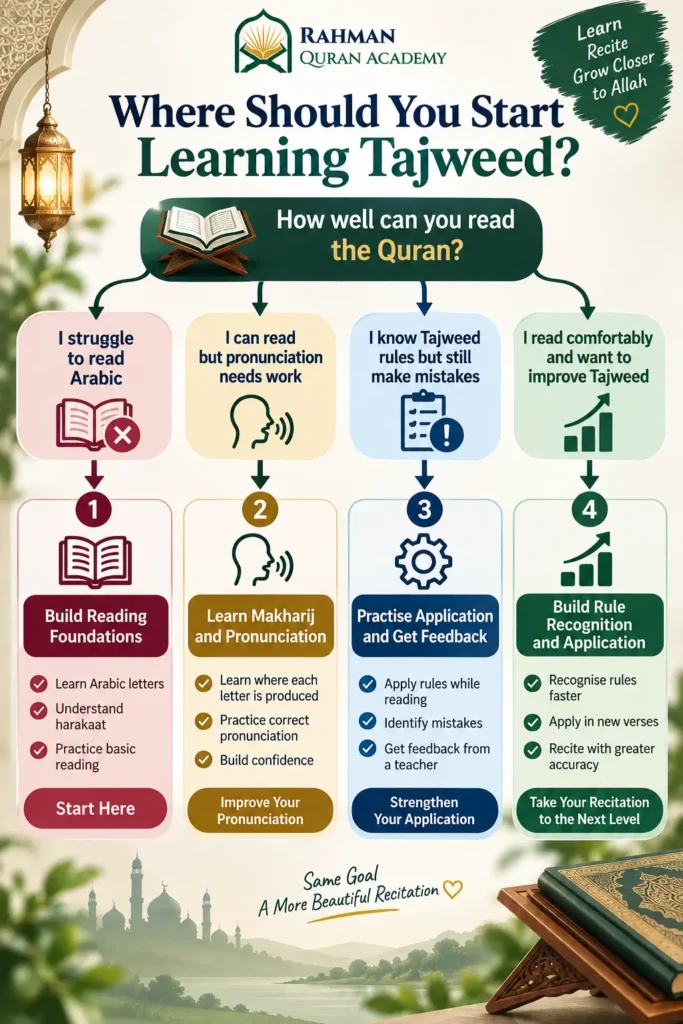
Not every beginner is starting from zero. Some people have never read Arabic script. Others read the Quran regularly but have never had their pronunciation checked. Others know the Tajweed rules by name but still make mistakes when they’re actually reciting. Each of these needs a different starting point, so it’s worth being honest about where you sit before picking a resource or a course.
If you cannot read Arabic comfortably
If sounding out Arabic letters and joined-up words is still a struggle, Tajweed rules will be hard to apply because you’re still working out what’s on the page. Reading foundations come first here; see Step 1 below.
If you can already read the Quran
If you can read fluently but have never had anyone check your pronunciation, or you’re not sure whether you’re applying rules correctly, you can generally move straight into Makharij (correct articulation points) and Tajweed rules, rather than starting from the alphabet again.
Step 1: Build Your Quran Reading Foundations
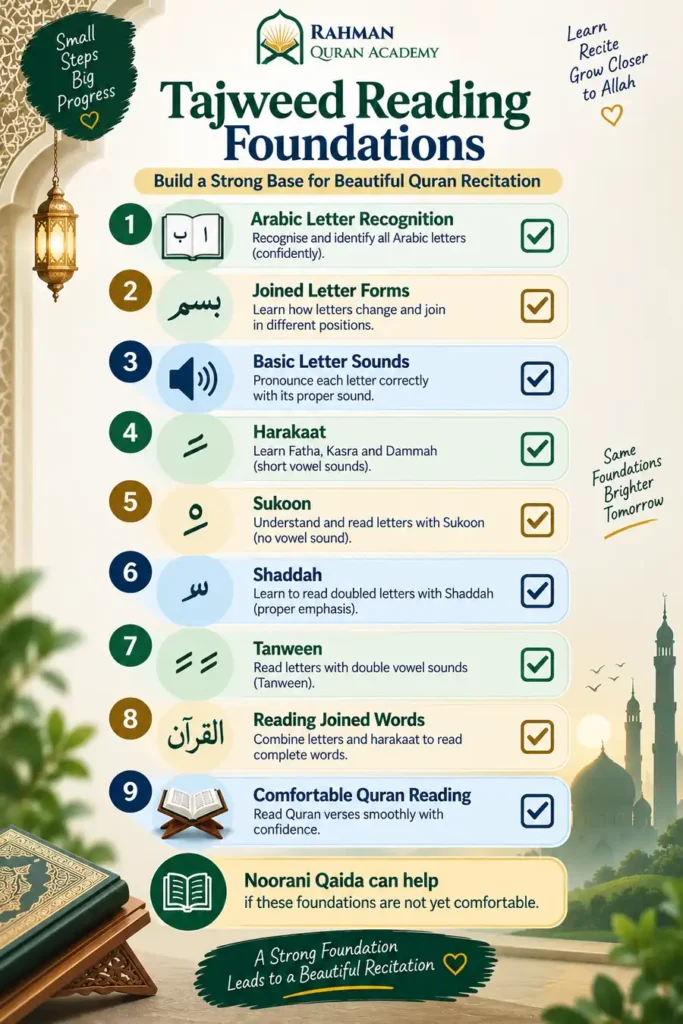
Arabic letters and their sounds
This means recognising each of the 28 Arabic letters, knowing how they’re written in their different joined-up forms, and being able to sound them out without hesitating.
Harakaat, Sukoon, Shaddah and Tanween
These are the marks that tell you how to pronounce a letter: the short vowels (Harakaat), the mark showing no vowel follows (Sukoon), the doubling mark (Shaddah), and Tanween the double vowel marks that produce an “n” sound at the end of certain words. Recognising these on sight is what makes fluent reading possible.
When Noorani Qaida can help
Noorani Qaida is a foundational primer used to teach Arabic letters, joining rules and basic reading before a learner moves into the Quran itself. It can be a genuinely useful starting point for someone who isn’t yet reading comfortably. It isn’t something every learner has to complete; a learner who can already read the Quran doesn’t need to restart from it, but for someone who is still working out letter shapes and sounds, learn Noorani Qaida is often where that groundwork gets built.
Step 2: Learn Makharij and Correct Letter Pronunciation
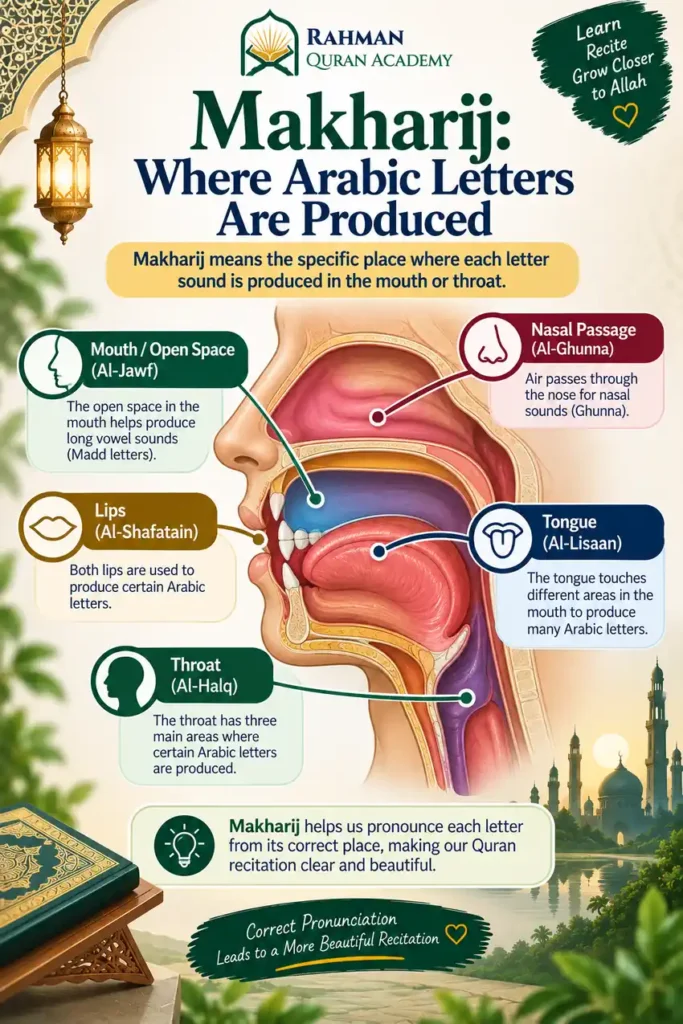
Makharij refers to the precise point in the mouth or throat where each Arabic letter is produced the difference, for example, between letters formed at the very back of the throat and ones formed at the tip of the tongue. Confusing certain Arabic letters can affect the pronunciation of a word and, in some cases, can affect its meaning, which is one reason this stage matters as much as it does.
This article won’t go through every articulation point letter by letter; a detailed guide to Makharij covers that in depth, but it’s worth knowing that Makharij is usually tackled early, either alongside or shortly after basic reading, because pronunciation habits formed here tend to stick.
Step 3: Learn Basic Sifaat
Sifaat are the characteristics of each letter’s sound; for example, whether it’s pronounced with a heavy, full mouth quality or a lighter one, and whether the sound is held or released quickly. At beginner level, you don’t need to memorise the full technical list. What matters is understanding that letters aren’t just about where they’re produced (Makharij) but also how they’re produced, and that this affects how a word should sound.
Step 4: Learn the Core Tajweed Rules Gradually
Once pronunciation basics are in place, the core Tajweed rules build on top of them. For a beginner, taking these rules in stages can make the learning process easier to manage, starting with the ones that come up most often in everyday reading.
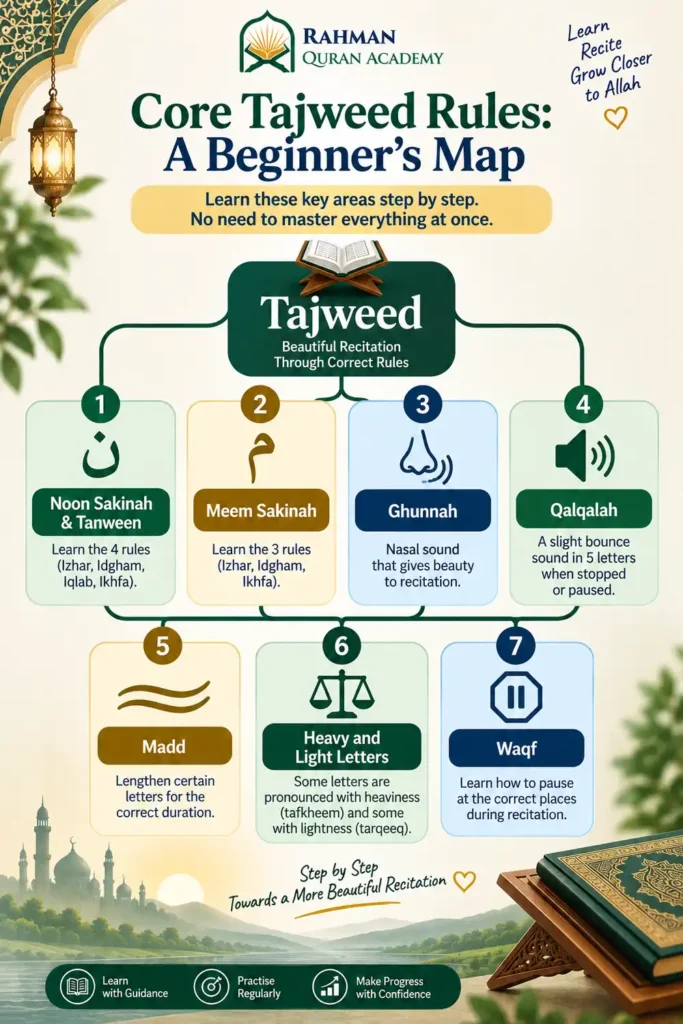
| Area | What it covers, briefly |
| Noon Sakinah & Tanween | How a silent noon or a tanween ending changes depending on the letter that follows it |
| Meem Sakinah | Similar rules, but for a silent meem |
| Ghunnah | The nasal sound held for certain letter combinations |
| Qalqalah | A slight bounce or echo on specific letters when they carry no vowel |
| Madd | Rules for elongating a vowel sound, and for how long |
| Heavy/light letters | Letters that are pronounced with a fuller, heavier mouth shape versus a lighter one |
| Waqf | Where and how to pause in recitation |
This table is a map, not the destination each of these areas has enough depth to warrant its own study. If you want the rule-by-rule detail, a detailed guide to Tajweed rules goes further than this roadmap does.
Step 5: Learn to Recognise Tajweed Rules in the Quran
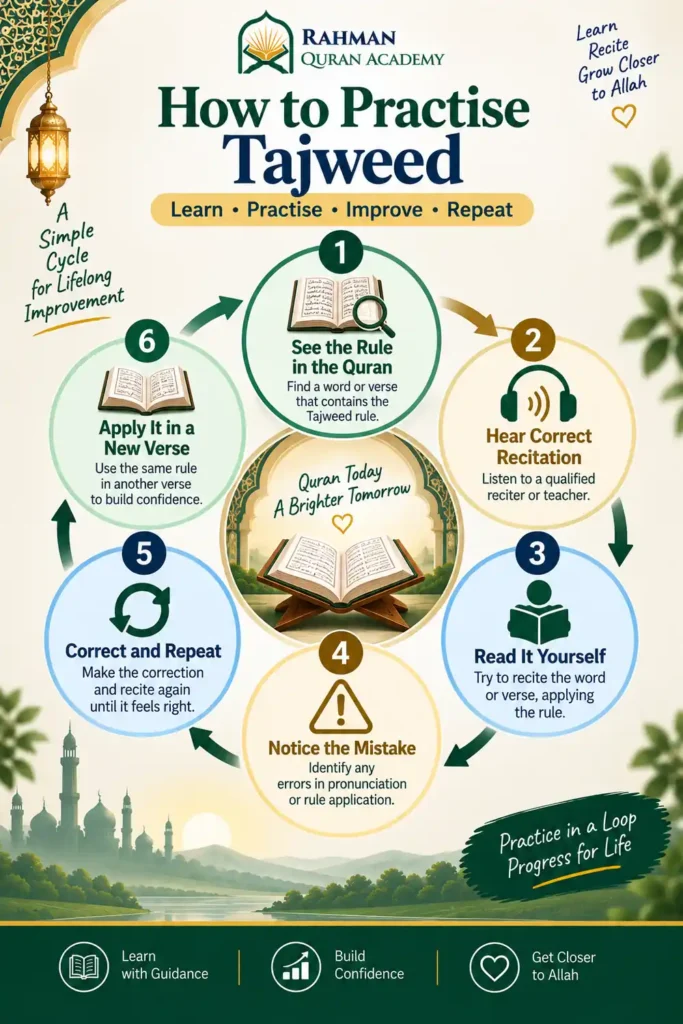
See the rule in the written text
Some Quran learning mushafs use colour-coding to mark Tajweed rules. When available, these markings can help you connect a written rule with its application in recitation.
Hear the rule in recitation
Listening to a qualified reciter apply a rule correctly and doing this repeatedly for the same rule across different verses helps you build an ear for what it’s supposed to sound like, which matters because some Tajweed distinctions are easier to hear than to explain.
Say it yourself
Once you can see it and hear it, try producing it yourself, ideally starting with the same verse you’ve just listened to, so you have something to compare against.
Step 6: Practise Tajweed While Reading the Quran
Start with short, familiar passages
Short, well-known surahs are easier to focus on because you’re not also struggling to decode unfamiliar words. This lets you concentrate on pronunciation and rule application rather than basic reading.
Slow down when practising
The Quran instructs believers to recite it with measured recitation. For practice, slowing down can also give you more time to focus on pronunciation and rule application before building back up to a natural reading pace.
Repeat difficult words and phrases
If a specific word or rule keeps tripping you up, isolate it and repeat it several times on its own before returning to the full verse.
Do not try to fix everything at once
Trying to correct every rule simultaneously in a new passage tends to overload attention and slow progress. It’s usually more effective to focus on one or two things at a time; for example, one Tajweed rule and one pronunciation point, and let the rest settle before adding more.
Step 7: Get Your Recitation Corrected
What feedback should identify?
Useful feedback should point out specifically what was mispronounced or misapplied, why, and what it should sound like instead, not just that something was wrong.
Why listening to yourself can help
Recording your own recitation and listening back is a simple way to catch some errors yourself, particularly ones related to pacing, pausing or obvious mispronunciations. It has real limits, though it’s genuinely difficult to reliably hear your own subtler articulation mistakes, because your ear has already adjusted to how you say the sound. Broader research on corrective feedback in language learning has found evidence that feedback can support learning, although this research is not specific to Tajweed.
When a teacher can be particularly useful
Because self-assessment has this blind spot, direct feedback from someone who can hear the difference is particularly useful for the errors you can’t catch yourself, especially fine articulation and Makharij mistakes. This doesn’t mean self-study is pointless; it means the two work well together, with self-study covering concepts, listening and repetition, and outside feedback covering the errors that are hard to self-diagnose. One-to-one Tajweed lessons are one way to get that kind of direct correction if you decide you want it. If you’re also weighing up what to look for in a Tajweed teacher, that’s a separate but related question worth thinking through.
Step 8: Build a Simple Tajweed Practice Routine
There’s no single routine that works for everyone, and how much time you can realistically give it will vary. As an example only, a session might look something like:
- A few minutes revisiting the last thing you were corrected on
- A few minutes on one Tajweed concept
- A longer stretch actually applying it while reading Quran
- A short block at the end reviewing anything that went wrong
Treat this as a starting template to adjust, not a fixed formula. What matters more than the exact split is consistency and actually applying each concept while reading, rather than only studying it on paper. If you want more ideas for structuring this between lessons, see: how to practise Tajweed at home between lessons.
How Do You Know If Your Tajweed Is Improving?
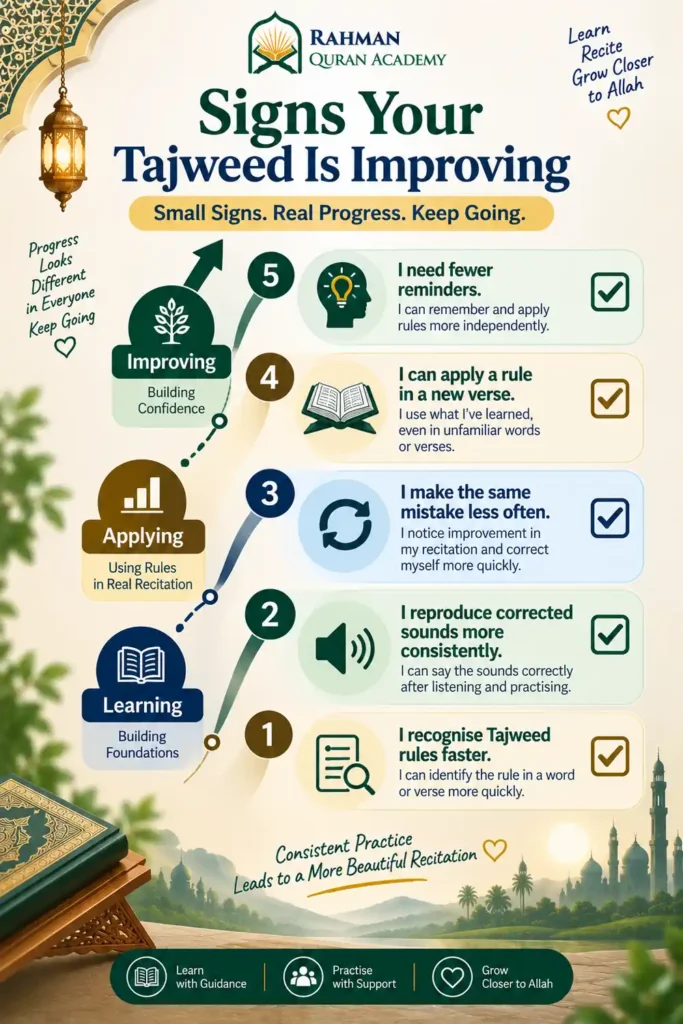
Rather than a fixed test or score, progress tends to show up as a few observable changes:
- You recognise a rule in the Quran text more quickly, without having to think it through
- You reproduce a corrected sound more consistently, not just once after being told
- The same error comes up less often
- You can apply a rule correctly in a new verse, not only the one you first practised it in
- You need fewer reminders for rules you’ve already covered
These are useful signals to watch for in your own practice rather than a formal metric, and progress on them isn’t always linear.
How Long Does It Take to Learn Tajweed?
There is no fixed timeline for learning Tajweed. Progress depends on your starting reading level, the areas you need to improve, how consistently you practise, how much feedback you receive, and the material you are working through. Building a foundation and applying the rules consistently is an ongoing learning process rather than something that has one universal finish line.
Can You Learn Tajweed Without a Teacher?
What you can study yourself
A genuine amount of Tajweed groundwork can be self-taught: learning the rules themselves, listening to qualified reciters, working through written material, and practising repetition on your own. Self-study can help you build knowledge of the rules, listening skills and repetition practice, particularly for the parts that are about knowledge and repetition rather than fine-grained sound correction.
Where self-study can become difficult
The limit tends to show up specifically around pronunciation and articulation errors that are hard to hear in your own voice, the same issue raised under self-listening above. Self-study alone doesn’t guarantee those get caught, however consistently you practise. If you’re weighing this up in more depth, learning Tajweed without a teacher looks at the self-study route more closely.
A practical middle ground
One practical approach is to combine self-study with periodic feedback from someone who can identify errors you may not notice yourself. That feedback doesn’t have to be constant; even occasional correction against specific errors can be useful.
What If You Already Know How to Read the Quran?
If you can already read fluently, you don’t need to restart from Arabic letters or work through a full reading primer. The more useful next step is a targeted check: get your Makharij and existing Tajweed application assessed so you know specifically what, if anything, needs correcting, rather than assuming you’re either “fine” or need to begin again from scratch. This is also the situation many adult learners find themselves in: comfortable reading the Quran, but never having had pronunciation formally checked. If mistakes keep showing up despite already knowing the rules, why Tajweed mistakes can continue even after learning the rules looks at that specific problem in more depth.
What Should You Learn After the Basics?
Once the fundamentals Makharij, basic Sifaat, and the core rule categories are in place and you’re applying them reasonably consistently in familiar passages, the next stage is usually about depth and range rather than new categories: refining the rules you’ve already learned and applying them consistently across less familiar surahs and longer passages. For a fuller breakdown of the rules themselves, our complete Tajweed guide goes into more depth than this roadmap does.
FAQ
How should a beginner start learning Tajweed?
Start by checking your current reading level. If reading Arabic is still difficult, work on foundations first. If you can already read, you can generally move into Makharij and Tajweed rules directly.
Should I learn Noorani Qaida before Tajweed?
Only if you need it. It’s a useful foundation for learners who aren’t yet reading Arabic comfortably, but an existing Quran reader doesn’t need to complete it first.
What should I learn first in Tajweed?
Correct letter pronunciation (Makharij) and basic Sifaat typically come first, since the core rules build on accurate pronunciation.
Should I learn Makharij before Tajweed rules?
Generally, yes: Makharij underpins how the rules should actually sound, so getting articulation right early makes the rules easier to apply correctly.
Can I learn Tajweed by myself?
You can self-teach a genuine amount the rules through listening and repetition, but catching your own subtle pronunciation errors is difficult, which is where outside feedback tends to help most.
Do I need a teacher?
Not necessarily for every part of the process, but direct feedback is useful for the errors you can’t hear yourself, particularly around articulation.
How much should I practise each day?
No fixed amount suits everyone. Consistency and actually applying rules while reading matter more than any specific number of minutes.
How long does it take to learn Tajweed?
It varies by starting level, consistency, and how much feedback you’re getting. There’s no reliable fixed timeline.
Can I learn Tajweed if I already know how to read Quran?
Yes, you’d typically skip the reading-foundation stage and move straight to getting your pronunciation and rule application checked.
How do I know if my Tajweed is improving?
Watch for faster rule recognition, fewer repeated errors, and being able to apply a rule correctly in verses you haven’t specifically practised.