
Is It Too Late to Learn Tajweed as an Adult?
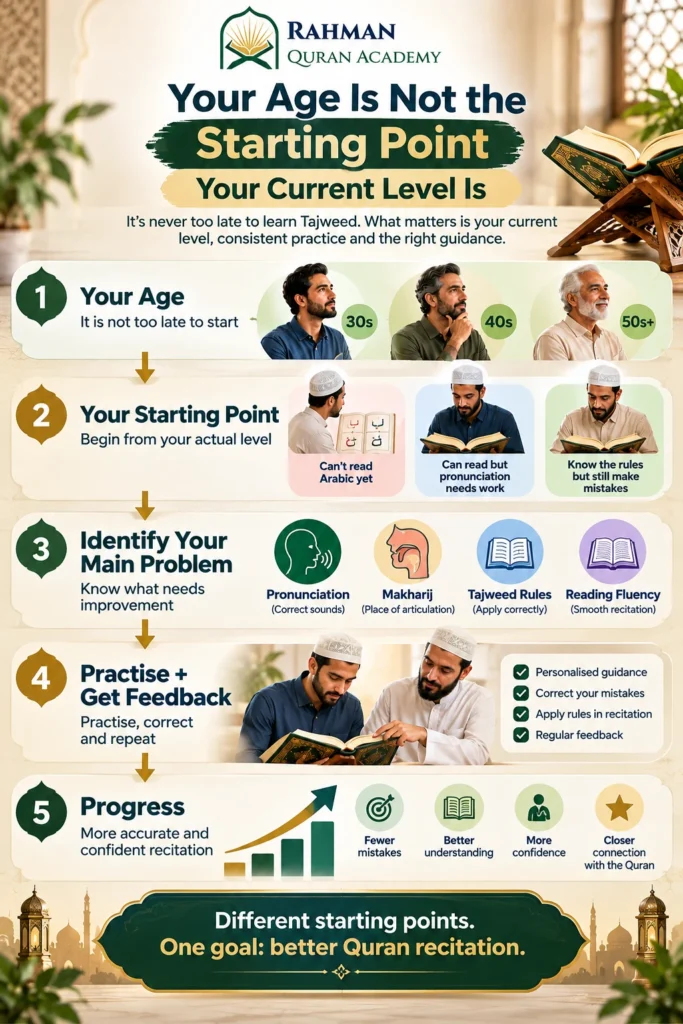
No, it is not too late to learn Tajweed as an adult. Adults improve their Quran recitation at every stage of life. What matters far more than your age is your starting point: your current reading ability, your existing pronunciation habits, and how consistently you can practise and get feedback.
That’s really the question worth asking instead of “am I too old?”
No, It Is Not Too Late But Your Starting Point Matters
Adulthood on its own is not a cut-off point for Tajweed. People take up Tajweed in their 30s, 40s, 50s and beyond, at every level from complete beginner to someone brushing up after years away.
What actually shapes your progress is:
- How comfortably you can already read Quran
- Whether you’ve built pronunciation habits that need correcting
- How consistently you can practise
- Whether you get accurate feedback on your recitation
- What you’re actually trying to achieve
This won’t be the same speed for everyone. But “too late” isn’t the honest description of what’s going on “I don’t know my starting point yet” usually is.
Why Adults Often Feel It Is “Too Late”
The worry isn’t really about a number. It’s usually one of a few specific concerns.
“I should have learned this as a child.”
Many adults compare themselves to children who started Tajweed early, or to peers who seem to recite with ease. That comparison says nothing about whether you can improve now, only that you’re starting later than someone else did.
“I have been reading incorrectly for years.”
This is one of the most common worries among adults who already read Quran regularly. A recurring theme in adult Tajweed discussions online is people who read Quran throughout childhood but never had their pronunciation properly corrected, and only realise this as adults.
“I will feel embarrassed in front of a teacher.”
Nobody enjoys having their mistakes pointed out, especially in something as personal as Quran recitation. This is addressed directly in a well-known hadith: the Prophet ﷺ said that the person skilled in reciting the Quran is with the noble, honourable recording angels, “and he who falters in it, and finds it difficult for him, will have two rewards” (Sahih Muslim 798a). Scholars explain this as recognising both the reward of recitation and the extra effort of struggling through it. Struggling is not a mark of failure; it’s an expected part of the process, and one that’s acknowledged rather than penalised.
“I do not have enough time.”
Busy working adults and parents often assume Tajweed requires long daily study sessions. It doesn’t have to; consistency matters more than duration, a point covered later in this article.
Not every adult experiences all of these. But if one or two of them sound familiar, you’re not unusual.
Does Age Actually Make Tajweed Harder?
This is the part where it’s easy to overstate the evidence in either direction, so it’s worth being precise.
What age can affect:
- How quickly new pronunciation patterns become automatic
- How much unlearning is needed if old habits are deeply set
- How much dedicated time is realistically available, given work and family commitments
What age does not mean:
- That improvement is impossible
- That an adult beginner will necessarily progress slower than a child in every respect
- That mistakes made for years are permanent
A 2026 systematic scoping review of neuroimaging studies found that adult second-language learning is associated with measurable, learning-related structural and functional changes in the brain, though the researchers also noted that findings vary with age, training intensity and study design, and that evidence specific to older adults is more limited (Frontiers in Human Neuroscience, 2026). This research is about general adult language learning, not Tajweed specifically, so it shouldn’t be read as proof that adults learn Tajweed just as fast as children, only as evidence that adult brains remain capable of the kind of change that learning a new skill requires.
Potential strengths adult learners bring:
- A clearer sense of why they want to improve, which supports consistency
- Better self-discipline for independent practice than many children have
- The ability to understand explanations of Tajweed rules in more depth, rather than only by imitation
Age is one factor among several, not a binary barrier.
Can You Correct Tajweed Mistakes You Have Had for Years?
This is the question behind most of the anxiety adults bring to Tajweed, so it deserves a direct answer: generally, yes, though it usually takes targeted, repeated practice rather than a single correction.
Why old pronunciation habits persist. A pattern repeated for years, without correction, simply becomes familiar. Familiarity isn’t the same as correctness; it just means the habit hasn’t been challenged.
Why knowing a rule isn’t the same as applying it. You can know, in theory, exactly how a letter should be pronounced and still say it the old way when reciting at normal speed. This gap between knowing and doing is common and is covered in more depth in why Tajweed mistakes continue even when you know the rules.
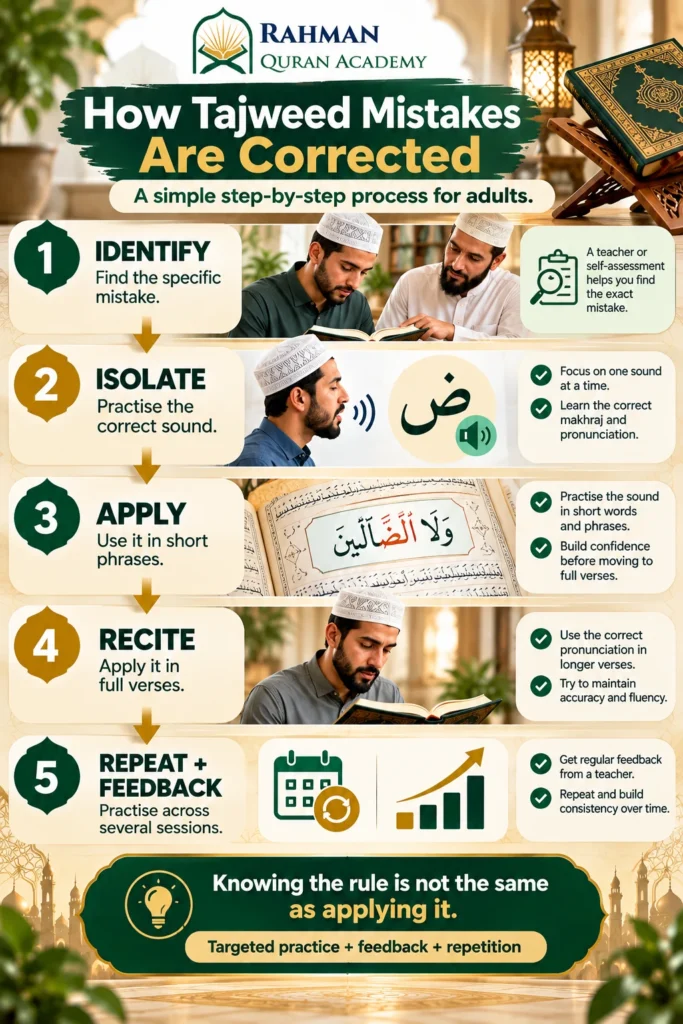
How habits actually get retrained. In practice, this usually looks like:
- A teacher or accurate self-assessment identifies the specific mistake
- You practise the correct sound in isolation
- You apply it in short phrases, then full verses
- You get feedback again, because errors tend to creep back under normal reading speed
- You repeat this across several sessions, not just one
There’s no fixed number of repetitions that guarantees a habit changes; it varies by person and by how deeply the pattern is set. What the evidence does support is that spaced, repeated practice rather than one intensive session is one of the more consistently effective learning strategies across many subjects and across the lifespan (Nature Reviews Psychology, 2022; Educational Psychology Review systematic review). Neither study is about Tajweed specifically, but both support the general principle that returning to a mistake over several sessions works better than trying to fix it once.
Where Should an Adult Start Learning Tajweed?
This is where “am I too old?” should really turn into “what’s my actual starting point?” Not every adult is in the same position, and treating everyone as a complete beginner or assuming everyone just needs quick correction misses the point.
| Your current ability | Likely starting point |
| Can’t yet recognise Arabic letters | Arabic letter and reading foundations — see learn Noorani Qaida |
| Recognises letters but struggles to join them into words | Noorani Qaida / reading foundation |
| Reads Quran, but slowly | Quran-reading fluency alongside gradual Tajweed; see online Quran reading classes |
| Reads Quran, but pronunciation is weak | Tajweed correction, focused on Makharij and specific rules |
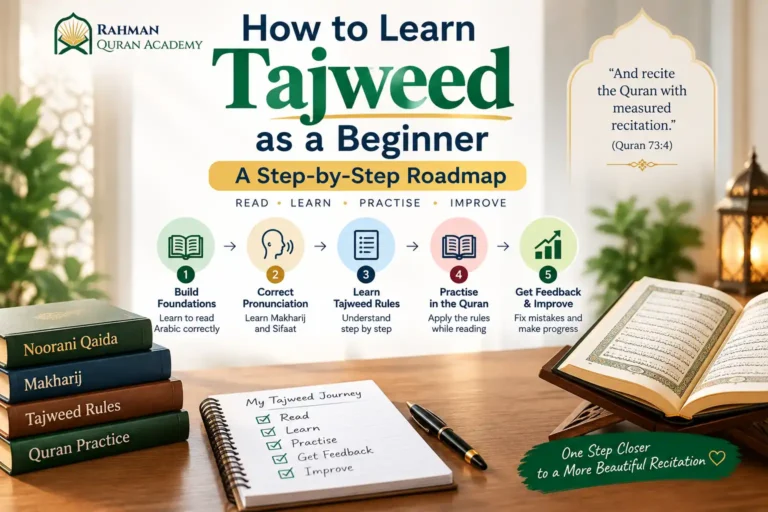
| Reads fluently, but doesn’t know Tajweed rules | Foundational Tajweed from the beginning — see the step-by-step beginner roadmap |
| Knows the rules in theory, but still makes mistakes while reciting | Applied Tajweed practice with feedback |
| Used to read well, but is rusty after years away | A short assessment, then targeted revision rather than starting from zero |
This isn’t a clinical assessment; it’s a practical way to work out where to actually begin, rather than guessing. If pronunciation specifically is the issue, it’s usually worth understanding the mechanics behind it, covered in Makharij: how to pronounce Quranic letters correctly.

Can You Learn Tajweed Without a Teacher?
Partly, and it’s worth being honest about where self-study helps and where it doesn’t.
What self-study can help with:
- Learning the theory behind Tajweed rules
- Listening to correct recitation repeatedly
- Practising independently between lessons
What teacher feedback adds:
- Catching pronunciation mistakes you can’t hear in your own recitation — this is genuinely difficult to do for yourself, since a mispronounced letter often sounds correct to the person saying it
- Confirming whether a rule is being applied correctly, not just understood
- Structured correction rather than guesswork
Books, apps and videos can support the theory and listening side of learning. Where they consistently fall short is pronunciation correction, because a self-taught learner has no reliable way to check their own Makharij against a trained ear. If you want the fuller picture of what YouTube-based self-study can and can’t replace, that’s covered separately in can you learn Tajweed from YouTube without a teacher? .
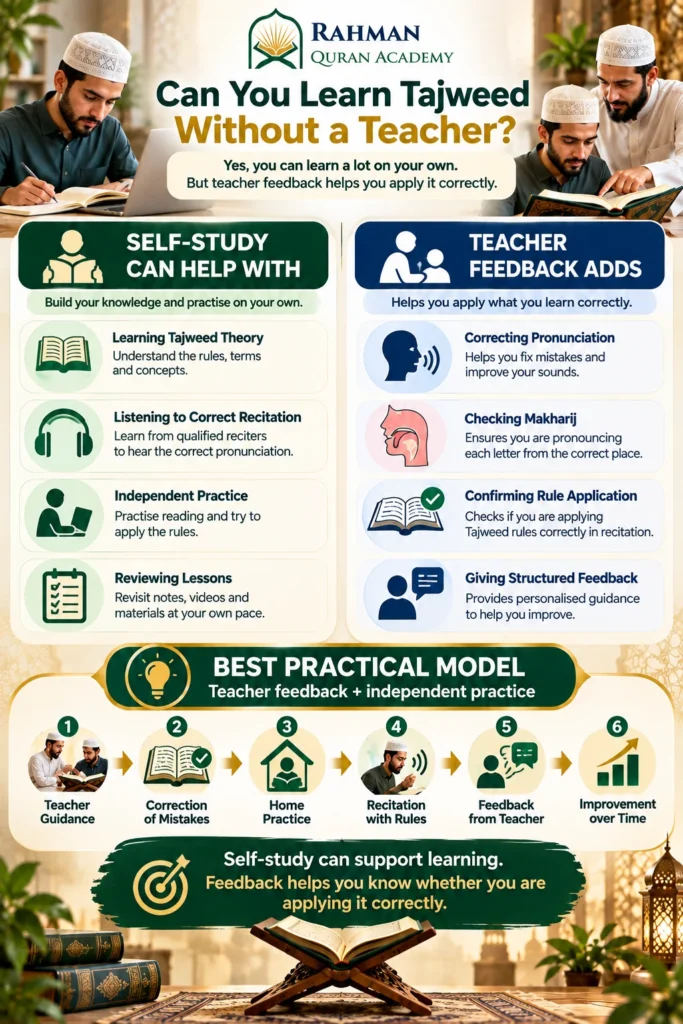
A workable middle ground for many adults is a teacher-plus-self-practice model: lessons for correction and structure, independent practice in between to make the correction stick. Rahman Quran Academy’s online Tajweed classes run as one-to-one sessions for exactly this reason: pronunciation correction is hard to do accurately alone.
How Long Does It Take to Learn Tajweed as an Adult?
There’s no credible universal timeline here, and it’s worth being suspicious of any answer that gives you one. Different course providers advertise timelines ranging from a few months to well over a year, but these are marketing estimates from individual providers, not evidence of a fixed, universal Tajweed learning timeline. Your actual pace depends on your starting point, consistency, and how much correction you need.
What’s more useful than a number is understanding the stages themselves:
- Knowing the rules — understanding what each Tajweed rule is and why it applies
- Applying the rules with guidance — using them correctly while a teacher checks and corrects in real time
- Applying the rules more independently — recitation holds up without constant prompting
- Advanced refinement — consistency across unfamiliar passages, not just practised ones
Most adults move through these stages at different speeds for different rules; you might apply Ghunnah confidently long before Madd feels automatic. That’s normal, not a sign you’re behind.
What Does an Effective Adult Tajweed Practice Routine Look Like?
Short, regular practice. Several short sessions across the week tend to work better than one long session, because spaced repetition is one of the more consistently supported learning strategies across different subjects (Nature Reviews Psychology, 2022).
Focus on one priority at a time. Trying to fix every mistake simultaneously usually means none of them sticks. Pick the rule or sound causing the most recurring errors and work on that first.
Listen and imitate. Repeated listening to accurate recitation helps train your ear before it trains your tongue.
Recite aloud and review. Reading silently doesn’t reveal pronunciation habits; reciting aloud, ideally recorded, does.
Revisit recurring mistakes. A mistake corrected once often reappears under normal reading speed. Coming back to it across several sessions is what makes the correction last.
This is a starting framework, not the full picture for the complete home-practice approach between lessons; see how to practise Tajweed at home between lessons.
How Do You Know Your Tajweed Is Improving?
Progress in Tajweed isn’t always obvious day-to-day, so it helps to know what to actually look for:
- Fewer recurring pronunciation errors on the same letters or rules
- More accurate Makharij (letter articulation points)
- Applying rules correctly without being prompted each time
- Less reliance on a teacher repeating the same correction
- More consistent recitation across different sessions
- Reasonable accuracy on verses you haven’t specifically practised
- Recitation that sounds smoother and less hesitant overall
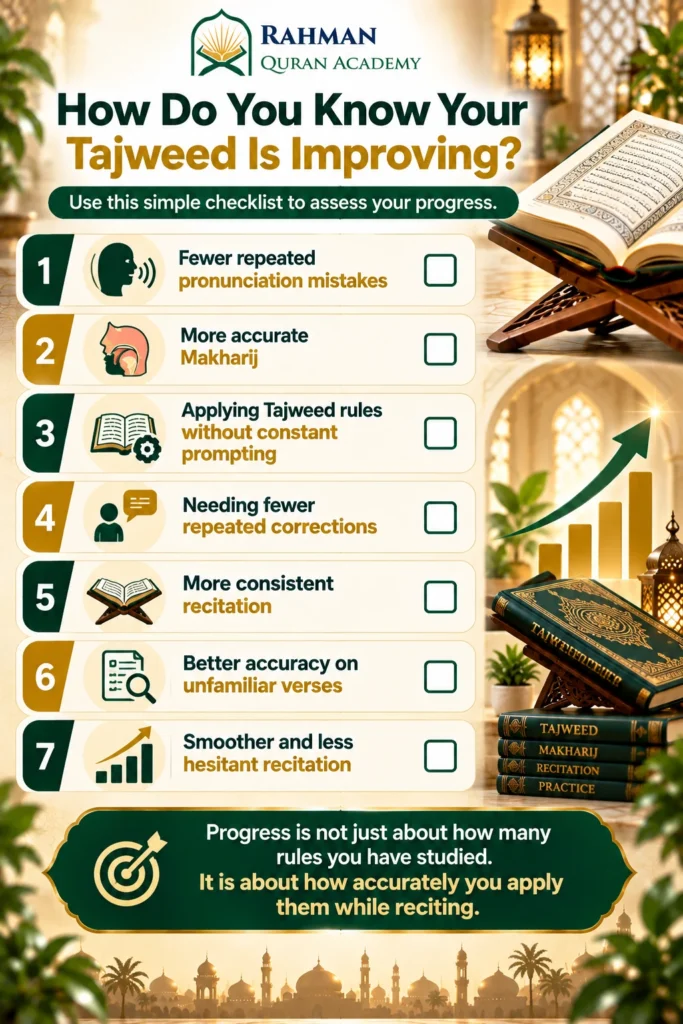
Progress here isn’t well measured by counting how many rules you’ve “covered.” A learner who has covered every rule on paper but still stumbles applying them during live recitation hasn’t finished; someone applying fewer rules but doing so consistently is further ahead in the way that actually matters.
Common Mistakes Adults Make When Learning Tajweed
Trying to learn every rule at once
Why it happens: It feels efficient to cover everything quickly. Why it matters: Nothing gets practised deeply enough to become automatic. Better approach: Learn and apply one or two rules properly before adding more.
Assuming fluent Quran reading means accurate Tajweed
Why it happens: Fluency and correct pronunciation feel similar from the inside. Why it matters: Long-standing pronunciation errors can sit underneath fluent-sounding recitation for years, unnoticed. Better approach: Get an honest assessment even if you already read comfortably.
Watching lessons without enough recitation
Why it happens: Watching feels productive and low-pressure. Why it matters: Tajweed is a spoken skill; understanding a rule isn’t the same as being able to apply it while reciting. Better approach: Balance every explanation with actual recitation practice.
Practising only occasionally
Why it happens: Busy schedules push practice to “when there’s time.” Why it matters: Irregular practice makes it harder for corrections to stick, since spaced repetition is what tends to make learning last. Better approach: Shorter, more frequent sessions beat occasional long ones.
Trying to correct every mistake at the same time
Why it happens: Every error feels urgent once you notice it. Why it matters: Attention gets spread too thin to fix anything properly. Better approach: Prioritise the mistake that recurs most often.
Avoiding correction because of embarrassment
Why it happens: Nobody likes hearing they’ve been reciting something incorrectly for years. Why it matters: Avoiding feedback means the mistake never actually gets addressed. Better approach: Remember that struggling through recitation is acknowledged, not penalised, as reflected in the hadith on the two rewards mentioned earlier.
A Simple 4-Week Starting Plan for Adult Tajweed Learners
This is a practical starting framework, not a scientifically proven or universal timeline. Everyone’s pace will differ.
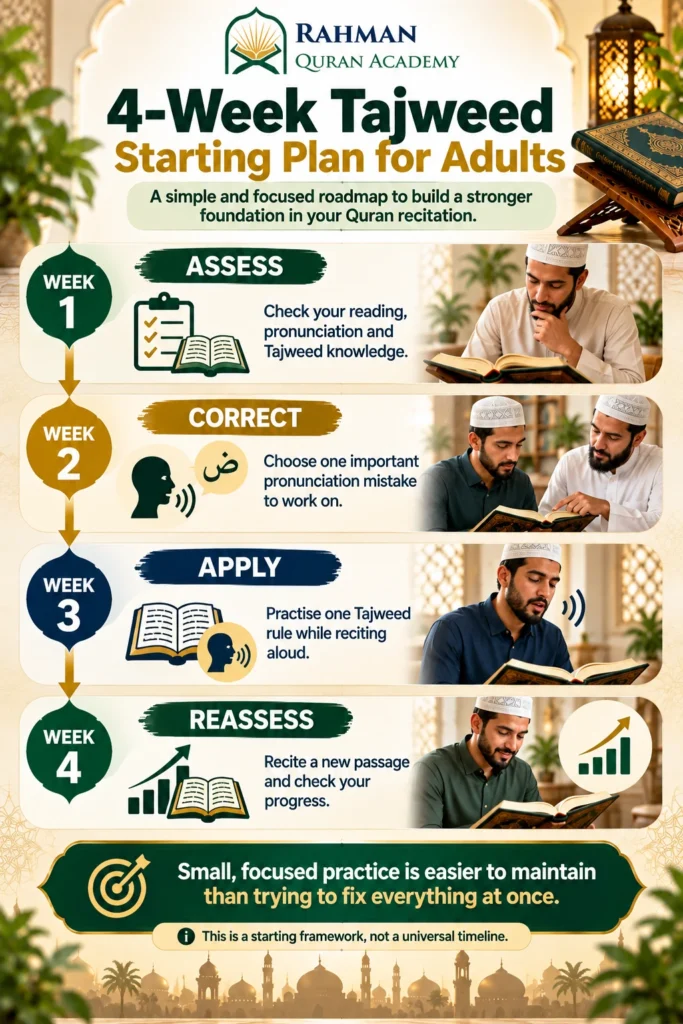
Week 1 — Assess. Get an honest read on your current level: reading ability, pronunciation, and rule knowledge. This is where a teacher’s ear is genuinely useful, since self-assessment of pronunciation is difficult.
Week 2 — Correct one pronunciation priority. Pick the single most frequent pronunciation error and focus practice specifically on it.
Week 3 — Build one Tajweed application skill. Take one rule you already understand in theory and practise applying it consistently while reciting aloud.
Week 4 — Apply and reassess. Recite a passage you haven’t specifically drilled, and check whether the Week 2 and Week 3 corrections are holding up under normal reading conditions.
When Should You Consider One-to-One Tajweed Lessons?
One-to-one lessons tend to make the most difference when:
- You keep making the same pronunciation mistakes without realising it
- You’re unsure whether your Makharij is actually correct
- You need flexible timing around work or family commitments
- You’re starting as a complete beginner and want a structured path
- You already know the rules in theory, but they aren’t showing up in your recitation
Rahman Quran Academy runs one-to-one online Tajweed classes for exactly this kind of personalised correction, with lessons delivered live rather than pre-recorded, so pronunciation can be corrected as it happens.
Frequently Asked Questions
Is it too late to learn Tajweed as an adult? No. Adults learn and improve Tajweed at every stage of life. Your starting point and consistency matter more than your age.
Can adults learn Tajweed from scratch? Yes. A complete beginner adult typically starts with Arabic reading foundations before or alongside Tajweed rules, rather than jumping straight into advanced rules.
Can I learn Tajweed if I already read Quran? Yes, and it’s a common starting point. Many adults who read fluently still have unaddressed pronunciation habits that only surface once someone checks their Makharij closely.
Can I correct Tajweed mistakes I’ve made for years? Generally yes, through targeted, repeated practice with feedback. Old habits don’t disappear after one correction, but they aren’t permanent either.
Do I need a teacher to learn Tajweed? Self-study can support theory and listening practice, but accurately identifying your own pronunciation mistakes is difficult without external feedback. A teacher isn’t the only path to some improvement, but it’s the most reliable path to pronunciation correction specifically.
How long does it take to learn Tajweed as an adult? There’s no universal timeline. Progress depends on your starting point, consistency, and how much correction is needed. It’s more useful to track which stage you’re at (knowing the rules, applying them with guidance, applying them independently, refining) than to aim for a fixed number of months.
This article is part of Rahman Quran Academy’s Tajweed guide. For the complete overview, see the Complete Tajweed guide .