

Tajweed Rules Explained: A Practical Guide for Quran Readers
Tajweed rules are the guidelines that tell you how to pronounce each letter of the Quran, when to lengthen a sound, when to add a nasal sound (Ghunnah), and where to stop and start. Knowing them is one skill. Spotting them on the page is a second. Applying them while you recite is a third. This guide covers all three, in a learning order that does not bury you in terminology.
Where should you begin?
- You cannot read Arabic letters yet: start with the basics in Noorani Qaida or Quran reading lessons, then return here.
- You can read, but nobody has corrected your recitation: read from the top. The sections on pronunciation, recognition and mistakes will help most.
- You learned as a child and want to restart: the adult guide to learning Tajweed as an adult pairs well with this page.
What Is Tajweed?
Tajweed is the discipline of reciting the Quran with each letter pronounced from its correct point, with its correct qualities, and with the right lengthening, nasal sounds, stops and starts. The Arabic word carries the sense of doing something well or making it better.
Allah describes the recitation He asks for in Surah Al-Muzzammil:
أَوْ زِدْ عَلَيْهِ وَرَتِّلِ ٱلْقُرْءَانَ تَرْتِيلًا “…and recite the Quran ˹properly˺ in a measured way.” (Quran 73:4, Clear Quran translation)
This verse is the basis for measured, clear recitation (tartil). It does not list individual rules. The rules were later organised by scholars of recitation so that readers could achieve that measured recitation accurately.
For a fuller explanation of meaning and purpose, see what Tajweed means.
What Should You Learn First in Tajweed?
Learn pronunciation before rules. If the letters themselves come out wrongly, no rule can fix them. Most learners do best by adding rules one group at a time.
A practical order:
- Arabic letters and basic pronunciation
- Makharij (where each letter is produced)
- Sifaat (the qualities of each letter, such as heavy or light)
- Noon Sakinah and Tanween
- Meem Sakinah
- Ghunnah
- Qalqalah
- Madd (lengthening)
- Waqf and Ibtida (stopping and starting)
- Applied recitation (putting everything together in real verses)
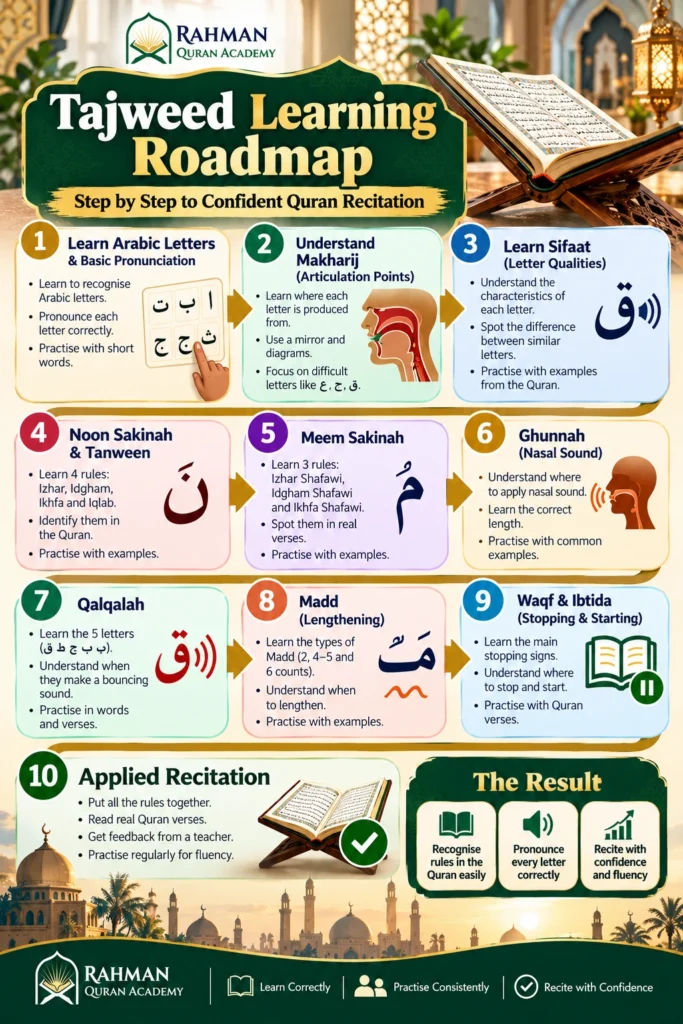
This is a useful sequence, not the only valid one. Teachers, books and institutions order topics differently, and that is fine. What matters is that you are not trying to memorise every rule on day one.
Your starting level changes the path:
- A beginner spends longer on steps 1 to 3.
- A reader who is fluent but uncorrected may start at step 4 and revisit steps 2 and 3 when mistakes appear.
- A learner returning after years often finds steps 2 and 3 are where old habits hide.
Visual 1 – Tajweed Learning Roadmap: Reading foundation → Makharij → core rules → application → feedback → fluency. (See visual notes at the end.)
Makharij and Sifaat: The Foundation of Correct Pronunciation
Makharij (singular makhraj) are the points in the mouth, throat, lips and nasal passage where Quranic letters are produced. Sifaat are the qualities a letter carries once it is produced, such as heavy or light, whispered or voiced.
The Makharij are usually grouped into five general areas:
- the space of the mouth and throat (for the long vowel sounds)
- the throat
- the tongue
- the lips
- the nasal passage
Within those areas, 17 specific points are the count most commonly taught, though some scholars count differently.
Why this comes before the rules: a learner can understand Ikhfa perfectly and still produce it badly if they mispronounce the surrounding letters. This is one reason people say they “know the rules” yet still sound uncertain.
Letter pairs that often cause trouble
The table below is a starting guide only. A teacher who can hear you can best confirm each letter’s placement.
| Pair | What is different | Common slip | Correction cue |
| ح / ه | ح comes from the middle of the throat with a tight, rasping friction. ه comes from the deepest part of the throat as a light breath. | Saying ح as a soft ه | Make ح narrower and rougher; keep ه light and airy |
| ع / ء | ع is a voiced, constricted sound from the middle of the throat. ء is a quick stop and release from the deepest part. | Replacing ع with a short ء | Let ع flow and vibrate; ء is a brief catch |
| ص / س | Both are whistling sounds from the tongue tip. ص is heavy, with the back of the tongue raised. س is light. | Saying ص like a thin س | Raise the back of the tongue so the sound sounds fuller |
| ط / ت | Both touch the tongue tip to the gum behind the upper front teeth. ط is heavy and emphatic. ت is light. | Saying ط like ت | Add weight and depth to ط |
| ق / ك | ق comes from the very back of the tongue, ك slightly forward. ق is heavy, ك is light. | Saying ق like ك | Move the sound further back and make it fuller |
Sifaat in one idea: seven letters (خ ص ض غ ط ق ظ) are commonly taught as heavy letters, pronounced with the back of the tongue raised. The rest are light. Many pronunciation errors come from blurring heavy and light.
For the full Makharij walkthrough, see Makharij of the Quranic letters.
Noon Sakinah and Tanween Rules
Noon Sakinah (نْ) is a noon with a sukoon, meaning no vowel. Tanween is the double vowel at the end of a noun (ــً ــٍ ــٌ), which carries an extra “n” sound. The rule you apply depends on the letter that comes next.
| Rule | Next letter(s) | What you do |
| Izhar | ء ه ع ح غ خ | Say the noon clearly |
| Idgham | ي ر م ل و ن | Merge the noon into the next letter |
| Iqlab | ب | Change the noon into a hidden meem |
| Ikhfa | The remaining 15 letters | Hide the noon with a nasal sound |
The 15 Ikhfa letters are: ص ذ ث ك ج ش ق س د ط ز ف ت ض ظ.
Note on Mushaf marking: different printed Mushafs mark these rules differently. Many show Iqlab with a small meem above the noon. Many show Idgham by removing the sukoon from the noon. Check the key at the front of your own Mushaf.
Izhar (clear pronunciation)
- When it occurs: noon sakinah or tanween is followed by one of the six throat letters ء ه ع ح غ خ.
- What you see: نْ or tanween, then one of those letters, usually across two words.
- How it sounds: the noon is clean and clear. No nasal blur.
- Example: مَنْ آمَنَ (2:62). Also أَنْعَمْتَ عَلَيْهِمْ (1:7), where the noon sits in front of ع.
- Common mistake: adding an extra nasal sound, or rushing past the noon.
- Correction cue: say the noon, then the next letter as two distinct sounds.
Idgham (merging)
- When it occurs: noon sakinah or tanween is followed by one of ي ر م ل و ن.
- What you see: the noon is often unmarked, and the next letter may carry a shaddah. Marking varies by Mushaf.
- How it sounds: the noon disappears into the next letter. With ي ن م و the merge carries Ghunnah for about two counts. With ل and ر there is no Ghunnah.
- Example with Ghunnah: مَنْ يَقُولُ (2:8).
- Example without Ghunnah: مِنْ رَبِّهِمْ (2:5).
- Common mistake: pronouncing the noon separately, or adding Ghunnah before ل and ر.
- Correction cue: treat the two letters as one doubled sound.
Iqlab (changing)
- When it occurs: noon sakinah or tanween is followed by ب.
- What you see: many Mushafs add a small meem above the noon or tanween.
- How it sounds: the noon becomes a hidden meem, with the lips lightly closed and a Ghunnah of about two counts before the ب.
- Example: مِنْ بَعْدِ (2:27). With tanween: سَمِيعًا بَصِيرًا (for example 4:58).
- Common mistake: keeping a clear noon sound, or pressing the lips too hard.
- Correction cue: close the lips gently and let the sound pass through the nose.
Ikhfa (hiding)
- When it occurs: noon sakinah or tanween is followed by any of the 15 Ikhfa letters.
- What you see: the noon or tanween with one of those letters next.
- How it sounds: the noon sits between clear and merged. A Ghunnah of about two counts. The tongue does not fully touch its usual noon position.
- Example: مِنْ قَبْلِكَ (2:4).
- Common mistake: pronouncing a clear noon (that is Izhar), or merging it completely (that is Idgham).
- Correction cue: keep the tongue away from the roof of the mouth and let the nasal sound flow into the next letter.
Meem Sakinah Rules
Meem Sakinah (مْ) is a meem with a sukoon. It follows three rules, based on the letter that comes after it.
| Rule | Next letter | What you do |
| Ikhfa Shafawi | ب | Hide the meem lightly, with Ghunnah |
| Idgham Shafawi | م | Merge the two meems, with Ghunnah |
| Izhar Shafawi | any other letter | Say the meem clearly |
“Shafawi” refers to the lips (shafatayn), where the meem is produced.
Ikhfa Shafawi
- When it occurs: مْ followed by ب.
- How it sounds: the meem is lightly hidden, with a Ghunnah of about two counts. The lips come together softly.
- Example: تَرْمِيهِم بِحِجَارَةٍ (105:4).
- Common mistake: pressing the lips together hard, or leaving out the nasal sound.
- Correction cue: gentle lips, steady nasal sound, then the ب.
Idgham Shafawi
- When it occurs: مْ followed by another م.
- How it sounds: the two meems merge into one doubled meem, with Ghunnah.
- Example: كَم مِّن فِئَةٍ (2:249).
- Common mistake: saying two separate meems.
- Correction cue: hold the meem as a single, steady sound.
Izhar Shafawi
- When it occurs: مْ followed by any letter other than ب or م.
- How it sounds: the meem is clear.
- Example: عَلَيْهِمْ غَيْرِ (1:7).
- Common mistake: hiding or merging the meem before و and ف, where it is easy to slip.
- Correction cue: give the meem its own clear closing before moving on.
Ghunnah
Ghunnah is the nasal sound produced in the nasal passage. It belongs to noon and meem. It is commonly held for about two counts.
You meet it in two main ways:
- In doubled noon and meem (نّ and مّ): this is the fullest Ghunnah. Examples: إِنَّ (2:6) and ثُمَّ.
- Within the Noon Sakinah, Tanween and Meem Sakinah rules above: Idgham with Ghunnah, Iqlab, Ikhfa and the Shafawi rules that carry it.
Counts explained simply: one “count” is roughly the time of one finger movement. It is a guide to proportion, not a stopwatch.
- Common mistake: cutting Ghunnah short, or stretching it far too long.
- Correction cue: listen to a skilled reciter and match the length by ear. Then check yourself on a recording.
Qalqalah
Qalqalah is a slight echo or bounce on five letters when they carry a sukoon: ق ط ب ج د. A classic memory phrase for them is قُطْبُ جَدٍّ.
Two common forms are taught:
- Qalqalah in the middle of a word or while continuing: a lighter bounce. For example, the د in قَدْ (58:1).
- Qalqalah when stopping on the letter: the strongest bounce. For example, stopping on أَحَدْ (112:1) or وَتَبّْ (111:1).
- What you see: one of the five letters with a sukoon, or one of them at the end of a word where you stop.
- How it sounds: a short, clean release.
- Common mistake 1: adding a vowel sound, so the letter becomes “da” or “duh”.
- Common mistake 2: skipping the echo entirely.
- Common mistake 3: making the bounce too heavy.
- Correction cue: release the letter briefly and stop. Do not turn the bounce into a syllable.
Madd Rules
Madd means lengthening. Letters of Madd (alif after a fatha, waw sakinah after a damma, ya sakinah after a kasra) stretch the sound. How long you stretch depends on what follows.
For most readers, four types are enough to begin with:
| Type | When it happens | Length (Hafs ‘an ‘Asim) | Example |
| Natural Madd (Madd Asli) | Madd letter with nothing special after it | 2 counts | قَالَ |
| Madd Muttasil | Madd letter followed by hamza in the same word | 4 to 5 counts | السَّمَاءِ (2:19) |
| Madd Munfasil | Madd letter at the end of a word, hamza at the start of the next | Commonly taught as 4 to 5 counts; some routes allow 2 | إِنَّا أَعْطَيْنَاكَ (108:1) |
| Madd Lazim | Madd letter followed by a fixed sukoon or shaddah | 6 counts | الضَّالِّينَ (1:7) |
A note on variation: Madd Munfasil is the type where teachers differ most. The most widely taught practice for Hafs is 4 or 5 counts, with 4 being the better known. Whatever your teacher uses, keep it consistent within a recitation session rather than mixing lengths.
- How to recognise it: look for a Madd letter, then check what comes immediately after.
- Common mistake: giving every Madd the same length.
- Correction cue: before you recite, scan the passage and mark each Madd as 2, 4/5 or 6 in pencil. Then recite using your own marks.
This is a beginner’s view of Madd. There are more types, and they are best learned with a teacher once the basics feel secure.
Waqf and Ibtida
Waqf is stopping while reciting. Ibtida is starting again afterwards. Where you stop and start affects how clearly the meaning comes across. This is why stopping is part of correct recitation, and not just a breathing pause.
Many Mushafs mark suggested stopping points with small signs. A commonly seen set:
| Sign | Meaning |
| م | Stop here |
| لا | Do not stop here |
| ج | Stopping or continuing are both allowed |
| قلى | Stopping is preferred |
| صلى | Continuing is preferred |
| ∴ (three dots, appearing twice close together) | Stop at one of the two places, not both |
Mushaf variation: different Mushafs use slightly different sets of signs. Check the key in your copy.
Two practical points:
- Stopping on a word changes how the end sounds. The final vowel is generally dropped, and the last letter takes a sukoon. This is also why Qalqalah appears more strongly when you stop on its letters.
- Starting again: begin where the meaning is complete. Avoid starting in the middle of a phrase in a way that breaks the sentence.
- Common mistake: stopping because you ran out of breath, not at a sensible point.
- Correction cue: practise a short passage with breath planning, so you reach the next suitable stop.
Quick Reference: Rule, Example, Mistake, Correction
| Rule | Example | Common mistake | Correction |
| Izhar | مَنْ آمَنَ | Extra nasal blur | Clear noon, then the letter |
| Idgham | مِنْ رَبِّهِمْ | Separate noon | One doubled sound |
| Iqlab | مِنْ بَعْدِ | Clear noon | Gentle lips, hidden meem |
| Ikhfa | مِنْ قَبْلِكَ | Clear or fully merged noon | Hidden noon with Ghunnah |
| Ikhfa Shafawi | تَرْمِيهِم بِحِجَارَةٍ | Hard lip press | Soft lips, steady nasal sound |
| Ghunnah | إِنَّ | Too short | Match a skilled reciter by ear |
| Qalqalah | أَحَدْ | Adding a vowel | Brief release, then stop |
| Madd | السَّمَاءِ | Same length for every Madd | Scan and mark before reciting |
| Waqf | — | Stopping for breath only | Plan breath to reach a stop |
How to Recognise Tajweed Rules While Reading the Quran
Use four steps: Look, Identify, Apply, Check. This turns a rule from a definition into something you do.
- Look. What letters and signs sit next to each other?
- Identify. Which pattern is it?
- Apply. What sound or action does the rule require?
- Check. Did it sound right?
Worked example 1: مِنْ بَعْدِ (2:27)
- Look: a noon with a sukoon, followed by ب in the next word.
- Identify: Iqlab.
- Apply: change the noon into a hidden meem, lips lightly closed, with Ghunnah.
- Check: Is there a nasal sound, and did you avoid a clear noon?
Worked example 2: مَنْ يَقُولُ (2:8)
- Look: noon sakinah followed by ي.
- Identify: Idgham with Ghunnah.
- Apply: merge the noon into the ي, holding a nasal sound.
- Check: did the noon vanish, or did you pronounce it separately?
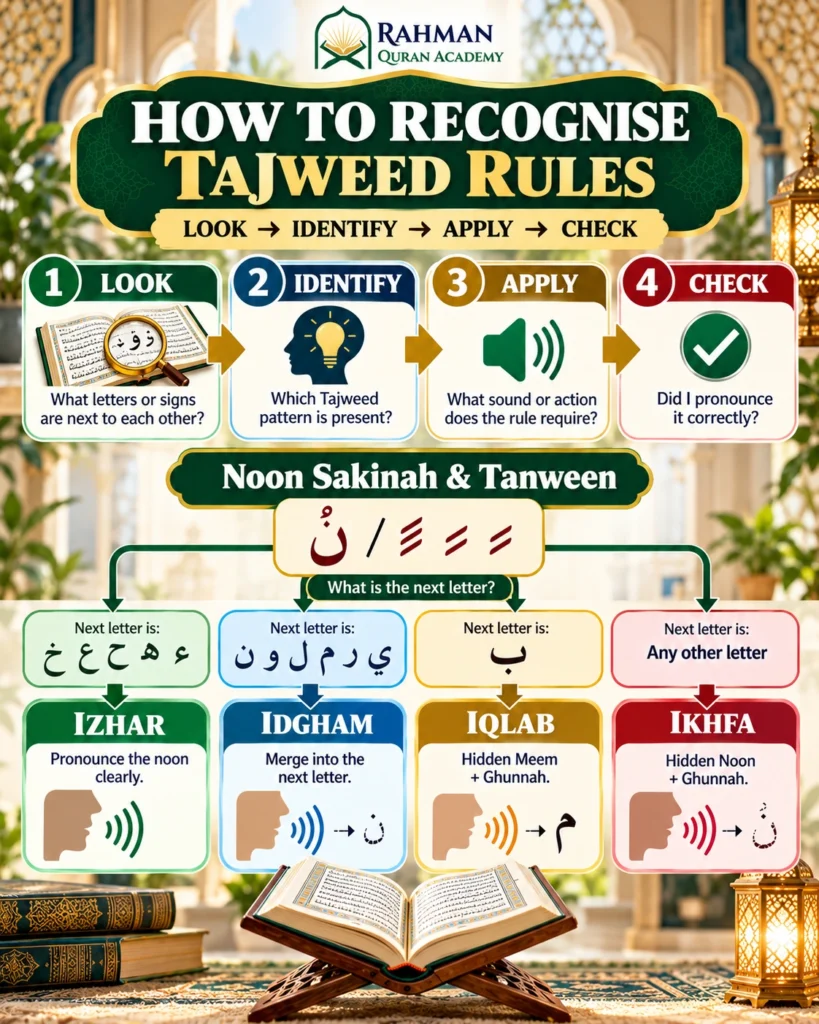
A decision tree for Noon Sakinah and Tanween
See نْ or tanween
│
├─ Next letter is ء ه ع ح غ خ ? → Izhar → say the noon clearly
├─ Next letter is ي ر م ل و ن ? → Idgham → merge (with Ghunnah for ي ن م و)
├─ Next letter is ب ? → Iqlab → hidden meem, lips lightly closed
└─ Any other letter? → Ikhfa → hide the noon, with Ghunnah
Colour-coded Mushafs: these can help you notice patterns. Treat them as a support, not a substitute. If the colours disappear, can you still spot the rule? That is the test. If the colours confuse you, try a plain Mushaf with the decision tree above, one pattern at a time.
Why Knowing Tajweed Rules Does Not Always Mean You Can Apply Them
Knowing a rule means you can explain it. Applying a rule means you can do it correctly while reciting. These are different skills, and most learners find one is stronger than the other.
| Level | Meaning | How to tell |
| Know | I can explain the rule | You can describe Ikhfa out loud |
| Recognise | I can spot it in the Mushaf | You can point to every Ikhfa in a page |
| Apply | I can use it correctly while reciting | You pronounce it correctly in flow |
A learner can be strong at Know and weak at Apply.
Illustrative scenario (not a real student story): A learner knows that Noon Sakinah has four rules, yet pauses to think every time they see نْ.
- Problem: slow rule recall.
- Solution: practise identifying the pattern inside actual verses, rather than only revising definitions.
Which area should you work on first?
| If you think… | Work on… |
| “I don’t know the rule.” | Rule explanation |
| “I know it but don’t spot it.” | Recognition practice, using the decision tree |
| “I spot it but pronounce it wrongly.” | Makharij and pronunciation work |
| “I can do it slowly, but forget while reading.” | Controlled repetition on short passages |
| “I cannot hear my own mistake.” | External feedback |
| “I stop too often.” | Gradual fluency practice |
| “Colours confuse me.” | Reduce visual dependence, focus on patterns |
| “I cannot practise consistently.” | A realistic routine you can actually keep |
For the deeper question of why mistakes continue, see why Tajweed mistakes continue after learning the rules.
Common Tajweed Mistakes and How to Correct Them
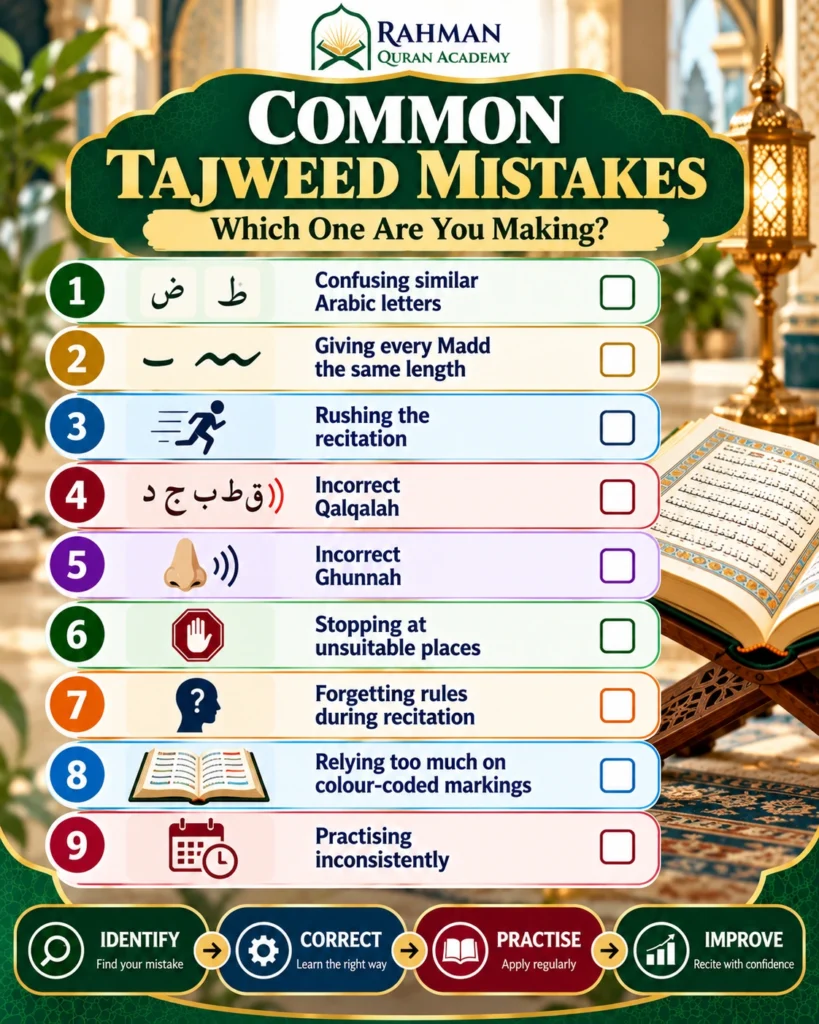
Most Tajweed mistakes fall into a few repeating categories. Find yours, then correct that one.
| Mistake | Why it happens | How to correct it | How to practise |
| Blurring similar letters (ص/س, ط/ت, ق/ك) | The sounds are close, or a habit formed years ago | Slow down, focus on tongue position | Repeat minimal pairs slowly, then in short verses |
| Same Madd length for everything | Madd types are not distinguished | Learn the four types above | Pencil-mark Madd before reciting |
| Rushing | Wanting fluency too early | Prioritise accuracy, then build pace gradually | Recite a short passage slowly, then repeat a little faster |
| Qalqalah with a vowel | The echo becomes a syllable | Release the letter, then stop | Practise on the five letters alone, then in words |
| Missing or over-long Ghunnah | No reference for the length | Match a skilled reciter by ear | Record and compare |
| Stopping at awkward places | Breath runs out | Plan your breath | Practise on one verse at a time |
| Forgetting rules mid-recitation | Recognition is not yet automatic | Use Look, Identify, Apply, Check | Practise recognition separately from full recitation |
| Over-reliance on colours or symbols | Visual cues replace understanding | Try a plain page for short passages | Identify rules aloud without colour |
| Inconsistent practice | Busy schedule | Choose a routine you can actually keep | Short, regular sessions beat rare long ones |
For a deeper breakdown, see common Tajweed mistakes and how to fix them.
How to Practise Tajweed Without Feeling Overwhelmed
Practise one pattern at a time, in short passages, and increase difficulty gradually. No honest source can give one daily-minutes figure that suits every learner, so build a routine around your own week.
A simple process:
- Pick one rule or one problem sound. Not five.
- Choose a short passage or a verse you know well.
- Listen, then repeat. Use a skilled reciter as your reference.
- Practise recognition separately. Read a page and only identify rules aloud, without reciting.
- Record yourself when it helps. Listen back for recurring errors.
- Increase difficulty gradually. Longer passages, less familiar verses.
- Choose consistency over intensity. A routine you can keep beats a heroic week followed by nothing.
On speed: if you read slowly and stop often while applying Tajweed, that is normal while recognition is still being built. Accuracy first. Fluency tends to develop as the patterns become familiar. It is not something to rush, and no honest teacher can promise a date.
How long does it take? There is no fair universal answer. Progress depends on your starting level, your pronunciation foundation, how consistently you practise, what you are aiming for, and whether you receive feedback.
For a full home routine, see practising Tajweed at home.
Can You Learn Tajweed Without a Teacher?
Yes, you can learn a good deal on your own, especially the concepts. The harder part is hearing your own pronunciation errors. That is where outside feedback tends to help most.
What self-study does well:
- explains the rules and terminology
- lets you revisit material at your own pace
- gives you reference recitation to listen to
- suits busy schedules and anyone nervous about being corrected
Where it can fall short:
- You may not be able to hear that your ص is sounding like س.
- A bad habit can be repeated many times before anyone notices.
- It is hard to judge Madd length, Ghunnah or Ikhfa by ear alone.
This does not mean everyone needs a teacher for every stage. A reader working on concepts might do well alone, then add feedback when pronunciation becomes the sticking point. Videos and colour-coded Mushafs can both be useful tools along the way.
For the longer discussion, see learning Tajweed through YouTube and self-study.
If you decide you want a teacher, online Tajweed classes at Rahman Quran Academy are live and one-to-one, and there are three free trial classes so you can try before committing. If your main goal is to improve how you recite across the whole Quran, Quran recitation classes may be the closer fit.
Parents: If you are helping a child learn, the broader guide to teaching the Quran to children may help.
Frequently Asked Questions
What is Tajweed in simple terms?
Tajweed is the set of rules for reciting the Quran accurately: pronouncing each letter correctly, lengthening where required, using nasal sounds where required, and stopping and starting in suitable places.
What are the main Tajweed rules?
The main groups are Makharij and Sifaat (letter pronunciation and qualities), Noon Sakinah and Tanween, Meem Sakinah, Ghunnah, Qalqalah, Madd, and Waqf and Ibtida. Additional rules, such as those for the letters lam and ra, are usually studied afterwards.
How many Tajweed rules are there?
There is no single agreed number. Scholars, textbooks and teachers group and count the rules differently. A more useful goal is to understand the main categories and learn to recognise and apply them.
What should I learn first in Tajweed?
Start with Arabic letters and pronunciation, then Makharij, then the rules in small groups. See the learning order above. Your starting level may change the order.
Can I learn Tajweed by myself?
You can learn the concepts and build a lot of practice by yourself. It is harder to hear your own pronunciation errors, so feedback becomes valuable at that point.
Why do I still make Tajweed mistakes after learning the rules?
Knowing a rule is different from recognising it in the Mushaf and applying it during live recitation. Many learners are stronger at one level than another. Identify which level is weak and practise that one.
How long does it take to learn Tajweed?
There is no universal timeline. It depends on your starting level, pronunciation foundation, practice consistency, goals and access to feedback.
Do I need a teacher to learn Tajweed?
Not for every stage. A teacher is most useful when you cannot hear your own errors or when a pronunciation habit refuses to change.