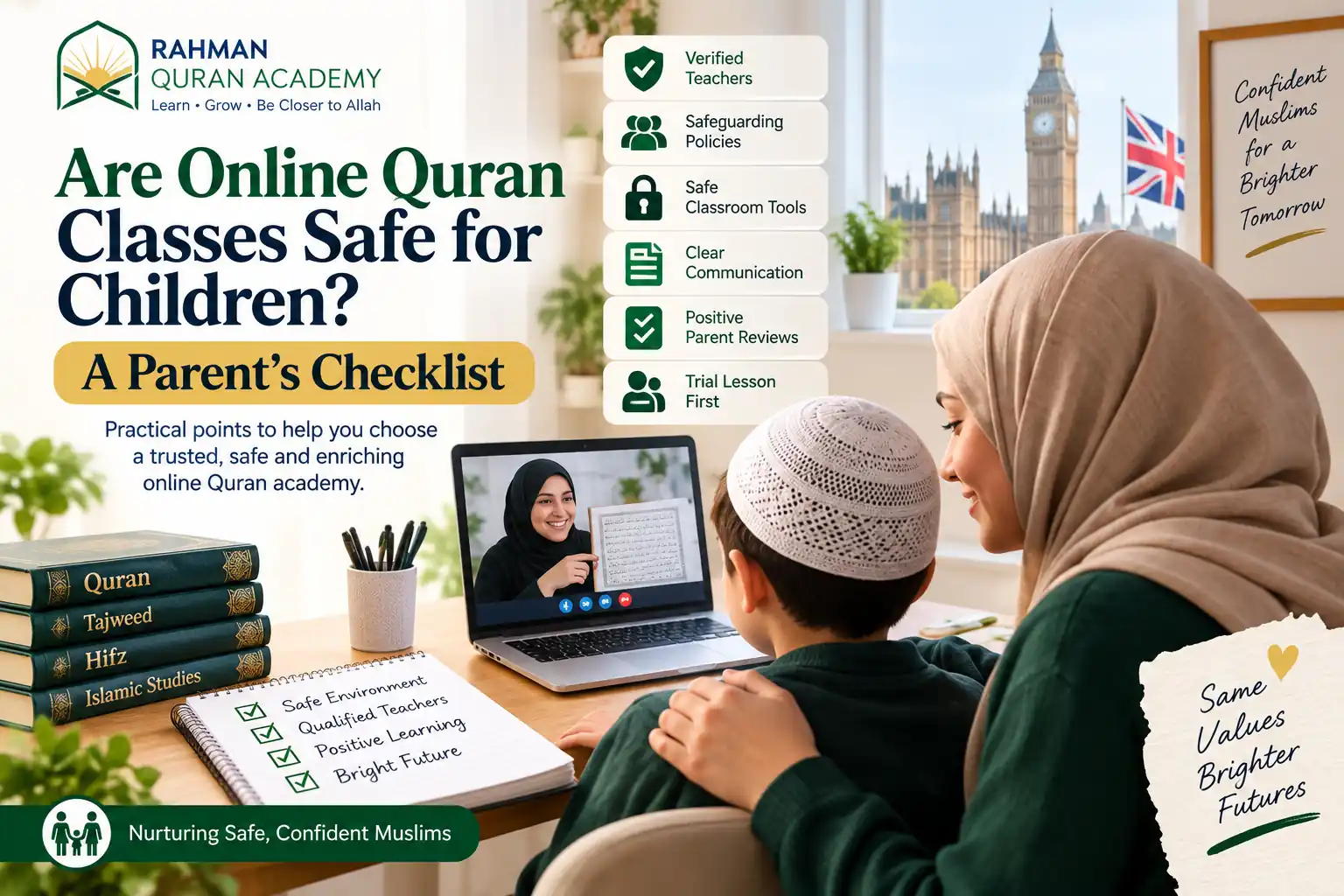
Are Online Quran Classes Safe for Children? A UK Parent’s Checklist
Online Quran classes can be safe for children, but being online does not automatically make a class safe. What makes it safe is what sits underneath it: who is teaching, how the academy screens and manages that teacher, how communication is controlled, how the technology is set up, how your child’s data is handled, and what happens if something goes wrong.
Being “reputable” isn’t something you take on trust. It’s something you check, one layer at a time – the teacher, the academy’s safeguarding system, the communication rules, the technology, the data, the supervision, and the response plan if a concern ever comes up.
For broader guidance on how children progress through Quran learning, see our Teaching the Quran to Children guide.
Are Online Quran Classes Safe for Children?
The Honest Answer
There is no single yes-or-no answer that applies to every academy, every teacher, and every child. Safety depends on the specific setting: this teacher, this academy, this lesson system, this communication approach, and how your own child experiences it.
A well-run online Quran class, with a properly screened teacher, clear safeguarding policies and controlled technology, can be just as safe as a well-run in-person class, sometimes safer, since a parent can be in the next room rather than dropping a child off elsewhere. A poorly managed one, online or in person, carries real risk. The format isn’t the deciding factor; the systems around it are.
What Does “Safe” Actually Mean?
“Safe” is often used loosely, as if a nice-looking website or a five-star review settles the question. In practice, safety is made up of several layers, and a class is only as strong as its weakest one:
• Trusted people – a teacher whose identity and suitability have been properly checked
• Clear safeguarding – a written policy and a named person responsible for it
• Safe communication – defined channels and boundaries between teacher and child
• Controlled technology – who can join a lesson and how access is managed
• Protected child data – what’s collected, why, and who can see it
• Appropriate supervision – matched to your child’s age and personality
• A clear response route – what happens if you or your child raise a concern
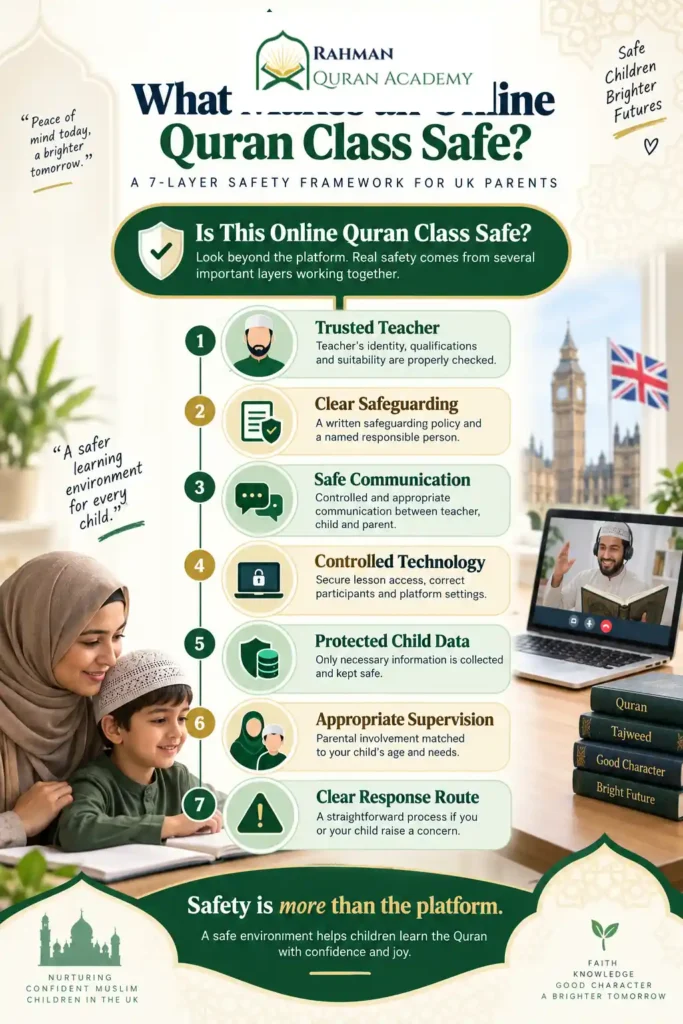
This article works through each layer and gives you concrete questions to ask, rather than a vague instruction to “choose a reputable academy.”
What Should Parents Check Before Choosing a Quran Academy?
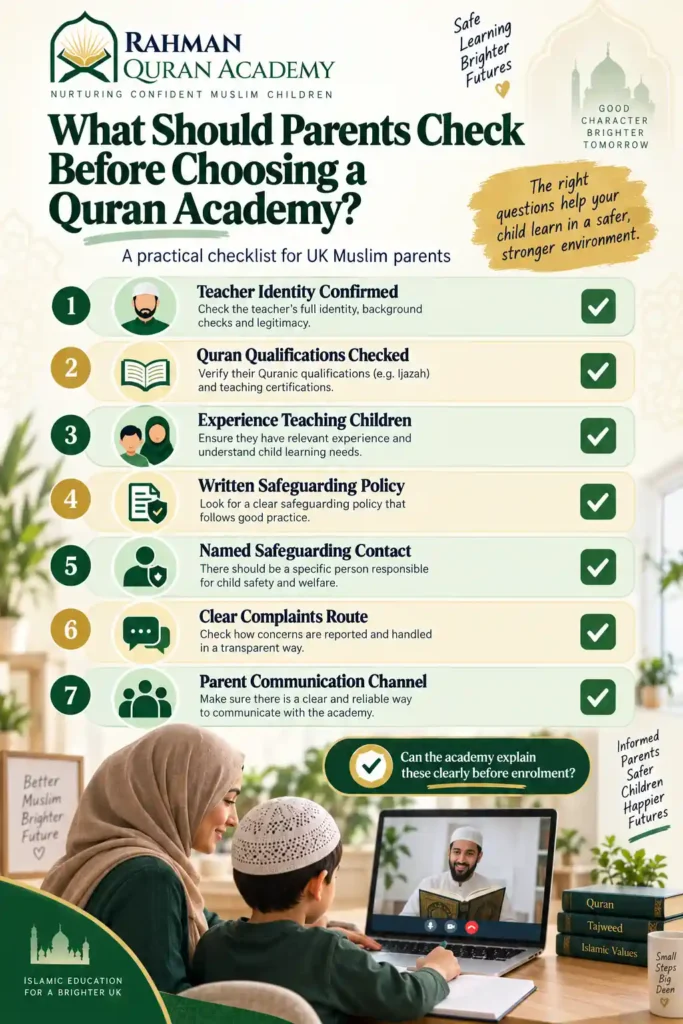
“Reputable” should be something you can verify, not just a feeling the website gives you. Before enrolling, look for four specific things.
Teacher Identity and Qualifications
Ask for the teacher’s full name, their Quran-teaching credentials (such as an Ijazah or sanad), and how long they’ve been teaching children specifically, not just adults. A reputable academy will answer this without hesitation.
Safeguarding Policy and Responsible Person
For parents in England, current Department for Education guidance for out-of-school settings covers supplementary schools, including religious settings and private tuition. It encourages parents to ask about safeguarding arrangements, policies, complaints procedures and who is responsible for safeguarding. Department for Education guidance for parents: Ask the academy who is responsible for safeguarding and how to contact them.
Complaints and Reporting Route
Ask what happens if a parent raises a concern: who receives it, how quickly they respond, and what the escalation process looks like. If the academy can’t describe this clearly, treat that as a gap, not a technicality.
Parent Communication
Find out how the academy itself communicates with you progress updates, scheduling, concerns – and whether that channel is separate from however the teacher communicates with your child.
How Should Parents Verify the Quran Teacher?
What to Ask About DBS and Background Checks
This is the area parents get wrong most often, usually by assuming too much. No blanket law requires every Quran teacher to hold an Enhanced DBS check. Whether a check is available, and at what level, depends on the person’s employment status and the nature of the activity.
Since 21 January 2026, a legal change (an amendment to the Rehabilitation of Offenders Act 1974 Exceptions Order) has allowed eligible self-employed tutors in England and Wales to apply for their own Enhanced DBS check, including a Children’s Barred List check, through a registered umbrella body something previously only an employer could arrange. This closed a long-standing gap, but eligibility rules themselves haven’t changed, and not every teaching arrangement automatically qualifies. Whether a check is available, and at what level, depends on the person’s employment status and the nature of the activity. GOV.UK: Eligibility for roles working with children
Rather than asking “do you have a DBS?” and accepting a yes, ask more precisely:
• What level of check has been completed: Basic, Standard or Enhanced?
• Does it include a Children’s Barred List check?
• When was it issued, and can I see the certificate (with the teacher’s consent)?
• What other safeguarding steps does the academy take alongside it, references, interviews, ongoing supervision?
A DBS certificate is a useful, point-in-time piece of evidence. It is not proof that someone is safe today, will remain safe, or has been checked for time spent outside the UK. Treat it as one input among several, not a guarantee.
Look Beyond Quran Qualifications
Being a Hafiz or holding a strong Ijazah demonstrates Quranic knowledge, not suitability to work safely with children. Ask separately about experience teaching children, how the academy assesses that, and whether the teacher has had any child-specific training.
If Tajweed is one of your child’s learning goals, you can also see what our online Tajweed classes involve.
For a broader look at the qualities that matter when choosing a teacher, see our what makes a good Quran teacher for children guide.
Check Teaching and Communication Boundaries
Ask what the teacher is and isn’t permitted to discuss or do outside the lesson itself – this overlaps with the communication section below, but it’s worth raising directly during enrolment, not assuming it’s covered.
How Much Supervision Does Your Child Need?
There’s no single supervision rule that fits every family. What’s appropriate depends on your child’s age, personality and how the lesson is run.
Younger Children
Younger children generally benefit from a parent being nearby, able to hear the lesson, even if not watching every second of it. This isn’t about distrust; it helps with focus as much as safety, and several UK reviews mention parents finding it useful to stay close by during early lessons. The amount of supervision can also depend on whether your child is learning one-to-one or in a group; our guide to one-to-one vs group Quran classes explains the differences in more detail.
Older and More Independent Children
Older children may reasonably have more independence, provided the basics are in place: you know when the lesson happens, who the teacher is, how communication works, and you remain reachable during the session.
Parent Visibility Without Removing Appropriate Privacy
Supervision doesn’t have to mean sitting beside your child for every minute. Being in the next room, checking in occasionally, and reviewing how the lesson went afterwards can achieve the same purpose without treating an older child like a toddler.
What Should Parents Check About the Online Lesson Setup?
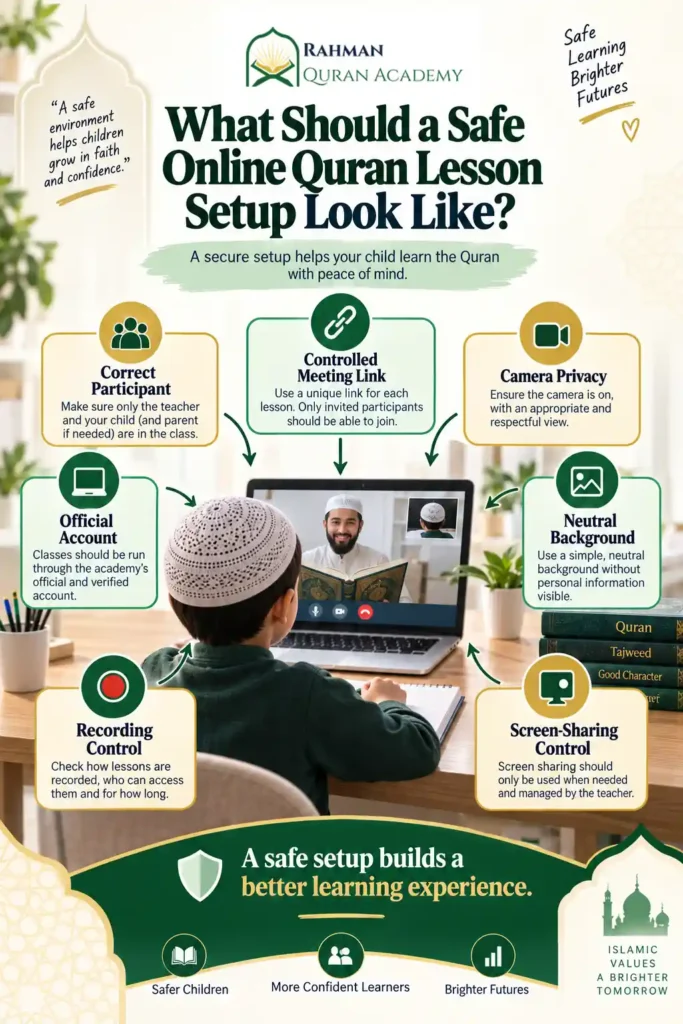
The platform itself Zoom, WhatsApp video, Google Meet or anything else is only one layer. “Is this app safe?” isn’t really the right question; how it’s configured and managed is what matters.
Meeting Links and Participant Access
Ask whether each lesson uses a unique, non-reusable link or code, who can access it, and whether the academy controls who is allowed to join a session.
Camera, Microphone and Background Privacy
Ask whether screen sharing and recording are controlled by the academy or left open to anyone in the call. On your side, keep the camera angled so the background is neutral: no bedroom, no visible documents, nothing identifying.
Personal Devices and Accounts
Check whether the teacher is expected to use an official academy account for lessons, rather than a personal number or account that could later be used to contact your child directly.
Communication Outside the Lesson
Confirm whether any contact outside the scheduled lesson time is expected, and through which channel. This is covered in more depth in the communication section below.
What Happens to Your Child’s Recordings and Personal Data?
Recording isn’t automatically good or automatically bad. It can support accountability, but it also creates an additional piece of information about your child that then has to be protected properly.
Are Lessons Recorded?
Ask directly whether lessons are recorded, and if so, why for quality checks, dispute resolution, or another specific reason. “We’ve always done it that way” isn’t a real answer.
Who Can Access Recordings?
Ask who can view a recording, how it’s stored, and whether it’s ever shared with anyone outside the academy.
What Personal Information Is Collected?
An academy may need information such as your child’s name, age, contact details, learning level and progress records to provide its service. The ICO’s Children’s Code includes data-minimisation principles, meaning providers should collect and retain only the personal data needed for the service. ICO: Data minimisation under the Children’s Code Ask what information is collected, why it is needed, who can access it and how long it is kept.
How Long Is Information Kept?
Ask how long recordings and personal data are retained, and what happens to them if your child stops lessons. A written privacy notice is a reasonable thing to expect and request.
What Should Safe Teacher Communication Look Like?
This is one of the most important areas for parents to understand clearly, because it’s where warning signs most often first appear.
Appropriate Lesson Communication
Communication between a teacher and your child should generally be lesson-related, happen through an approved channel, and be visible or accountable to you or the academy where relevant, not hidden.
Private Messages and Personal Accounts
Ask directly: can the teacher message my child privately? Is WhatsApp or a personal social media account used, and if so, is a parent included or copied in? A teacher moving communication onto a personal account, unprompted, is a boundary worth questioning.
Requests for Secrecy
A request for a child to keep communication, gifts or conversations secret from a parent is a serious warning sign that deserves attention. NSPCC: What parents need to know about sexual grooming
Social Media Boundaries
Ask whether teachers are permitted to follow, add or message students on personal social media accounts. A clear “no” is a good sign; vagueness is not.
None of this means every direct message is abuse; a quick “running five minutes late” text is normal. Context and pattern matter more than any single message.
What Warning Signs Should Parents Never Ignore?
Most online Quran teachers are exactly what they present themselves to be: dedicated, patient people teaching a subject they care about. Community discussions among Muslim parents include isolated accounts of harsh correction or uncomfortable behaviour – these are individual experiences, not evidence that this is common. Still, it’s worth knowing what to watch for.
Requests for Secrecy
“Don’t tell your mum/dad about this”, in any form, about any topic.
Unexpected Private Contact
Messages, calls or contact requests outside the agreed lesson channel, especially ones a parent wasn’t told about.
Unnecessary Personal Questions
Questions about your child’s life, home or feelings that have no obvious connection to the lesson.
Resistance to Reasonable Parent Involvement
Discomfort or pushback when you ask to sit in, ask questions, or request a recording explanation.
Humiliation, Threats or Intimidation
Harsh correction, mockery or fear-based pressure. Firm but respectful correction is normal; humiliation is not.
Unknown Participants or Unexplained Recording
Anyone joining a lesson your child doesn’t recognise, or recording happening without a clear explanation.
One sign, taken alone, often has an innocent explanation. A pattern of several, especially combined with secrecy, is what to act on.
What Should Parents Do If Something Concerns Them?
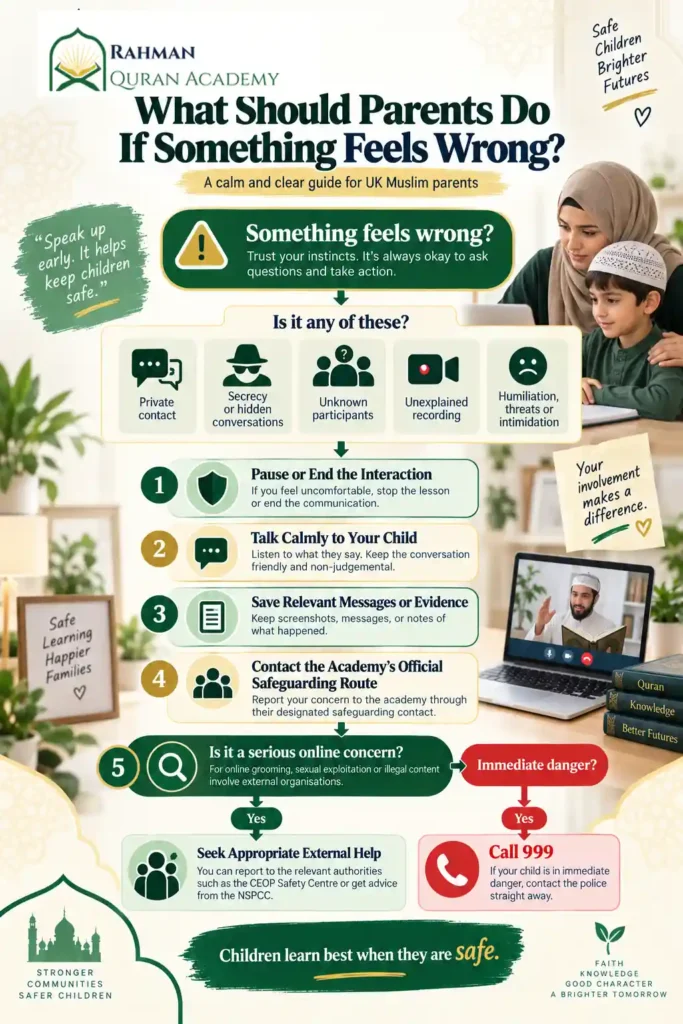
If something feels wrong, the goal is to respond calmly and correctly, not to investigate the matter yourself.
Pause or End the Interaction
If needed, end the lesson or contact immediately. Your child’s comfort comes first.
Talk to Your Child Calmly
Ask open, non-leading questions: “Did you feel comfortable?” “Did anything make you uncomfortable?” “Did anyone ask you to keep something secret?” Avoid suggesting an answer or reacting with visible alarm, which can make a child clam up.
Keep Relevant Messages or Evidence
Save screenshots, messages or recordings rather than deleting them, even if they’re upsetting to look at.
Contact the Academy’s Official Safeguarding Route
Raise it through the designated safeguarding lead or official complaints process you identified before enrolling.
Escalate Serious Concerns Appropriately
For online grooming or sexual exploitation concerns, you can report directly to the CEOP Safety Centre. The NSPCC Helpline (0808 800 5000) can also advise on any safeguarding worry. If your child is in immediate danger, call 999.
Don’t investigate allegations yourself by confronting the teacher directly or interrogating your child for details – report through the proper channels instead.
How Can You Test an Academy Before Enrolling?
A trial lesson is useful for more than judging teaching quality. Treat it as a safety check as well.
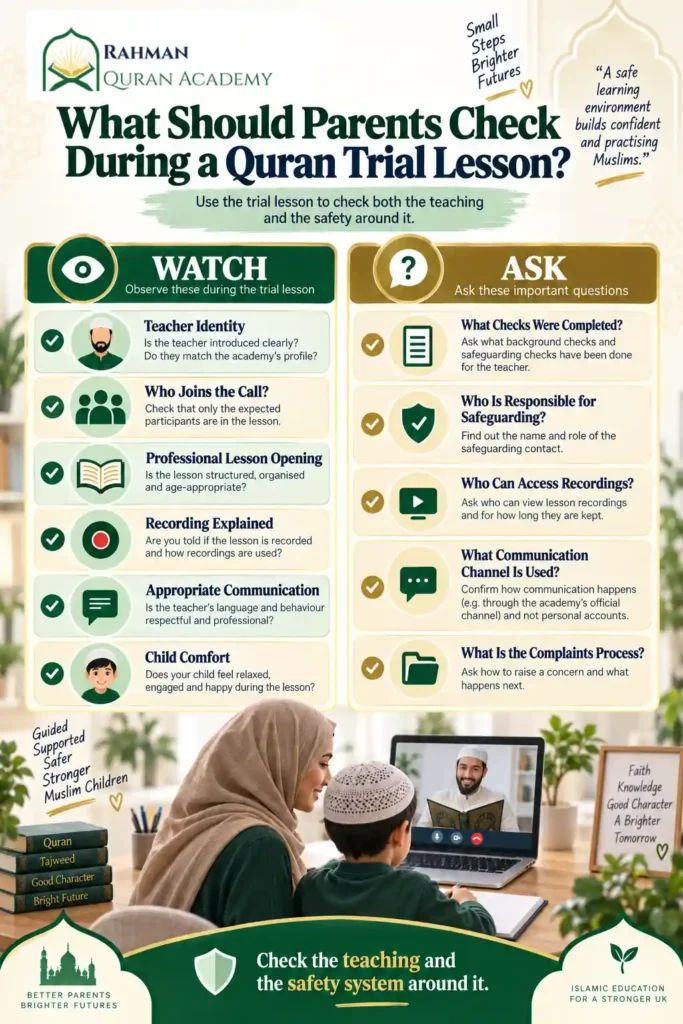
What to Watch in a Trial Lesson
• Who joins the call, and does the teacher confirm their identity clearly
• How the lesson opens – professionally, on time, with a clear structure
• Whether any recording is mentioned and explained upfront
• Whether the teacher is patient and age-appropriate in tone
• Whether you’re able to ask questions without friction
Questions to Ask Before Joining
• What checks have been completed on this teacher, and at what level?
• Who is the designated safeguarding lead, and how do I contact them?
• Is the lesson recorded, and if so, who can access it?
• What communication channel will the teacher use outside lessons, if any?
• What is the complaints process if I have a concern later?
What to Ask Your Child Afterwards
Once the lesson ends, ask your child how it felt, not just whether they enjoyed it: “Did you feel comfortable with the teacher?” “Was there anything that felt strange?” Their answer, alongside what you observed, tells you more than the sales page ever will.
Should Parents Review Safety After the First Month?
Safeguarding isn’t a one-off box ticked at enrolment. Circumstances, teachers and comfort levels can all shift over time.
Check the Teacher Relationship
Has the relationship stayed professional and appropriate? Has anything about the tone or content of lessons changed?
Review Communication and Privacy
Check that communication is still happening through the agreed channel, and that no informal private contact has crept in.
Ask Your Child Again
Ask the same calm, open questions again; comfort levels and willingness to speak up can change over weeks, even if nothing was wrong at first.
Change Arrangements if Something No Longer Feels Right
If something feels off, you’re entitled to pause lessons, request a different teacher, or leave the academy altogether. Reasonable providers won’t make this difficult.
Final Parent Safety Checklist
• Teacher’s identity, qualifications and experience teaching children confirmed
• Relevant background checks discussed level, date, and what they do and don’t cover
• Written safeguarding policy exists and was shared or explained
• Named safeguarding contact identified
• Complaints and reporting route explained clearly
• Communication rules (channel, boundaries, private messaging) confirmed
• Appropriate parent visibility agreed, matched to your child’s age
• Lesson access controlled via unique links, no unexplained participants
• Recording policy explained purpose, access, retention
• Privacy and data questions answered, ideally with a written policy
• Child’s comfort checked before, during and after the trial
• Warning signs understood and taken seriously if they appear
• Response route known in advance, before it’s ever needed
If an academy can’t answer basic safeguarding questions clearly, don’t rely on reassurance alone; ask again, or look elsewhere.
Frequently Asked Questions
Are online Quran classes safe for children?
They can be, but safety depends on the specific teacher, academy and systems in place, not the format itself. Verify the layers set out in this guide rather than assuming safety from a website or price alone.
How can I check whether an online Quran teacher is trustworthy?
Confirm their identity and qualifications, ask about relevant background checks and experience teaching children, and review how the academy handles safeguarding, communication and complaints.
Does an online Quran teacher need a DBS check?
There’s no blanket legal requirement covering every Quran teacher. Whether a check applies, and at what level, depends on their employment status and role. Since January 2026, eligible self-employed tutors in England and Wales can apply for their own Enhanced DBS check through a registered umbrella body. GOV.UK: DBS checks for self-employed people and personal employees
Ask what level of check has been completed rather than assuming “DBS checked” means fully vetted.
Should parents sit with their child during online Quran classes?
It depends on the child’s age and the lesson model. Younger children often benefit from a parent being nearby; older, more independent children may need less direct supervision as long as communication and access are properly controlled.
Can a Quran teacher privately message my child?
This should be defined clearly by the academy before you enrol. Unapproved private messaging, especially on personal accounts, is a boundary worth questioning directly.
Are online Quran lessons recorded?
Some academies record lessons, and some don’t. Recording isn’t automatically safer or less safe; ask why lessons are recorded, who can access the recordings, and how long they’re kept.
How is my child’s personal information protected?
Ask what data is collected, why it’s needed, who can access it, and how long it’s retained. Under the ICO’s Children’s Code, providers should collect and keep only what’s genuinely necessary.
What should I do if I have a safeguarding concern?
Contact the academy’s official safeguarding or complaints route first. For serious online grooming or exploitation concerns, report to CEOP; for immediate danger, call 999.
What’s Next
Once you’re satisfied with an academy’s safeguarding, communication and teaching arrangements, the next step is comparing the wider learning experience, teaching style, structure and fit for your child. You can also explore our Quran classes for kids to see the kind of online learning options available for children, or read our How to Choose Online Quran Classes for Your Child in the UK guide for the wider selection process.