
One-to-One vs Group Quran Classes for Children: Which Is Better?
Neither format is automatically better for every child. One-to-one classes usually provide more individual attention, personalised pacing and direct correction, while a well-managed small group can offer peer interaction, shared motivation and a lower cost per child. The better choice depends on your child’s level, learning goal, need for correction, personality, ability to stay engaged in a group, and the actual class size.
Real parent experiences reflect this. Some parents report that their child struggled to focus in group Zoom classes but did much better with individual attention, while other families found their children did perfectly well learning online in a shared setting.
For a broader guide to teaching the Quran at different stages, see our [Teaching the Quran to Children: A Complete Guide for Parents].
What Is the Real Difference Between One-to-One and Group Quran Classes?
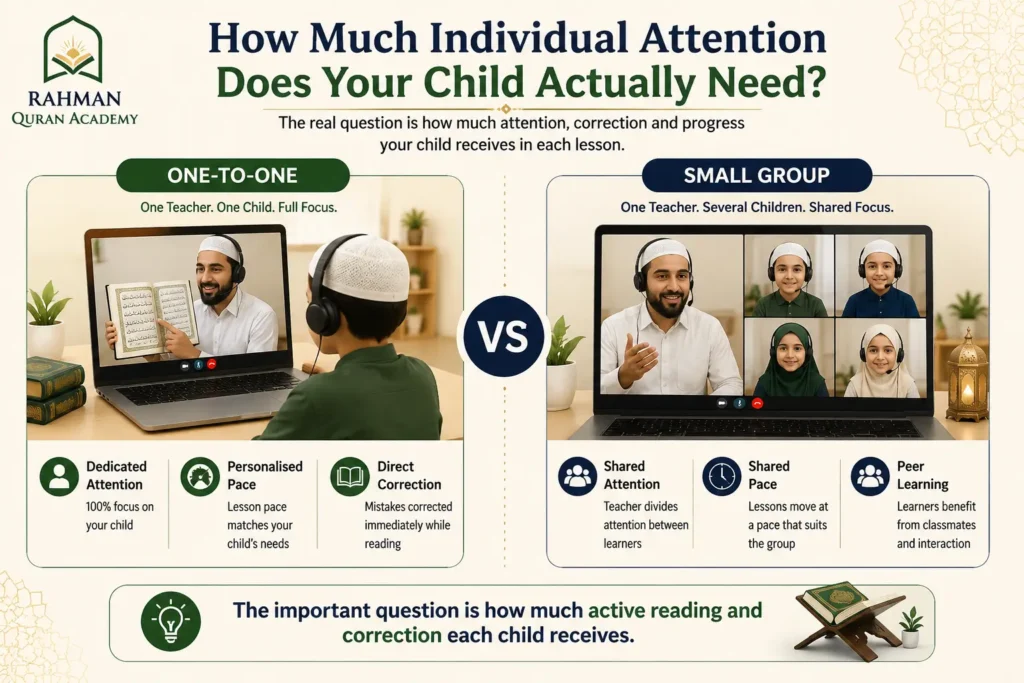
In a one-to-one class, one teacher works with one child; pace, correction and listening time all belong entirely to that child. In a group class, the teacher’s attention is distributed across several learners, with a shared lesson pace and turn-taking for recitation.
This doesn’t mean a group means less learning. The meaningful question isn’t the format label; it’s how much active reading, correction and teacher interaction each child actually receives during the lesson.
How One-to-One Classes Work
The teacher listens to one child read, corrects as they go, and adjusts the pace and content to that child’s level in real time, with no need to share time with anyone else.
How Group Classes Work
The teacher manages several children together, dividing attention between them, taking turns for recitation, and often teaching shared content that suits the group as a whole.
For a closer look at what makes online Quran classes effective for children, see our [online Quran classes for children] guide.
What Does “Small Group” Actually Mean?
“Group” isn’t one category; two children learning together is a very different experience from eight or ten. In UK education research, the Education Endowment Foundation (EEF) defines small-group tuition as roughly 2–5 pupils, though that’s an evidence definition built around school tutoring, not a universal rule for Quran classes.
One-to-One vs Group Quran Classes: Quick Comparison
| Factor | One-to-One | Small Group |
| Teacher attention | Dedicated to one child | Shared between pupils |
| Pace | Fully personalised | Shared with the group |
| Correction | Continuous opportunity for individual correction | Teacher divides correction across pupils |
| Reading time | Potentially higher | Shared between pupils |
| Peer interaction | Low | Higher |
| Cost per child | Usually higher | Usually lower |
| Best for | Targeted individual support | Matched learners and social learning |
| Group-level dependency | None | Important |
| Shy child | Private environment | Depends on the child |
| Similar-level siblings | Not required | Can work well |
This is a general guide to the trade-offs, not a guarantee. A well-run group can outperform a poorly matched one-to-one class, and vice versa; one-to-one doesn’t automatically mean faster results.
How Much Individual Attention Does Your Child Actually Need?
Parents aren’t really choosing a format; they’re choosing how much attention, correction and progress their child needs. That’s the question worth answering first.
Does Your Child Need Frequent Correction?
If your child has recurring reading or Tajweed issues, one-to-one has a practical advantage, simply because the teacher’s attention isn’t divided. See our guide to Quran reading mistakes for more on identifying these.
Quran-reading research also highlights the importance of teacher modelling and direct feedback when helping learners develop accurate Tajweed and recitation.
Does Your Child Need a Different Pace?
A child who needs things explained more than once, or more repeated practice than their peers, may benefit from a pace that adjusts to them specifically rather than to a group average.
How Much Time Does Your Child Actually Spend Reading?
This is worth asking directly of any class you’re considering: in a group lesson, how much of the actual time does each child spend reciting? The answer varies a great deal by class size and teaching style; there’s no fixed figure to expect.
Can Your Child Learn While Waiting for Other Children?
Some children stay engaged and even learn by listening while a peer reads. Others lose focus quickly once it isn’t their turn. Community discussions among parents show this varies a great deal from child to child.
When Is One-to-One Quran Learning Likely to Be the Better Fit?
Your Child Is a Beginner Who Needs Frequent Support
If foundational skills are still developing, individual correction can be genuinely useful in the early stages. See how to start teaching your child the Quran for more on this stage.
Your Child Needs Frequent Pronunciation or Tajweed Correction
When a child needs consistent, immediate correction, undivided teacher attention makes that easier to deliver.
Your Child’s Pace Is Very Different From Other Learners
A personalised lesson can slow down or speed up without needing to wait for, or hold back, a group.
Your Child Is Shy or Hesitates to Read Aloud
This doesn’t mean every shy child needs private lessons. A private setting may reduce social pressure for some children, while other children actually gain confidence from supportive peers. Parent discussions show children respond very differently; it depends on the individual child.
Your Child Has a Focused Hifz Goal
Intensive memorisation and revision can benefit from dedicated teacher listening, since accuracy checking is easier one-to-one. This doesn’t mean group Hifz can’t work; see below.
When Can Group Quran Classes Be the Better Fit?
Your Child Is Comfortable Reading in Front of Others
If your child is confident reciting with peers listening, a group setting won’t hold them back.
Learners Are at Similar Levels
When everyone in the group reads at a comparable level, the shared pace suits the whole class rather than leaving anyone behind or under-challenged.
Your Child Benefits From Peer Interaction
Some children are more motivated and learn more happily alongside others their own age.
Shared Practice Helps Motivation
Hearing classmates recite and progress can encourage a child to keep going, in a way solo lessons sometimes don’t.
Cost Is an Important Consideration
Group classes are usually more affordable per child, which matters for many families without being a compromise on quality by itself.
Siblings Have Similar Levels and Goals
When siblings are genuinely matched in level and pace, learning together in a small group can work well for the whole family.
Does Group Size Matter More Than the Label “Group”?
A group of two children is a very different experience from a group of five, and different again from a group of eight to twelve. The label “group” on its own tells you very little; the actual size and how it’s run matter far more.
The EEF’s evidence framework defines small-group tuition as roughly 2–5 pupils, and its research finds that effectiveness depends heavily on group size and how well the sessions are implemented, not on the group format alone.
Questions worth asking any academy about group size:
● How many children will actually be in the class?
● Are they at a similar Quran level?
● Does each child recite during every lesson?
● How is individual correction handled?
● What happens if one child is far behind the others?
This tells you far more than simply being told: “small groups are better.”
Which Is Better for Quran Reading and Tajweed?
A 2026 study of 29 eighth-grade students examined an individualised Qur’anic recitation approach in which students recited directly to the teacher and received immediate, specific feedback on makhraj and Tajweed.
For intensive individual recitation and correction, one-to-one has a practical advantage, because the teacher can concentrate fully on one child’s reading. A properly managed small group can still work well when learners are matched, and each child gets meaningful recitation time.
Quran Reading
Format mainly affects how much correction and reading time your child gets. See Quran reading mistakes for details on correcting specific issues.
Tajweed
Individual correction is easier to deliver one-to-one, though this isn’t the place to re-teach Tajweed rules; see our Tajweed Classes for structured practice.
Fluency and Confidence
Format can affect how much repeated, guided reading practice a child gets. See our guide on Quran reading fluency for how to build this regardless of format.
Which Is Better for Hifz?
One-to-one can be particularly useful when a child needs frequent individual listening, memorisation checking and revision planning. A well-run group can still work when learners are closely matched in pace and memorised portion. See our Hifz Classes for more.
New Memorisation
New memorisation usually benefits from close, immediate listening easier to provide consistently one-to-one.
Revision
Revision needs accurate checking against what’s already memorised, which individual attention makes easier to track.
Group Hifz
Group Hifz can still work well when the children involved are memorising at a similar pace and stage, with clear individual tracking of each child’s progress.
What If Your Child Is Shy, Easily Distracted or Highly Social?
Shy Child
Worth observing: their willingness to read aloud, their comfort with being corrected in front of others, and whether group peers seem to motivate or intimidate them.
Easily Distracted Child
Worth asking: can they hold attention while others are reading? Do they need frequent redirection? Does the teacher notice and respond when they disengage?
Socially Motivated Child
A group can offer peer interaction, a shared routine and social encouragement that some children respond well to.
None of this is a behavioural diagnosis, just practical signs worth noticing. Parent discussions repeatedly show that child fit varies, rather than one format being universally best.
Is One-to-One Quran Learning Worth the Extra Cost?
It can be worth paying more when the additional individual attention solves a genuine learning problem, but that’s a judgement based on your child’s actual needs, not a general rule.
What the extra cost can buy:
● Individual teacher time
● A fully personalised pace
● More direct, immediate correction
● Less waiting between turns
● Targeted practice on specific issues
● Flexible adaptation lesson to lesson
What group classes offer instead:
● Shared teacher time
● A peer learning environment
● Lower cost per child
● Shared activities and motivation
Private classes aren’t automatically “worth it” for every family; it depends on whether the extra attention is actually solving something your child needs.
Can Siblings Learn Quran Together?
When Siblings Are Well Matched
If siblings share a similar Quran level, pace, goal and learning style, learning together in a group can work well.
When Separate Lessons Make More Sense
If siblings differ meaningfully in level, pace, Tajweed needs, or Hifz targets, separate support may serve each child better.
Example: Sibling A is a beginner, still building basic reading. Sibling B is already reading fluently. Grouping them simply because they’re siblings would likely under-serve one of them; the match matters more than the relationship.
Can a Child Switch From Group to One-to-One Later?
Yes. Format doesn’t have to be permanent; it can change as your child’s needs change.
Reasons families switch to one-to-one:
● Progress stalls
● Correction issues keep repeating
● The child needs a different pace
● The child isn’t getting enough reading time
● Hifz becomes more intensive
● The child becomes uncomfortable in the group
Reasons families switch to group:
● The child becomes more confident
● A well-matched peer group becomes available
● Social learning becomes genuinely useful
● The family wants lower-cost maintenance learning
The best format for your child now isn’t necessarily the best format in a year, and that’s fine.
Could a Hybrid Approach Work Better?
For some families, combining formats works better than choosing one exclusively.
● One-to-one Quran reading, plus group Islamic Studies
● One-to-one Tajweed correction, plus group revision
● Individual beginner support, moving to group once the foundation is solid
● Private Hifz monitoring, plus small-group reinforcement
A hybrid isn’t automatically the best option for every family either; it’s worth considering when your child’s needs genuinely span both kinds of support.
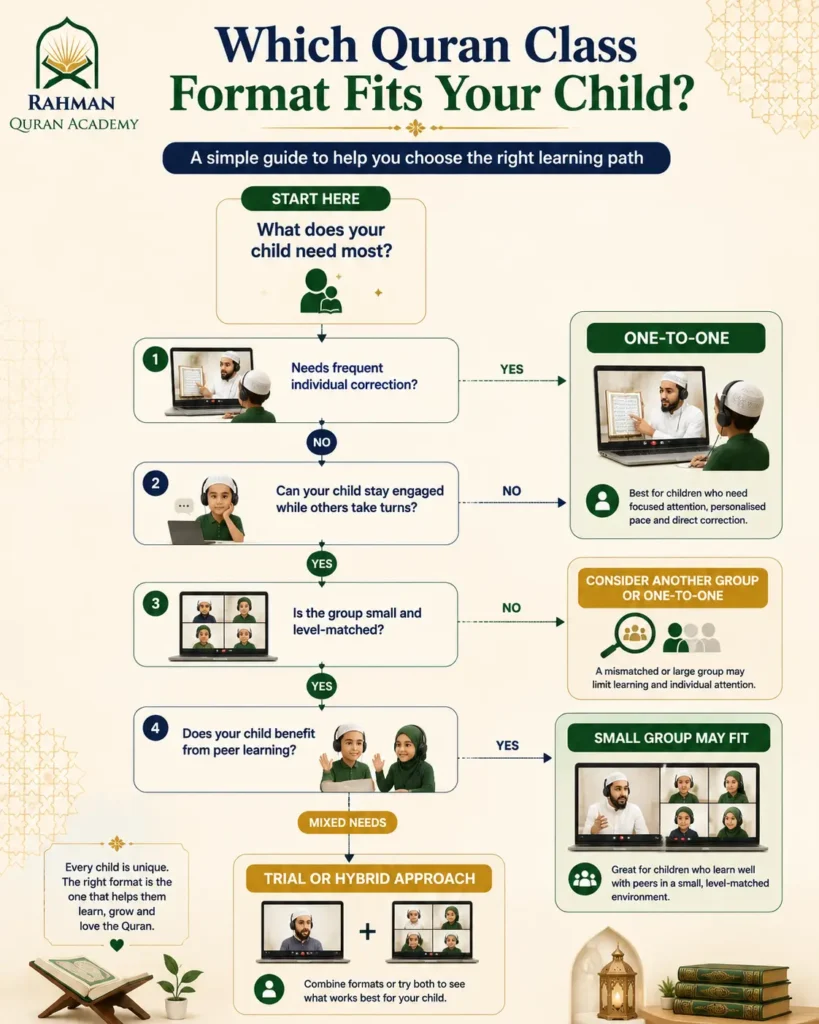
How to Choose the Right Format for Your Child
What Is Your Child’s Current Quran Level?
Beginner, developing, or already confident this shapes how much individual correction is likely to matter.
What Is the Main Goal?
Quran reading, Tajweed, fluency, Hifz or revision each has slightly different demands. See our guides on Quran reading mistakes and Quran reading fluency for more detail on specific goals.
How Much Individual Correction Is Needed?
More frequent, specific correction needs tend to favour one-to-one attention.
Can Your Child Stay Engaged While Others Take Their Turns?
This is one of the most practical predictors of how a child will do in a group setting.
Is the Group Level-Matched?
A mismatched group can undermine even a well-taught lesson, regardless of group size.
Does Your Child Prefer Private Support or Peer Learning?
Some children simply focus and thrive better one way than the other worth factoring in honestly.
Is the Higher Cost of One-to-One Justified by a Real Need?
Worth asking plainly: is the extra attention solving an actual problem, or would a well-matched group do just as well?
How Many Children Are Actually in the Group?
Always worth confirming the real number; “small group” can mean very different things between academies.
A simple way to think about it:
● Mostly individual-support needs → one-to-one is likely to fit better.
● Mostly social or shared-learning needs, with a genuinely matched group → small group may suit well.
● A mix of both → worth trialling a format, or considering a hybrid approach.
How Much Attention Does Your Child Actually Get?
It helps to picture the attention itself, not just the format label.
One-to-One
Teacher ↔ Child
Small Group
Teacher ↔ Child A
Teacher ↔ Child B
Teacher ↔ Child C
Teacher ↔ Child D
The important question isn’t which diagram looks better on paper; it’s how much active reading and correction each child receives in practice. That depends on class size and how the lesson is actually run, not the format label alone.
What Should Parents Check During a Trial Class?
This is where the decision becomes concrete rather than theoretical. During a trial, it’s worth watching for:
☐ How much time did my child actually spend reading?
☐ Did the teacher correct my child’s mistakes?
☐ Was the correction specific and understandable?
☐ Did my child stay engaged while other children participated?
☐ Was the lesson pace suitable?
☐ Were the other students at a similar level?
☐ Did my child feel comfortable attempting to read or answer?
☐ Did the teacher explain what my child needs to work on next?
This is a decision tool for judging fit, not a checklist for choosing between providers.
For more on the qualities to look for in a Quran teacher, see our guide to what makes a good Quran teacher for children.
Frequently Asked Questions
Is one-to-one Quran learning better for children?
Not automatically. It tends to suit children who need frequent individual correction, a different pace, or extra support, but a well-matched group can also work well for other children.
Are group Quran classes good for children?
They can be, particularly when the group is level-matched, appropriately sized, and each child gets meaningful reading time.
How many children should be in a Quran group?
There’s no universal number. Education research generally uses 2–5 pupils as a definition of small-group tuition, but for Quran classes the more important question is whether each child gets enough individual reading and correction time.
Is one-to-one Quran learning worth the extra cost?
It can be, when individual attention solves a genuine need, such as frequent correction, a mismatched pace, or intensive Hifz support, for example.
Which is better for Quran beginners?
Beginners who need frequent correction often benefit from one-to-one support, though a small, well-matched beginner group can also work.
Which is better for Tajweed?
One-to-one makes it easier to deliver immediate, individual correction, though a matched small group with genuine turn-taking can still support Tajweed development.
Which is better for Hifz?
One-to-one is often useful for close listening and revision tracking, but group Hifz can work well when learners are memorising at a similar pace.
Can siblings learn Quran together?
Yes, when they’re genuinely matched in level, pace and goals. If they differ significantly, separate lessons usually serve each child better.
Can a child switch from group to one-to-one?
Yes, the format doesn’t need to be permanent, and many families adjust it as their child’s needs change.
What if my child is shy in group Quran classes?
Some shy children do better with the privacy of one-to-one lessons, while others gradually build confidence through supportive peers; it depends on the individual child.
Still unsure which format suits your child? Our Kids Quran Classes include a free trial, so you can see how the class works and judge the fit before deciding.