

How to Help Your Child Read the Quran More Fluently
Quran reading fluency means reading the Quran accurately, steadily and with growing smoothness, not simply reading fast. Accuracy always comes first, because pace can only develop safely once your child’s letters and sounds are secure. The most effective method is short, guided, repeated reading: a passage is modelled, your child reads it, one priority issue is corrected, and the passage is read again. Real progress shows not just on familiar pages, but when your child reads something they haven’t seen before.
What Is Quran Reading Fluency for Children?
Fluency is accurate, steady and increasingly smooth reading, with fewer unnecessary pauses and less prompting from you. It is not simply reading quickly.
Fluency Is Not the Same as Speed
A child who reads fast but skips details or guesses at words isn’t reading fluently; they’re reading carelessly. A child who reads slowly but accurately has a stronger foundation, because a natural pace can be built on top of accuracy. Genuine fluency is controlled: your child reads at a pace they can sustain without losing precision.
Picture two children reading the same page. One finishes quickly but slides over several words. The other reads more slowly, gets every word right, and pauses only where the text calls for it. The second child is closer to real fluency, even though they took longer because their reading has something solid to build on.
This also aligns with the Quranic instruction to recite with measured recitation (Quran 73:4).
For a broader overview of teaching your child at every stage, see our guide on teaching the Quran to children.
Is Your Child Struggling With Fluency or Basic Quran Reading?
A child who cannot recognise letters, repeatedly mispronounces them, or misses basic reading signs has an accuracy or foundation problem. A child who can read accurately but hesitates, pauses unnecessarily, or struggles to keep a steady flow is more likely to have a fluency problem.
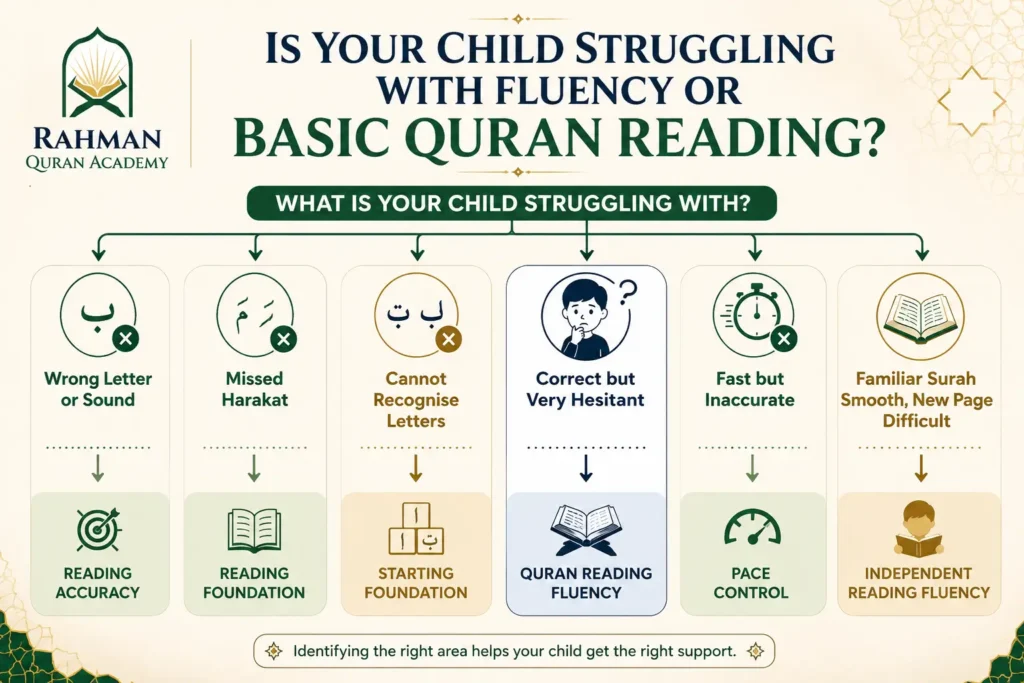
If Your Child Still Mispronounces Letters
Recurring mistakes with specific letters or sounds point to a pronunciation issue rather than a fluency one. See our guide to Quran reading mistakes for how to correct these before working on flow.
If Your Child Cannot Recognise Letters Easily
If letter recognition itself is shaky, fluency practice will only add pressure to an unfinished foundation. Our guide on how to start teaching your child the Quran covers this earlier stage.
If Your Child Reads Accurately but Hesitates Often
This is the core fluency problem this article addresses. Your child knows the words but stops, restarts, or waits for encouragement before continuing, even on text they’ve read before.
If Your Child Reads Fast but Accuracy Falls
Speed that costs accuracy isn’t progress. Slow the pace back down, restore accuracy, and only then look at building it back up gradually.
If Familiar Surahs Are Smooth but New Pages Are Difficult
Smooth recitation of a memorised Surah doesn’t always mean independent reading is strong; memory can be doing some of the work. We cover this in detail further down.
At a glance:
| What parent notices | Primary focus |
| Wrong letter or sound | Accuracy → Quran reading mistakes |
| Missed Harakat | Foundation → Quran reading mistakes |
| Cannot recognise letters | Starting foundation → how to start teaching |
| Correct but very hesitant | Fluency (this article) |
| Fast but inaccurate | Pace control |
| Familiar Surah smooth, new page difficult | Independent reading fluency |
What We Check Before Calling It a Fluency Problem
When a child reads slowly, we first check whether the difficulty is actually fluency or whether an underlying reading issue is getting in the way. We listen for repeated pronunciation or recognition problems, missed Harakat, unnecessary pauses and how the child manages unfamiliar text. If the child can read accurately but still hesitates or reads word by word, we focus on fluency. If basic reading accuracy is still inconsistent, we address that foundation first rather than simply asking the child to read faster.
In our lessons, we usually listen to a short unfamiliar passage rather than judging fluency only from a memorised Surah. This helps us see whether the child can maintain a steady flow without relying on memory.
Why Do Children Struggle With Quran Reading Fluency?
Reading Still Takes Too Much Mental Effort
When your child is still working out each letter and sound, there’s little mental space left for smooth, connected reading. Effortful decoding and fluent reading rarely happen together; one has to become automatic before the other develops.
Too Many Pauses Break the Flow
Some pausing is correct; proper stopping points (Waqf) are part of good recitation. The problem is pausing that has nothing to do with the text: hesitating mid-word, stopping out of uncertainty, or waiting to be told the next sound.
Reading Word by Word
Choppy, word-by-word reading can be a normal stage on the way to smoother reading, especially while a child is still developing automatic recognition. The aim is to gradually move from reading each word separately towards a steadier flow, without sacrificing accuracy or correct recitation.
Practice Is Too Long or Too Unfocused
More practice time doesn’t automatically mean more progress. Repeating the same page for twenty unfocused minutes can reinforce hesitation just as easily as fix it. Shorter, targeted practice focused on the actual sticking point can be more useful than simply adding more practice time.
The Child Tries to Read Faster Than Accuracy Allows
Pressure to keep up with a sibling, a class, or a schedule can push a child to read faster than their accuracy allows. This usually makes fluency worse, not better.
The Child Rarely Reads Unfamiliar Passages
If practice always returns to the same well-known pages, your child never gets to build the independent reading skill that fluency actually depends on.
Confidence and Excessive Correction
Frequent interruptions or comparisons with how quickly someone else reads may make some children more hesitant to keep reading aloud. Some parents describe their child slowing down or freezing up specifically after being corrected too often, a common concern and one worth being mindful of, though it isn’t a fixed outcome.
How Can You Help Your Child Read the Quran More Fluently?
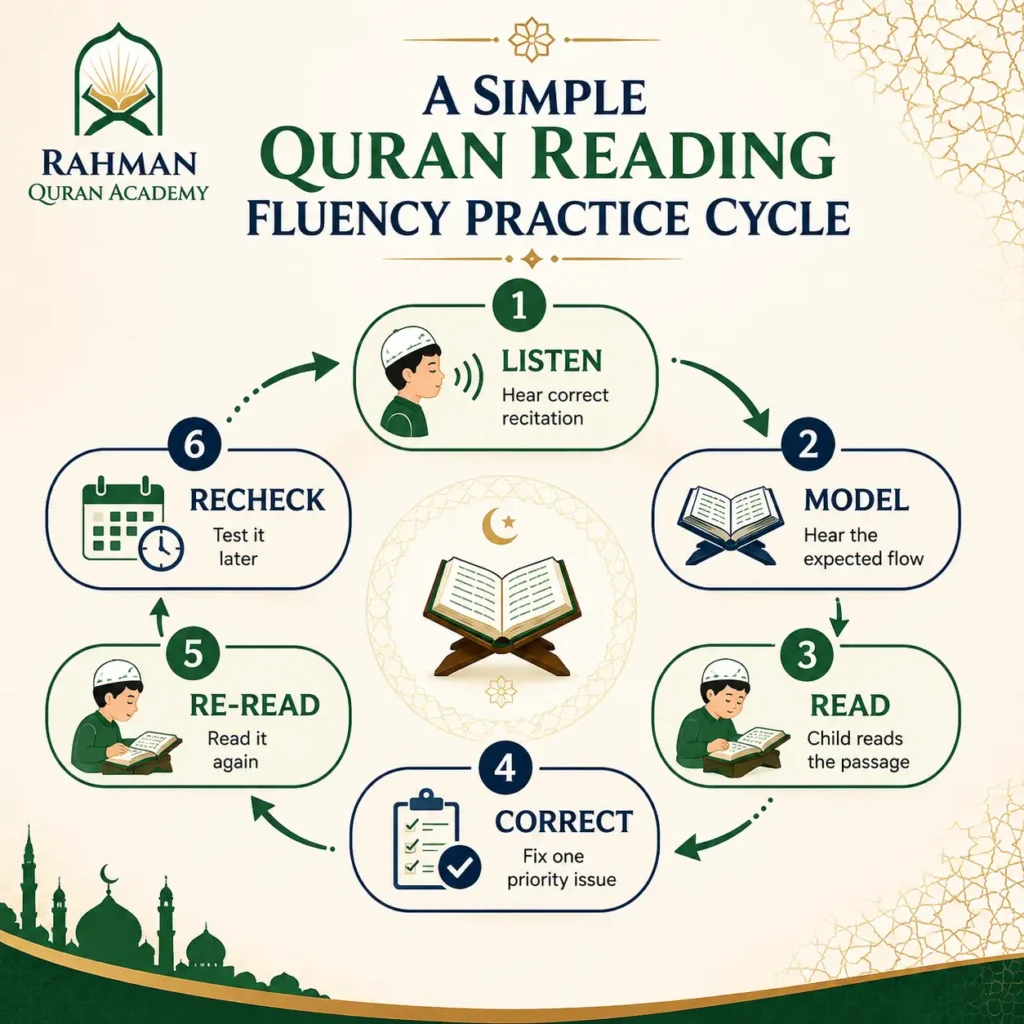
Use short passages at your child’s level, model the recitation, let your child read it, correct only the most useful issue, reread the passage, and gradually increase independence and pace as accuracy holds.
Start With a Short, Manageable Passage
A whole page is rarely the best practice unit for fluency work. A few lines your child can genuinely focus on will do more than a full page skimmed under pressure.
Listen to a Correct Model First
Before your child reads, they should hear the passage read correctly by you, a teacher, or a reliable recording. This gives them a template for pace, pronunciation and stopping points before they attempt it themselves.
Let the Child Read the Same Passage Again
Reading the same short passage more than once, with focused feedback between attempts, can help build smoother reading. A recent study of Qur’anic reading fluency found that increased repetition was associated with progressively higher fluency levels, although improvement varied between learners.
Practise in Short Meaningful Units
Don’t split Quran text the way English reading schemes use slash marks for random phrases, which risks breaking the wording in places that don’t respect the actual stopping points. Keep any phrase-based practice aligned with valid Waqf and proper recitation, not arbitrary chunks.
Correct One Priority Problem at a Time
Stopping your child after every second word to fix something turns reading practice into a stop-start exercise. Pick the one issue that matters most right now, and let smaller ones wait.
Increase Pace Only When Accuracy Holds
The order matters: accuracy first, then control, then smoothness, and only then a more natural pace. Trying to skip ahead to pace before the earlier stages are solid tends to undo them.
Recheck the Same Skill Later
Don’t judge progress only in the moment right after practice. Come back to the same passage or a similar one a few days later to see whether the improvement has actually held.
The practice cycle:
Listen → Model → Read → Correct → Re-read → Recheck
If you’d like structured, one-to-one support building this skill, our Quran Reading Classes are built around exactly this kind of practice.
Should You Make Your Child Read the Quran Faster?
No, faster reading should not be the main goal.
● Speed without accuracy isn’t useful progress.
● Rushed reading tends to increase mistakes, not reduce them.
● Measured recitation matters at every stage, not only for beginners.
● Pace should increase naturally as reading becomes more secure; it shouldn’t be pushed ahead of it.
This reflects the same principle behind the instruction to recite at a measured pace (Quran 73:4). And to be clear: reading slowly isn’t automatically a problem; some children simply need more time, and that’s fine.
How Can Parents Practise Quran Reading Fluency at Home?
Choose a Short Passage at the Child’s Level
Pick something challenging but not overwhelming a passage your child can realistically manage with a little support.
Listen First
Read it aloud yourself, or play a correct recording, before your child attempts it.
First Reading — Accuracy
Let your child read without chasing speed. Note any real mistakes, but don’t interrupt every hesitation.
Second Reading — Smoother Flow
On the second attempt, gently reduce unnecessary hesitation with a light prompt rather than a full stop each time.
Third Reading — Greater Independence
By the third read, your child should need less prompting. This is where you’ll start to see genuine fluency, not just repetition.
Revisit It Later
Come back to the same passage in a few days to check whether the improvement held, rather than only measuring progress within the same session.
There’s no fixed rule that every child must practise for exactly 15, 20 or 30 minutes. Short, focused and consistent sessions matter more than hitting a specific time target.
Example (hypothetical): imagine a 6–8-year-old working through a short passage three times in one sitting. On the first read, the teacher notices a few pauses. On the second, the child applies the correction and reads a little more smoothly. By the third read, the same passage flows with far less hesitation. This is an illustrative example, not a specific case.
Why Can My Child Read Familiar Surahs Fluently but Struggle With New Pages?
Because familiar Surahs can be supported by memory and repeated exposure, while a new page requires your child to recognise and decode unfamiliar text more independently.
Familiar Recitation Can Rely on Memory
When a Surah has been heard and repeated many times, a child can recite it smoothly even if their independent reading isn’t yet at the same level. This isn’t a bad thing; it’s simply a different skill.
New Pages Test Independent Reading
An unfamiliar page removes that memory support entirely. Suddenly your child has to decode every word in real time, which is why the same child can sound confident on one page and hesitant on the next.
How to Practise With Unfamiliar Passages
● Choose a manageable new passage, a few lines at a time.
● Model it correctly first.
● Let your child read it.
● Correct the one hesitation that matters most.
● Reread the same passage.
● Revisit it a few days later.
Memorised recitation isn’t “fake fluency”; it’s a genuine skill, just a different one from independent reading. Both are worth building.
How Can You Improve Fluency Without Losing Tajweed?
Accuracy and correct pronunciation come before pace; fluency should never be built by sacrificing Tajweed.
Accuracy Comes Before Pace
If speeding up starts to blur pronunciation or skip Harakat, that’s a sign to slow back down, not push through.
Keep Pronunciation Stable
This isn’t the place to re-teach Makharij in detail. If pronunciation errors keep recurring, that’s better addressed through our Quran reading mistakes guide or dedicated Tajweed practice.
Respect Proper Stopping and Starting
Detailed Waqf rules aren’t the focus here, but fluency practice should always work with them, not around them.
Gradually Reduce Hesitation
The aim is smoother reading, not simply faster reading. As hesitation reduces, pace tends to follow naturally.
Know When to Stop Pace Practice
If accuracy starts to slip as pace increases, that’s the signal to return to slower, more controlled reading rather than push forward.
Structured Tajweed practice like our Tajweed Classes can help keep pronunciation stable while fluency develops.
How Can You Tell if Your Child Is Becoming More Fluent?
Improving Quran reading fluency means looking for smoother reading without losing accuracy.
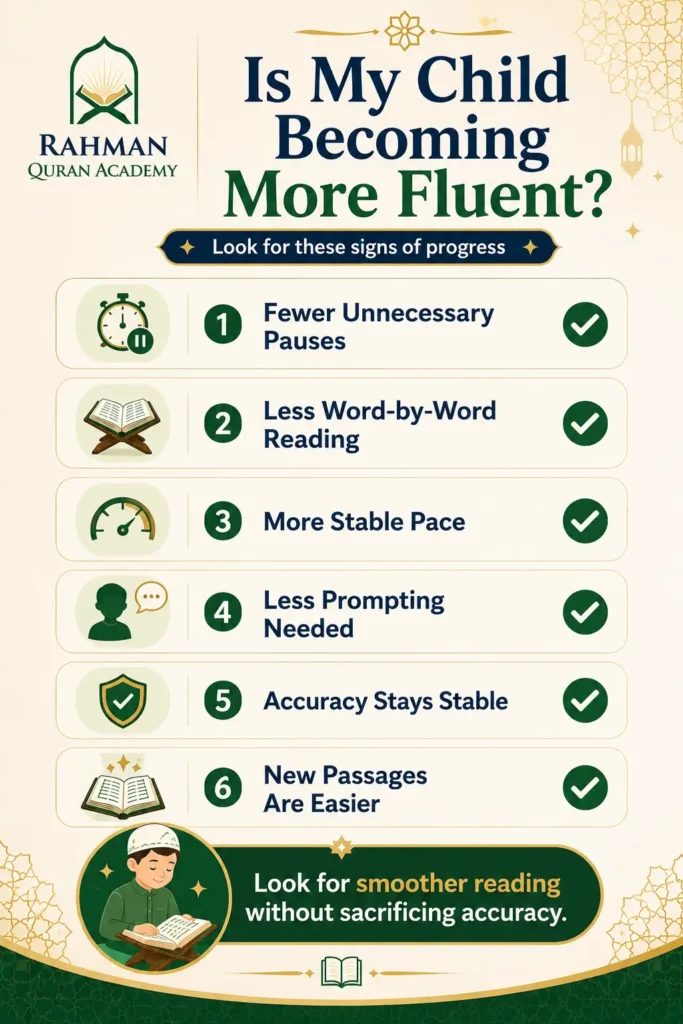
Fewer Unnecessary Pauses
Your child stops less often for reasons that have nothing to do with the text.
Less Word-by-Word Reading
Words start joining into natural phrases rather than being read one at a time.
More Stable Pace
Reading speed becomes more consistent across a passage, rather than starting fast and slowing to a crawl.
Less Prompting
You find yourself stepping in less often to nudge your child forward.
Accuracy Stays Stable
Fewer pauses shouldn’t come at the cost of more mistakes; accuracy should hold steady or improve alongside fluency.
Improvement Transfers to New Passages
The clearest sign of real progress: your child reads an unfamiliar page more smoothly too, not only the ones they’ve practised.
The strongest measure of fluency is whether your child can read an unfamiliar, age-appropriate passage more smoothly without accuracy dropping, not how many pages they got through.
Fluency progress checklist:
☐ Fewer unnecessary pauses
☐ Less word-by-word reading
☐ More stable pace
☐ Less prompting needed
☐ Accuracy stays stable
☐ Improvement shows on unfamiliar text
What If Your Child Is Still Struggling?
Don’t automatically add more practice time. First, work out whether the issue is really about foundation, pronunciation, fluency, practice method, teacher feedback, or the difficulty of the passage itself.
Recheck the Reading Foundation
If the underlying issue turns out to be letter recognition or recurring pronunciation mistakes, that’s worth resolving first. See how to start teaching your child the Quran
Reduce the Passage Difficulty
A passage that’s slightly too advanced will produce hesitation that looks like a fluency problem but is really a difficulty-mismatch problem.
Change the Practice Method
If the same approach hasn’t worked after a fair try, the method — not the child — may need adjusting. Shorter passages, more modelling, or a different correction style can make a real difference.
Ask a Teacher to Assess the Reading
Sometimes it helps to have someone outside the family listen and pinpoint exactly what’s holding fluency back. See what makes a good Quran teacher for children and what to look for.
A Few Example Scenarios
The following are illustrative examples, not real cases, included to make the ideas above more concrete.
Scenario 1: Accurate but Hesitant Child
Problem: pauses after almost every word. Approach: short passage, correct model, reread with light prompting until pauses reduce.
Scenario 2: Fast but Inaccurate Child
Problem: rushes and skips detail. Approach: slow the pace deliberately, rebuild accuracy, then reintroduce pace gradually.
Scenario 3: Memorised but Hesitant on New Pages
Problem: fluent on familiar Surahs, hesitant on unfamiliar Mushaf text. Approach: dedicate practice time specifically to unfamiliar short passages.
Scenario 4: Lots of Practice, Little Improvement
Problem: practice time keeps increasing, but reading doesn’t improve. Approach: diagnose exactly what’s breaking the flow, rather than adding more unfocused repetition.
Frequently Asked Questions
How can I improve my child’s Quran reading fluency?
Use short passages at your child’s level, model correct reading first, let them read and reread with light correction, and check that the improvement carries over to unfamiliar pages.
How can I improve Quran reading speed without losing accuracy?
Keep pace secondary to accuracy. Only let pace increase once your child can read a passage correctly and with control; speeding up before that stage tends to backfire.
How can I help my child stop pausing after every word?
Work on short, familiar phrases first so your child can read connected words with confidence, then gradually extend to longer stretches of text.
Is it better for children to read the Quran slowly or quickly?
Slowly and accurately is a better foundation than quickly and carelessly. A measured pace (Quran 73:4) is the goal at every stage, not just for beginners.
How often should a child practise Quran reading?
No fixed number of minutes suits every child. Short, focused, consistent sessions tend to help more than long, unfocused ones.
Does listening to Quran recitation help reading fluency?
Yes, hearing a correct model before reading gives your child a template for pace, pronunciation and stopping points, which supports fluency practice.
Why can my child recite memorised Surahs but struggle with new pages?
Familiar Surahs are often supported by memory, while new pages require independent decoding. Both are genuine skills, and unfamiliar-passage practice specifically builds the second one.
When should my child see a Quran teacher for fluency problems?
If hesitation persists despite consistent, focused practice at home, a teacher can listen closely and identify exactly what’s holding fluency back.
If you’d like a teacher to listen to your child read and build a fluency plan around exactly what they need, our Kids Quran Classes are a good place to start.