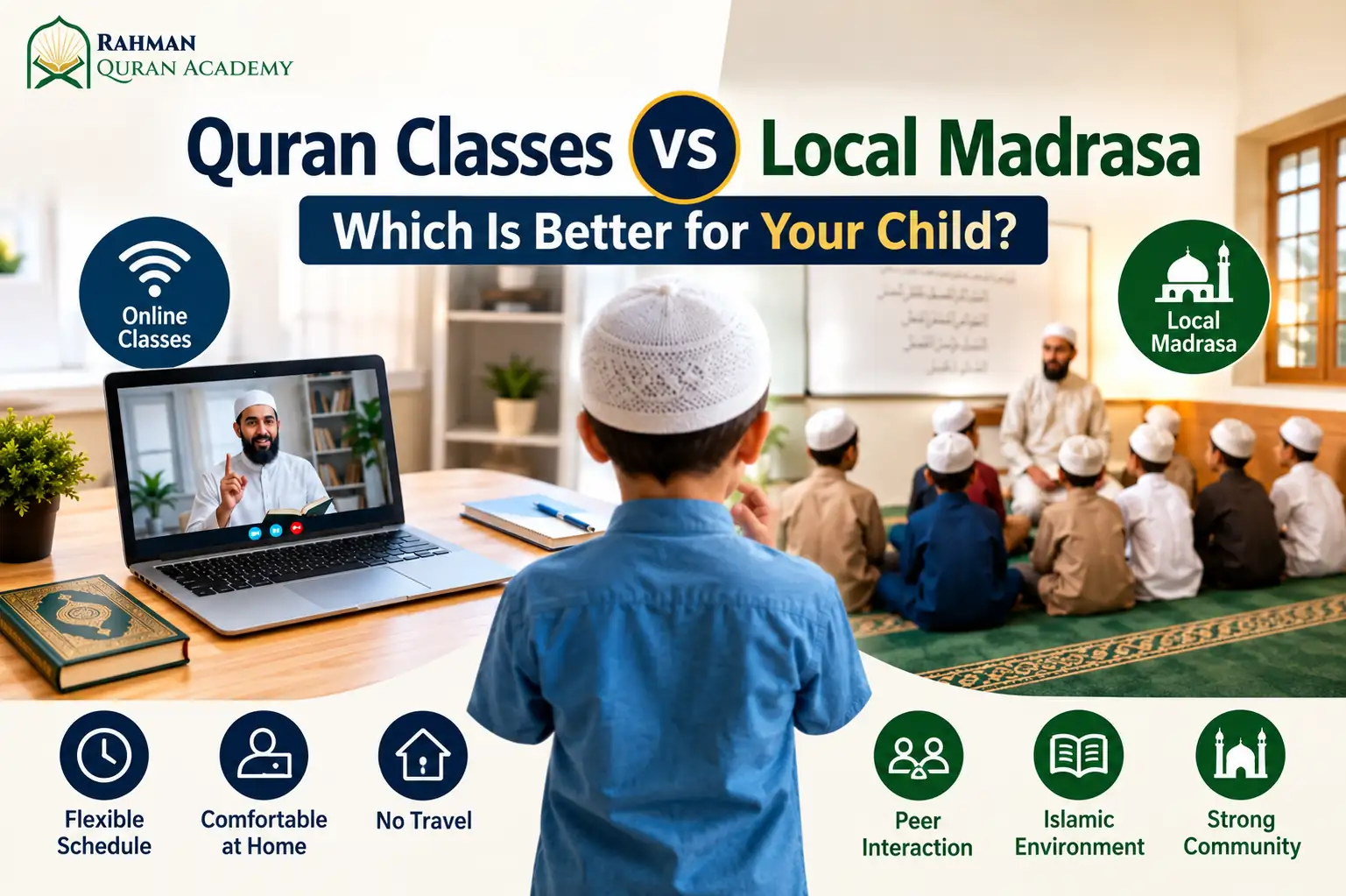
Online Quran Classes vs Local Madrasa: Which Is Better for Your Child?
| Neither option is automatically better for every child. Online Quran classes may suit families who need flexible scheduling, home-based learning or access to a wider choice of teachers. A local madrasa may suit children who benefit from face-to-face routine, peer interaction and a physical Muslim community. The better choice depends on the actual teaching experience, the child’s needs and what the family can sustain. |
For many UK Muslim parents, the choice comes down to local madrasa, online Quran classes, or a combination of both. Both formats can work well. Both can also disappoint a family if the wrong provider or class is chosen.
This article is part of our wider guide, Teaching the Quran to Children, and focuses specifically on how online Quran classes and local madrasas compare across the things that actually affect a child’s learning: teacher attention, class size, community, schedule, cost and safeguarding.
Online Quran Classes vs Local Madrasa: Quick Comparison
Before going into detail, here is a fast overview. Treat this as a starting point rather than a final answer; the notes in the last column matter as much as the two before it.
| What Matters | Online Quran Classes | Local Madrasa | What It Actually Depends On |
| Flexibility | Lessons can often be arranged around school and work | Usually follows a fixed weekly timetable | The individual provider or madrasa’s own scheduling |
| Teacher attention | Can be one-to-one, if that is the model offered | Can also be one-to-one or small group | The actual class model, not the label “online” or “madrasa” |
| Class size | Varies by provider; some are one-to-one, some are group | Varies widely by mosque or madrasa | Ask directly; do not assume |
| Community | Limited physical interaction with other Muslim children | Mosque connection and peer environment | How much your family values physical community |
| Travel | None | Regular travel to and from a physical setting | Distance, transport and family logistics |
| Screen use | Adds to the child’s daily screen exposure | None | The child’s existing device use and lesson length |
| Parent involvement | May need a quiet space, a working device and occasional supervision | Drop-off and pick-up, less involvement during the lesson itself | The child’s age and independence |
| Safeguarding | Must be assessed at the individual provider level | Must be assessed at the individual setting level | Actual policies and practice, not the format |
| Cost/value | Tuition fees only, no travel cost | Tuition plus travel time and, often, parking or transport | Total cost to the family versus what the child actually receives |
What Actually Makes the Difference: Format or Teaching Quality?
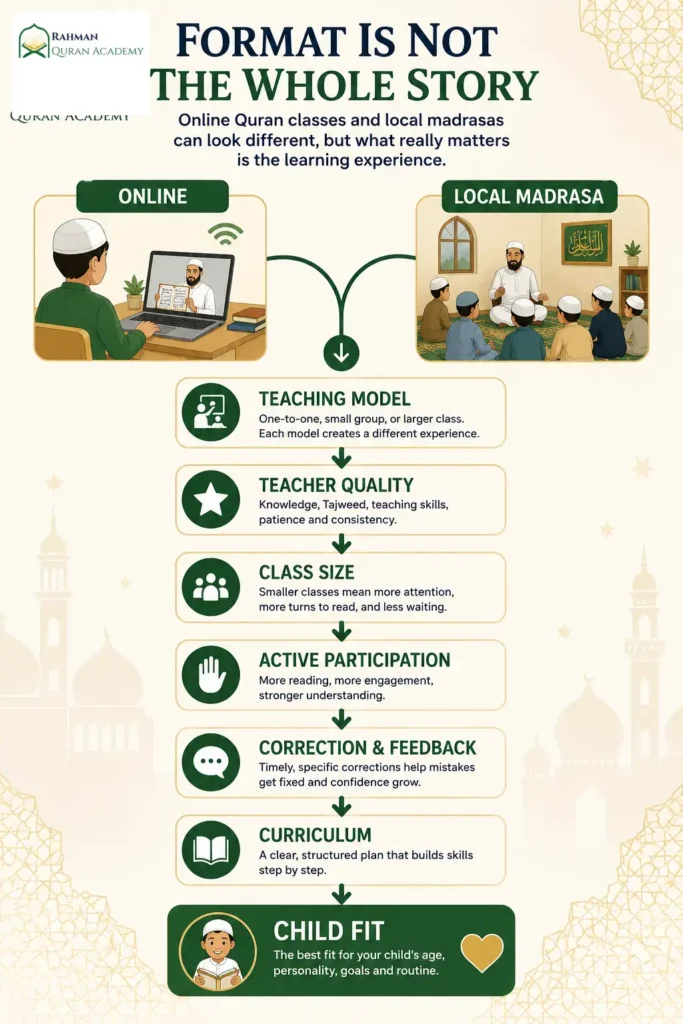
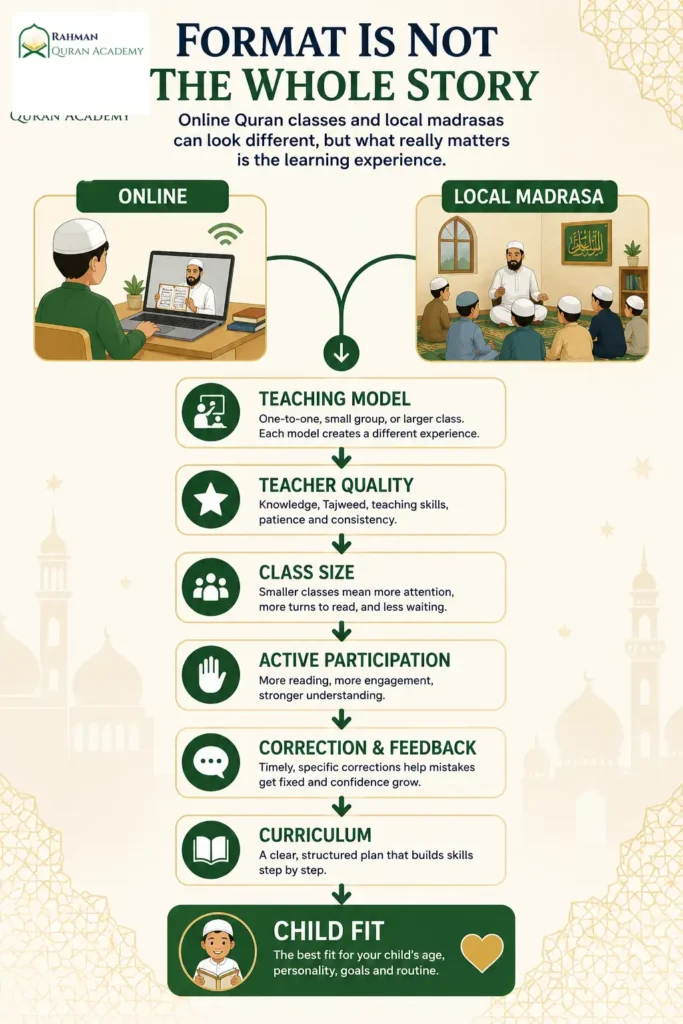
A common mistake when comparing these two options is focusing on the label rather than the lesson. “Online” and “madrasa” are delivery formats, not teaching methods. An online class can be one-to-one or a large group. A local madrasa can also be one-to-one, a small circle, or a large class of twenty or more children. What actually shapes a child’s progress sits underneath the format.
So before asking “online or local”, it helps to ask what is actually happening inside the class itself.
One-to-One vs Group Teaching
Whether a child is taught alone or alongside other children changes how much individual correction they receive, how comfortable they feel making mistakes, and how quickly pronunciation or memorisation problems get caught. Neither model suits every child; some children thrive with individual focus, others are motivated by learning alongside peers.
This is a big enough topic on its own, so we’ve covered it in detail in one-to-one vs group Quran classes, which looks at how each model affects attention, pace and cost.
Class Size and Active Participation
With fewer pupils sharing the teacher’s time, a smaller class can give each child more opportunities to read and receive individual correction. A larger class, online or local, means the opposite: more waiting, fewer individual corrections, and a greater chance that a struggling child goes unnoticed for longer.
Class size is worth asking about directly, in numbers, for both an online provider and a local madrasa. “Small group” can mean four children or fourteen, depending on who you ask.
Teacher Correction and Feedback
Correction is where Quran learning actually happens: a teacher noticing a mispronounced letter, a missed Tajweed rule, or a hesitant word, and addressing it there and then. This depends far more on the individual teacher’s patience, training and attentiveness than on whether the lesson takes place over a screen or in a room.
We go into what to look for in a teacher, regardless of format, and what makes a good Quran teacher for children.
Curriculum and Learning Goals
Some providers, online and local, follow a structured curriculum with clear stages: Noorani Qaida, Quran reading, Tajweed rules, then Hifz. Others are more informal, moving at whatever pace suits the group on the day. A structured curriculum tends to make it easier for parents to see whether their child is actually progressing, rather than simply attending.
What Does a Local Madrasa Offer That Online Classes May Not?
A local madrasa offers things that are genuinely difficult to replicate through a screen. These are worth taking seriously rather than treating as sentimental extras.
Community and Belonging
A 2023 study published in the British Journal of Religious Education surveyed Muslim female teachers working in maktabs (mosque-based supplementary schools) in England about the purpose of their work. The study found that maktab education is often understood by those running it as playing a wider community role, not simply delivering Quran lessons and pushed back on the idea that maktab education can be reduced to a single stereotype.
For many UK Muslim families, a local madrasa is also where a child sees other Muslim children their own age regularly, in a specifically Muslim space. This is a form of community connection that an online lesson, however well taught, does not directly reproduce.
Face-to-Face Routine
Walking or being driven to a physical class, sitting in a room, and returning home creates a routine some children respond well to: a clear start and end to “Quran time” that is separate from screens and home distractions.
Peer Interaction
Parent discussions online include examples of children being motivated by watching classmates read or memorise well. Peer motivation is a real factor for some children; seeing a friend progress through a surah can encourage a child to keep going.
This isn’t universal. Other children find reading in front of a group uncomfortable and prefer private correction, which is exactly why class model matters more than format on its own.
Physical Learning Environment
A dedicated room, a physical Mus’haf, sitting on the floor or at a desk alongside other children this physical setting is part of the experience for many families, and it’s not something an online lesson can offer in the same way, whatever the teaching quality behind the screen.
What Can Online Quran Classes Offer That a Local Madrasa May Not?
Online Quran classes offer an alternative for families who want to learn from home and avoid the travel involved in reaching a local class.
Flexible Scheduling
A March 2025 discussion among UK parents on the r/MuslimParenting forum illustrates this well: a parent of three children was weighing up weekend school, evening classes, online tutoring and face-to-face options, and specifically raised concern about homework and revision becoming overwhelming when layered on top of an already busy school week.
Online classes can often be scheduled at whatever time actually works for a family, rather than fitting family life around a fixed local timetable. For families juggling multiple children, shift work or long commutes, this matters a great deal. We cover this in more depth in how busy UK families can fit Quran classes around school and work.
Access to a Wider Choice of Teachers
A family is no longer limited to whichever teachers happen to be available at their nearest mosque. Online learning opens up choice, including, for some families, access to a female teacher for a daughter, or a teacher with a particular specialism in Tajweed or Hifz that may not exist locally.
Learning From Home
No driving, no parking, no waiting outside in the car. For families with young children, multiple siblings on different schedules, or parents working evenings, removing the travel element alone can be the difference between a class actually happening consistently and it quietly falling away after a few weeks.
Potential for Personalised One-to-One Support
Where an online provider genuinely offers one-to-one teaching, a child can move at their own pace, get corrected immediately, and avoid the discomfort of reading aloud in front of a group. The word “potential” matters here; this benefit only exists if the provider actually delivers one-to-one lessons, rather than simply offering an online version of a large group class.
Where Can Each Option Fall Short?
Possible Limitations of Online Quran Classes
Not every child engages well with a screen. A March 2026 r/MuslimParenting discussion described a parent whose son didn’t find online Quran learning engaging enough, and who later found their child was happier once they moved to an in-person teacher found through word of mouth. The parent’s own reflection was that some children zone out in front of a screen while others manage perfectly well.
This is a genuinely useful counterpoint to marketing that presents online learning as automatically more engaging. It isn’t, for every child. Other practical limitations include technical issues (poor connection, a frozen call), home distractions during the lesson, and the fact that screen-based learning adds to a child’s total daily screen exposure alongside school and any recreational use.
Possible Limitations of Local Madrasa
Travel is the most obvious one: getting a child to and from a physical class, often on top of a full school day, takes time and coordination that not every family can sustain long-term. Class sizes at some madrasas can also be large, which limits how much individual correction any one child receives in a given session.
A February 2025 discussion on r/MuslimLounge from someone identifying as a Quran teacher raised concerns about excessive memorisation pressure and long learning sessions leaving some children struggling to stay focused. This reflects a real underlying concern worth taking seriously: whether a learning environment is genuinely age-appropriate and responsive to a child, rather than a claim that this describes local madrasas generally. The quality, pace and level of pressure can vary by setting, so it’s worth checking rather than assuming.
Why the Actual Class Matters More Than the Label
A separate part of the same March 2026 r/MuslimParenting thread is instructive: parents in the discussion weren’t only debating online versus local; they were asking each other how they found a teacher who actually suited their child through word of mouth, through the masjid, or through trial and error online.
That’s the real decision underneath the format question. A patient, well-trained teacher in a large local class can outperform a disengaged online teacher, and vice versa. Before choosing based on “online” or “madrasa”, it’s worth sitting in on (or observing online) an actual lesson, asking about class size in numbers, and watching how the teacher responds when a child makes a mistake.
Are Online Quran Classes as Effective as Local Madrasa?
What the Research Actually Tells Us
A 2018 participatory study of 27 British Muslim students found that supplementary Islamic education in the UK already takes many forms: weekday mosque classes, weekend classes, home-based groups and even Skype tutoring, well before online Quran academies became common. Its main finding for this comparison is that British Muslim children’s education pathways are not uniform, which supports the idea that there isn’t one universally correct format for every family.
Outside Quran-specific research, a randomised controlled trial published in 2024–2025 examined virtual tutoring for young readers and found positive effects in the context studied evidence that online tutoring can work well under the right conditions. A separate meta-analysis of synchronous online learning found a small but statistically significant benefit for cognitive outcomes compared with asynchronous (pre-recorded or self-paced) formats, though other comparisons in the same analysis were not statistically significant.
Why Quran-Specific Head-to-Head Evidence Is Limited
It’s important to be direct about this: there is currently limited strong, Quran-specific research directly comparing online classes against local madrasas for UK children. The studies above are useful context: one on British Muslim supplementary education generally, two on tutoring and online learning more broadly, but none of them proves that either format produces better Quran learning outcomes. Any claim that “research proves online is better” (or the reverse) is going further than the current evidence supports.
Read more about what’s known specifically about online Quran teaching in are online Quran classes effective for children.
What Makes an Online Lesson More Likely to Work
Based on the broader tutoring evidence and parent experience, a handful of practical factors seem to matter: a live, interactive teacher rather than pre-recorded content; a genuinely small class or one-to-one model; a quiet, distraction-free space at home; a stable connection; and a lesson length that suits the child’s age and attention span. These are the same factors worth checking in a local class, too.
How Should Parents Compare Safeguarding?
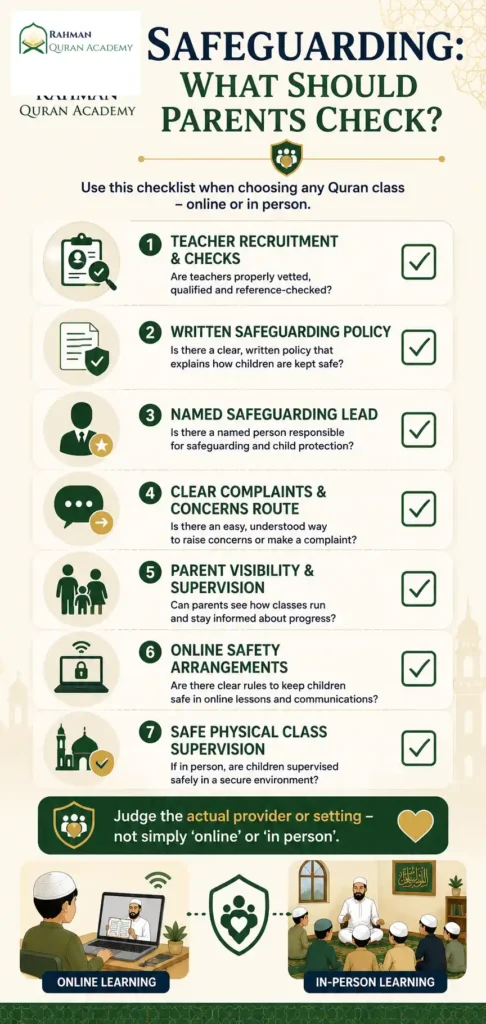
Safeguarding is one area where parents shouldn’t let the label define them. Whether a class is delivered by video call or in a room at the local mosque, the questions to ask are broadly the same.
Current UK government guidance for parents and carers on out-of-school settings, which explicitly covers religious supplementary settings, including madrasas, was updated in early 2026 and sets out what parents should expect any provider of tuition, clubs or supplementary schooling to have in place, including clear safeguarding policies, safer recruitment practice, and a named person responsible for child protection.
Questions to Ask an Online Provider
How are teachers recruited and checked, including any DBS or equivalent checks? Is a lesson ever conducted one-to-one without a parent able to see or hear what’s happening? Is there a written safeguarding policy, and who is responsible for acting on a concern? How is a child’s online safety handled during and around the lesson?
Questions to Ask a Local Madrasa
Who supervises the physical space, and what are the arrangements for drop-off and pick-up? What safer-recruitment checks are carried out on teachers and volunteers? Is there a designated safeguarding lead, and what happens if a parent or child raises a concern? What is the actual class size, and is a teacher ever alone with a single child behind a closed door?
Why Online or In Person Does Not Automatically Mean Safer
Neither format is inherently safer than the other. A well-run online provider with clear policies, visible lessons and proper checks can be safer than a poorly supervised local class, and the reverse is equally true. Safeguarding needs to be assessed at the level of the individual provider or setting, not assumed from the format alone.
We’ve built a full checklist for this specific to online providers in our online Quran classes safety checklist, which goes into far more detail than is useful here.
What About Cost and Overall Value?
Cost comparisons often focus on the headline monthly fee, which tells a family less than it seems to.
Look Beyond the Monthly Fee
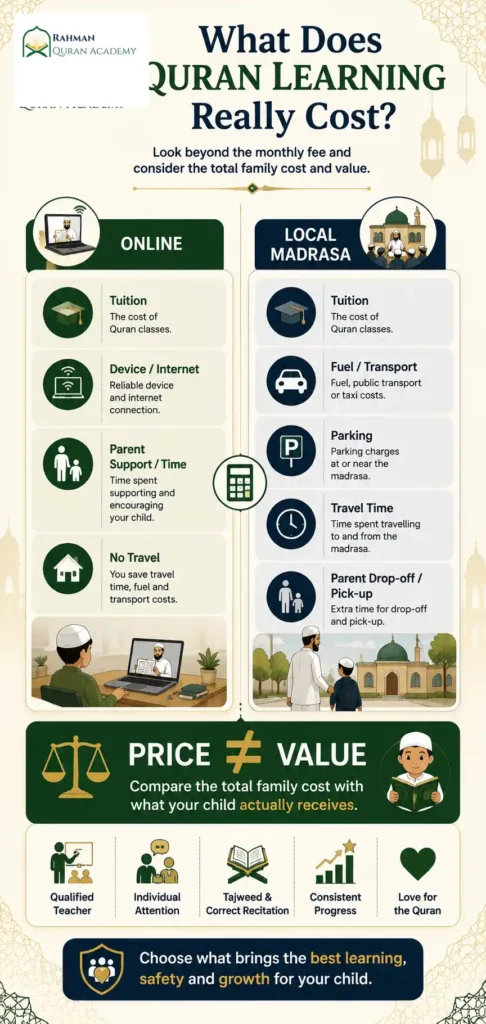
A cheaper monthly rate isn’t automatically better value if the class is large, the teacher rotates frequently, or the child receives little individual correction. Equally, a higher fee doesn’t guarantee quality. The fee is a starting point for comparison, not the answer on its own.
Include Travel and Parent Time
A local madrasa’s true cost to a family includes travel time, fuel or transport fares, parking where relevant, and often a parent’s evening or weekend given over to drop-off and pick-up, particularly with more than one child attending. Online classes remove this, which is a real saving even where the tuition fee itself is similar.
Consider What the Child Actually Receives
The more useful comparison is cost against what actually happens in the lesson: how much individual attention, how much correction, how consistent the teacher is, and how much the child is genuinely learning session to session. A family paying less for a large, inconsistent class may be getting worse value than a family paying more for a small, consistent one regardless of format.
Compare Like With Like
When comparing quotes or fees between an online provider and a local madrasa, try to compare the same things: class size, lesson length, frequency per week, and whether Tajweed correction and progress tracking are actually included, not assumed.
Which Option Fits Your Child’s Age, Learning Stage and Personality?
A child’s age, current stage and personality often matter more to the decision than the format itself.
Beginner and Early Reading Stage
Young beginners, particularly those starting Noorani Qaida, often benefit from frequent, short, closely supervised correction since early mistakes in letter recognition and pronunciation can become habits if left uncorrected. This is achievable both online and locally, provided the class size is genuinely small.
Quran Reading and Tajweed
As a child moves into Quran reading and Tajweed rules, consistency of teacher and regular, specific correction of pronunciation become more important than the format. A teacher who consistently notices and addresses recurring mistakes gives the child clearer opportunities to improve.
Hifz and Structured Memorisation
Hifz places different demands on a child: sustained daily revision, careful pacing to avoid burnout, and a teacher who can track a growing portfolio of memorised material accurately. Both formats can support this well, but it’s worth asking specifically how progress and revision are tracked, since this is where inconsistent teaching shows up fastest.
Shy, Distracted or Highly Social Children
A shy child who finds it uncomfortable to make mistakes in front of others may do better with one-to-one teaching, whether delivered online or locally. A child who is easily distracted at home may concentrate better in a physical class away from household noise and siblings or, for some children, the opposite is true, and a familiar home environment helps them settle. A highly social child who enjoys learning alongside friends may respond well to a local group setting.
Where a child has additional needs, individual support requirements can vary considerably, and it’s worth discussing these directly with any provider rather than assuming either format is automatically better suited.
Could a Hybrid Approach Be Better?
For some families, the honest answer isn’t “online” or “local”; it’s a combination of both.
When Combining Both Makes Sense
Hybrid arrangements tend to work when one format is solving a problem the other genuinely can’t. That might mean a local madrasa for community and peer connection, paired with online sessions for focused, one-to-one Tajweed correction that the local class doesn’t have time for.
Example Hybrid Models
Some families keep a weekend session at the local mosque for community and Islamic studies, and use weekday online lessons for Quran reading practice. Others use a local group class for the social and community side, alongside private online support for a child who is falling behind and needs closer, individual correction. There’s no single correct combination; it depends on which specific gap each format is being asked to fill.
When Hybrid Is Just More Complexity
Hybrid isn’t automatically better, and it can tip into more than a family can realistically sustain. The March 2025 r/MuslimParenting discussion mentioned earlier is a good example: a parent already weighing up weekend school, evening classes and online tutoring on top of mainstream schoolwork, worried about the total load becoming overwhelming and turning into forced rote learning rather than something meaningful.
Before combining formats, it’s worth being honest about the added cost, the extra scheduling, and whether the child has the time and energy for two separate commitments without becoming exhausted or resentful of Quran learning altogether.
How to Make the Right Decision for Your Child
Once you’ve thought through teaching quality, community, cost, and your child’s own personality, a short, honest checklist can help bring the decision together.
1. What does my child need most right now?
2. How much actual teacher attention will they receive, in either option?
3. What is the real class size the number, not the label?
4. How much of the lesson will my child actively participate in, rather than wait?
5. How well does the timetable genuinely fit our family’s week?
6. Does my child learn better privately, or alongside peers?
7. How important is physical Muslim community to our family, honestly?
8. How much parent involvement can we realistically provide, week after week?
9. Are the safeguarding arrangements clear, and have we asked directly?
10. What is the total cost and value, tuition, travel and time included?
11. Which option can our family actually sustain in six months, not just this month?
Online May Fit If…
• Your family needs scheduling flexibility around school, work or shift patterns
• Travel to a local class isn’t realistic or sustainable
• You want access to a specific teacher, or a female teacher, not available nearby
• Your child engages well with one-to-one, screen-based learning
Local Madrasa May Fit If…
• Physical Muslim community and peer connection matter to your family
• Your child responds well to a face-to-face routine and structure
• A suitable local class with a good teacher and manageable class size is genuinely available
• Your child prefers, or is motivated by, learning alongside other children
Hybrid May Fit If…
• Community and one-to-one correction are both priorities you can’t get from a single format
• Your family has the time and capacity for two separate commitments without overload
• You’re using each format for a distinct purpose, not just doubling up out of uncertainty
Frequently Asked Questions
Is online Quran learning better than a local madrasa?
Neither is universally better. Online classes tend to suit families needing flexibility and home-based learning, while a local madrasa tends to suit children who benefit from community and face-to-face routine. The actual teacher, class size and correction matter more than the format itself.
Are online Quran classes as effective as local madrasa classes?
They can be, when the class is genuinely small or one-to-one, and the teacher is engaged and consistent. There is currently limited Quran-specific research directly comparing the two formats, so this is best judged by observing the actual lesson rather than assuming either format wins by default.
Is a local madrasa better for children’s social development?
A local madrasa can offer physical peer interaction and community connection that online lessons don’t directly replicate, which some families value highly. This doesn’t mean online learning causes social isolation; it simply offers a different kind of experience.
Which is better for a shy child?
A shy child who’s uncomfortable reading aloud in front of others may prefer one-to-one teaching, which can be delivered either online or locally. What matters is the class size and teaching model, not whether it takes place on a screen or in a room.
Which is better for Quran reading or Tajweed?
Progress with reading and Tajweed depends mainly on consistent, specific correction from a teacher who catches the same recurring mistakes over time. This is achievable in both formats, provided the class size stays small enough for individual attention.
Can a child attend both online Quran classes and a local madrasa?
Yes, and some families find a hybrid approach works well; for example, a local class for community alongside online lessons for focused one-to-one correction. It’s worth being realistic about the added cost, scheduling and whether your child can manage two commitments without becoming overloaded.
How should parents compare safeguarding between online and local options?
Ask both an online provider and a local madrasa the same core questions: how teachers are recruited and checked, whether there’s a written safeguarding policy, who is responsible for acting on concerns, and what supervision looks like during lessons. Safeguarding depends on the individual provider or setting, not on whether the format is online or in person.
How should I choose between online Quran classes and a local madrasa?
Start by identifying what your child needs most: flexibility, community, one-to-one attention or peer motivation; then observe an actual lesson from any provider you’re considering rather than relying on labels. Our guide to choosing online Quran classes for your child in the UK covers this decision in more detail.
A Final Word
What it depends on, in the end, is your child and your family, not which option sounds better on paper. Both online Quran classes and local madrasas can, in the right circumstances, give a child a genuinely strong Quran education. Both can also fall short if the class is too large, the teacher isn’t the right fit, or the schedule isn’t sustainable.
If you decide online learning may suit your child’s needs, the next step is to look beyond the timetable and compare the teacher, lesson format, safeguarding and actual learning experience. You can explore our Kids Quran Classes for a sense of how a structured, one-to-one online programme is put together.
For a full walkthrough of vetting and choosing a provider, see how to choose online Quran classes for your child in the UK.