

Why Children Make Tajweed Mistakes Even After Learning Quran
A child may understand a Tajweed rule in a lesson but still make mistakes when reciting the Quran on their own. This doesn’t necessarily mean the child has forgotten the rule or hasn’t been learning properly. Understanding a rule and applying it consistently during recitation are different skills.
Children may need more guided practice, individual feedback, and time to use a rule accurately without reminders. The most useful next step is to identify exactly where the difficulty occurs rather than assuming the child needs to repeat the entire lesson.
Why Do Children Still Make Tajweed Mistakes After Learning the Rules?
Children can continue making Tajweed mistakes because recognising a rule does not automatically mean they can apply it correctly while reading.
A child might explain a rule when asked, recognise it in a familiar example, or recite correctly after a teacher’s reminder. However, the same child may struggle to apply it while reading a different passage.
Several difficulties may explain this difference:
- Remembering the rule but missing it during recitation: The child knows what to do but does not apply it consistently while reading.
- Difficulty producing a sound accurately: The child may understand the teacher’s explanation but still need help with the pronunciation of a particular letter.
- Relying on reminders: The child may correct an error immediately after feedback but repeat it later without a reminder.
- Difficulty applying learning to new passages: The child may perform well in a practised example but struggle when the same rule appears in unfamiliar words.
- Reading faster than their current accuracy allows: The child may concentrate on continuing the recitation and overlook details that require attention.
These patterns are not a diagnosis. They are observations that can help a parent and teacher decide what to practise next.
Knowing a Tajweed Rule Is Different from Applying It

Learning Tajweed involves more than memorising the names and definitions of rules. A child also needs to recognise where a rule applies and perform it accurately during Quran recitation.
For example, a child may remember a teacher’s explanation but still need support when the relevant rule appears in a longer passage. The child may be concentrating on the words, pronunciation, and continuity of the recitation at the same time.
This is why repeating a rule’s definition may not solve every recurring mistake. The teacher needs to identify whether the main difficulty is understanding the rule, recognising it in the text, or applying it correctly.
For a broader explanation of Tajweed and its rules, see our complete Tajweed guide.
Four Signs That a Child Needs More Focused Tajweed Practice
The following observations can help parents describe a difficulty more clearly to their child’s Quran teacher.
1. Your Child Understands the Rule but Cannot Apply It Consistently
Your child may answer questions about a rule correctly but still miss it while reciting.
This suggests that the lesson explanation and independent recitation need to be connected more effectively. Ask the teacher to practise the rule in short examples before checking whether the child can apply it in a longer passage.
2. Your Child Can Correct a Mistake After a Reminder
A child may correct a pronunciation or Tajweed mistake when the teacher points it out, then repeat the same mistake later.
The correction shows that the child can respond to feedback in that moment. It does not yet establish that the skill has become consistent.
The teacher can revisit the same point during a later part of the lesson and check it again in a different passage.
3. Your Child Recites Practised Passages Better Than New Ones
Some children perform more accurately when reading familiar material but make more mistakes when they encounter unfamiliar words or passages.
Practised material can become easier through repetition. New material helps the teacher assess whether the child can recognise and apply the relevant rule in a different context.
Both types of practice can be useful, but progress should not be judged only by how well a child recites a familiar passage.
4. Your Child’s Pronunciation Remains Unclear Despite Understanding the Explanation
A child may know what a teacher is asking them to do but find a particular sound difficult to produce accurately.
In this situation, repeating the rule’s name or definition may not be enough. The teacher may need to model the sound, listen carefully to the child’s attempt, and provide individual correction.
Parents should avoid guessing at technical pronunciation corrections. A qualified Quran teacher can assess the sound and demonstrate the appropriate way to practise it.
For more on Quranic letter pronunciation, read our guide to Makharij in Tajweed.
How Can Parents Tell What Is Causing the Repeated Mistakes?
Parents do not need to identify the technical Tajweed rule themselves. Instead, they can observe when the difficulty occurs and share that information with the teacher.
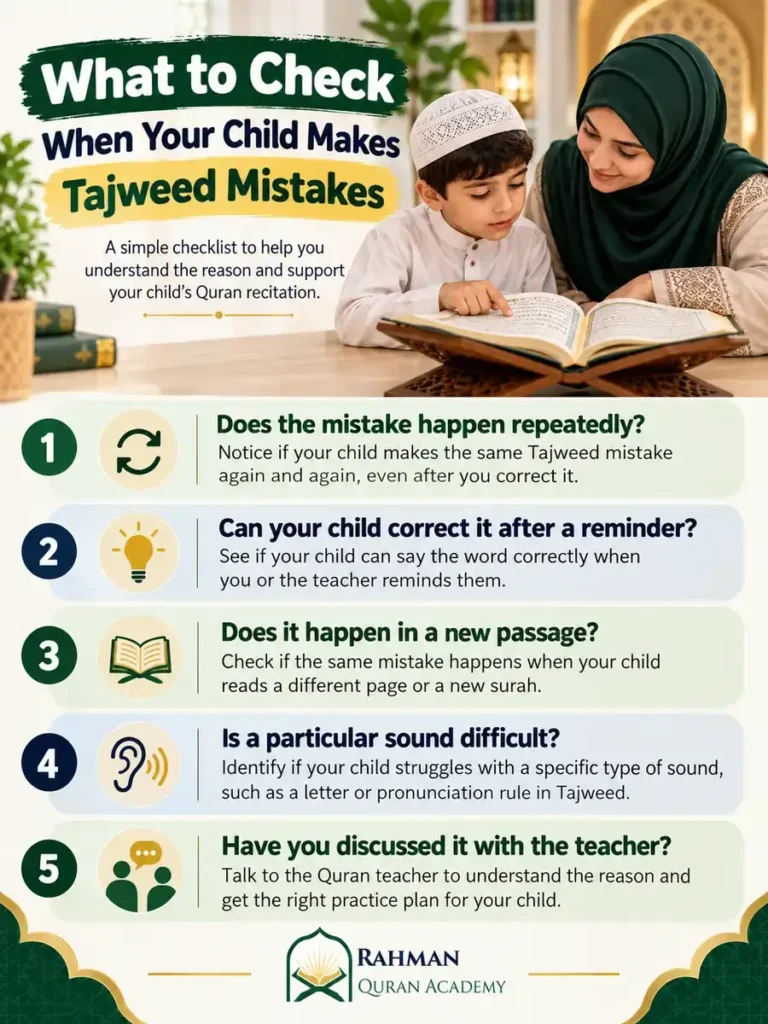
Consider these questions:
- Does the mistake occur in every lesson or only occasionally?
- Does the child correct it after a reminder?
- Does the same difficulty appear in a new passage?
- Does the child struggle to produce a sound, or do they mainly forget to apply a rule?
- Has the teacher noticed improvement when checking the same skill again later?
These observations can make a conversation with the teacher more productive. They should not be used to label a child as careless, slow or unable to learn.
For more general guidance on recurring Quran reading difficulties, see Why Do Children Make Quran Reading Mistakes — And How to Help. That article covers wider reading difficulties; this guide focuses specifically on mistakes that continue after Tajweed instruction.
What Should You Ask Your Child’s Quran Teacher?
If your child repeatedly makes the same Tajweed mistakes, ask the teacher to explain the specific difficulty and the plan for practising it.
Useful questions include:
- Which particular Tajweed skill is my child struggling to apply?
- Is the difficulty related to understanding the rule, recognising it, or producing the sound?
- Can my child apply the rule without a reminder?
- Does the same difficulty appear in unfamiliar passages?
- What short practice should we follow between lessons?
- How will we check whether the improvement continues in future lessons?
A good teacher should be able to explain the learning goal in language you can understand, demonstrate the relevant skill, and give feedback appropriate to your child’s level.
You can also read What Makes a Good Quran Teacher for Children? for more guidance on teaching quality.
How Can You Support Your Child Between Tajweed Lessons?
Home practice should reinforce what the teacher has taught rather than introduce a collection of new rules.
Try these simple steps:
- Follow the teacher’s chosen focus. Ask which one skill your child should practise first.
- Keep practice manageable. A short, focused session may be more useful than asking your child to repeat a long passage without a clear goal.
- Listen without interrupting constantly. Notice the difficulty and discuss it with the teacher if you are unsure how to correct it.
- Use the teacher’s demonstration. Encourage your child to follow the pronunciation or recitation model provided during the lesson.
- Check progress again later. Ask the teacher whether the skill is improving in both practised and unfamiliar material.
Parents can also use Quran.com’s word-by-word recitation feature as a supplementary listening aid. However, a qualified Quran teacher should check your child’s Tajweed and pronunciation.
Avoid putting pressure on your child to recite perfectly after every lesson. Learning accuracy takes practice, and children may need different amounts of support for different skills.
For additional advice on practice between lessons, read How to Practise Tajweed at Home Between Lessons.
How Do You Know Whether Your Child Is Improving?
Progress is not measured only by the number of rules a child can name or by completing a particular lesson.
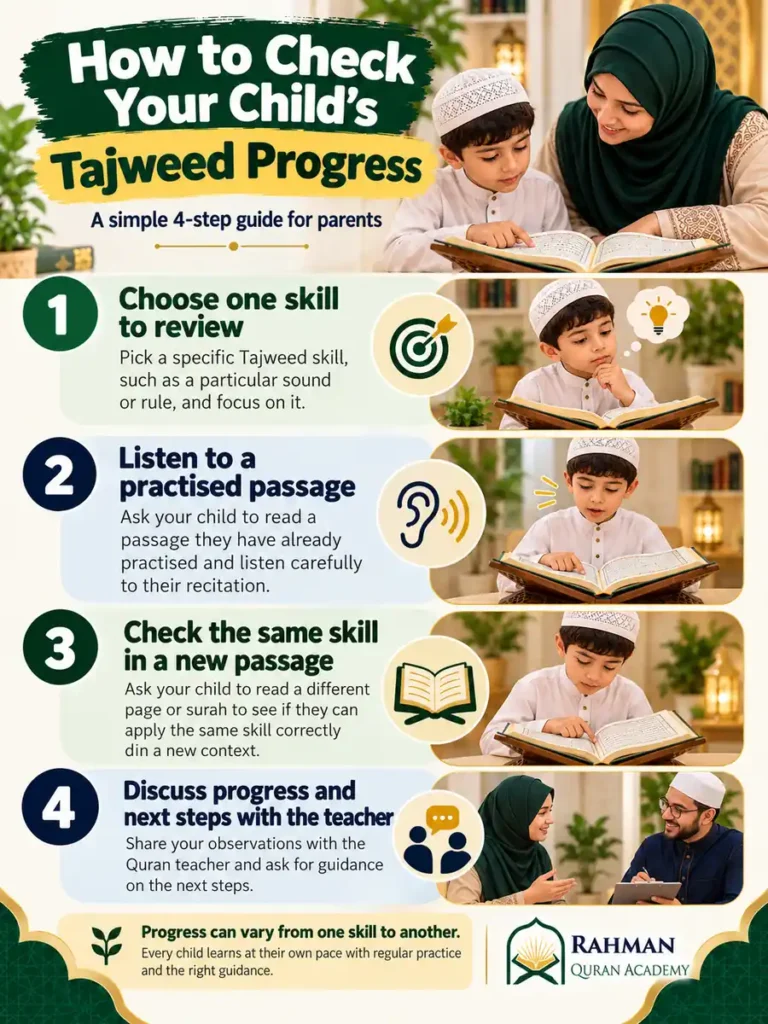
More useful signs include:
- The child applies the target skill more consistently.
- The child needs fewer reminders for the same difficulty.
- The child can use the skill in a passage they have not practised repeatedly.
- The teacher can identify specific improvements and explain what still needs work.
Progress may not be identical across every Tajweed rule. A child might improve in one area while needing more practice in another.
If the same difficulty continues, ask the teacher to reassess the specific skill and adjust the practice rather than simply repeating the same explanation.
Frequently Asked Questions
Why does my child keep making the same Tajweed mistakes?
Your child may understand the rule but still be learning to recognise and apply it consistently during recitation. The teacher can assess where the difficulty occurs and choose focused practice.
Does repeating a Tajweed mistake mean my child has forgotten the rule?
Not necessarily. A child may remember a rule but struggle to apply it independently, produce a sound accurately or use the rule in an unfamiliar passage.
Should I correct every Tajweed mistake my child makes?
Parents should follow the teacher’s guidance rather than attempt technical corrections they are unsure about. Ask the teacher which skill to focus on and how to support practice at home.
Why does my child recite familiar passages better than new ones?
Repeated practice can make familiar material easier. New passages help show whether the child can recognise and apply the same skill in a different context.
How can I tell whether my child is improving in Tajweed?
Look for more consistent application, fewer reminders, and better performance when the skill is checked again later. Ask the teacher for specific examples of progress.
Should my child learn more Tajweed rules if they still make mistakes?
Not automatically. The teacher should first assess whether the current difficulty involves understanding, recognising or applying a rule. More explanations alone may not address the underlying difficulty.
Help Your Child Build More Accurate Quran Recitation
If your child has learnt Tajweed rules but continues to repeat mistakes, the next step is to identify the particular skill that needs attention. Focused teaching, suitable practice, and clear feedback can help children work towards more consistent recitation.
At Rahman Quran Academy, you can explore online Tajweed classes and discuss your child’s learning needs with a teacher.