
Why Do Children Make Quran Reading Mistakes: And How to Help
Children commonly make Quran reading mistakes because Arabic sounds, letter forms, vowels and Tajweed patterns can be unfamiliar, while rushing, inconsistent practice and limited feedback can reinforce errors. The most useful approach is to identify the exact mistake, understand why it is happening, practise the specific skill slowly, and recheck it before moving on. A qualified teacher is best to review persistent pronunciation or Tajweed problems.
For a broader guide to teaching the Quran to children, see our complete guide to teaching the Quran to children.
Why Do Children Make Quran Reading Mistakes?
Most reading mistakes come from a combination of factors rather than a single cause: the sounds and letter forms of Arabic are still new, reading foundations are still developing, and the way practice happens at home can either reinforce accuracy or let small errors settle in.
Arabic Sounds May Be Unfamiliar
Several Arabic letters don’t have an equivalent sound in English, and some are close enough to each other that they’re easy to mix up. A 2022 study of preschool-age Quran learners found various pronunciation errors involving Arabic articulation points and letter qualities, including substitution of difficult Arabic consonants. It noted that learners’ mother-tongue sound patterns could influence how those consonants were produced. That study was conducted in Malaysia rather than the UK, but the underlying pattern a child’s home-language sounds shaping how they approach unfamiliar Arabic letters is a reasonable one to expect wherever a family’s everyday language differs from Arabic.
Letter Shapes and Joining Can Cause Confusion
Arabic letters change shape depending on where they sit in a word, which is a genuinely different skill from recognising a fixed letter shape. A child can know a letter’s sound perfectly well in isolation and still hesitate or misread it once it’s joined to others.
Harakat and Reading Patterns Are Easy to Miss
The short vowel marks (harakat) are small and easy to skip over, especially when a child is focused on the letters themselves. Missing or swapping a harakah changes the sound of the word, even when the letters are read correctly.
Rushing Can Hide Errors
When a child reads quickly, mistakes can slip past unnoticed by the child and sometimes by the listener too. Speed on its own isn’t the problem; reading faster than a child can currently read accurately is.
Inconsistent Practice Can Reinforce Mistakes
Gaps between practice sessions make it easier for an error to be repeated a few more times before anyone catches it. A 2026 systematic review of 20 studies on early-childhood Quran reading found recurring challenges around Hijaiyah letter recognition, makhraj (articulation points) and basic Tajweed, and highlighted inconsistent continuity of learning at home as a recurring theme across the research.
Limited or Delayed Feedback Can Let Patterns Become Habits
If a mistake isn’t picked up on for a while, the child simply practises the incorrect version more than the correct one. This is one of the more fixable causes, and it’s the main reason a clear, early feedback loop matters more than long practice sessions.
Is It Normal for Children to Make Quran Reading Mistakes?
Yes, mistakes are a normal part of learning to read the Quran. What matters more than any single mistake is whether it’s a one-off slip or a pattern that keeps returning.
Normal Learning Errors vs Persistent Patterns
A mistake made once or twice, especially on a new word or rule, is a typical part of learning. A mistake that shows up in the same way across several sessions the same sound substituted, the same harakah missed, the same rule ignored is a pattern worth paying closer attention to.
When a Mistake Deserves Extra Attention
A mistake is worth focusing on when it repeats consistently, when it changes the meaning of a word, or when the child doesn’t seem to notice it even after it’s been pointed out. This isn’t about judging how “serious” a mistake is in a religious sense; it’s simply about which errors are worth spending practice time on first.
What Are the Most Common Quran Reading Mistakes Children Make?
These are recurring patterns that come up often in how children read, rather than a fixed or universal ranking.
Confusing Similar Arabic Letters and Sounds
Letters that look or sound close to each other are a common source of confusion. For example, a child may confuse ذ with ز, ح with ه, ق with ك, or ص with س. Which pairs cause trouble for a given child often depends on their home language and which sounds are new to them, so these examples are illustrative rather than a fixed list every child will struggle with.
Misreading Harakat
Fathah, kasrah and dammah can be misread or missed altogether, particularly when a child is still building confidence with the letters themselves.
Stretching Madd Incorrectly
Elongated letters (madd) can be held too briefly or too long, affecting the rhythm and, depending on the word and rule involved, the correctness of the recitation.
Missing or Misapplying Basic Tajweed Rules
At a beginner level, this usually shows up as a rule simply not being applied yet, rather than a technical error; for example, not softening a sound where a Tajweed rule calls for it.
Reading Too Quickly
Accuracy is sacrificed for finishing the page. This is closely related to, but distinct from, reading fluency as a skill in its own right.
Stopping or Starting in the Wrong Place
Awareness of waqf (stopping) signs takes time to build, and children often either stop mid-phrase or read straight through where a pause was intended.
Guessing Instead of Reading the Text
This is especially common with familiar or frequently repeated passages, where a child may recite from memory rather than genuinely reading what’s on the page.
Forgetting Letter Forms When They Change Position
A letter that’s easy to recognise on its own can be harder to spot once it changes shape at the start, middle or end of a word.
Repeating the Same Mistake After Correction
This one is less about the technical category of error and more about what it tells you: if a mistake keeps coming back after being corrected, the correction likely isn’t addressing the actual cause yet.
How Can You Work Out What Mistake Your Child Is Actually Making?
This is often more useful than knowing the name of the mistake. “Practise more” only helps once you know what, specifically, needs practising.
Listen to the Same Word or Letter More Than Once
A single misread word doesn’t tell you much on its own. Hearing it two or three times across a session gives you a much clearer picture of whether it’s consistent.
Separate Recognition From Pronunciation
Ask, in effect: does the child know which letter this is, or do they know the letter but say it slightly wrong? These are two different problems with two different fixes.
Check Whether the Error Happens Every Time
An error that only appears when a child is tired, rushing or reading something new is a different issue from one that happens consistently, regardless of context.
Isolate the Smallest Part That Is Going Wrong
Rather than treating a whole line as “wrong,” narrow it down to the specific letter, harakah or rule that’s actually causing the mistake.
Compare Before and After Correction
Once you’ve corrected something, listen for whether it holds in the same word, and later in a different word using the same sound or rule.
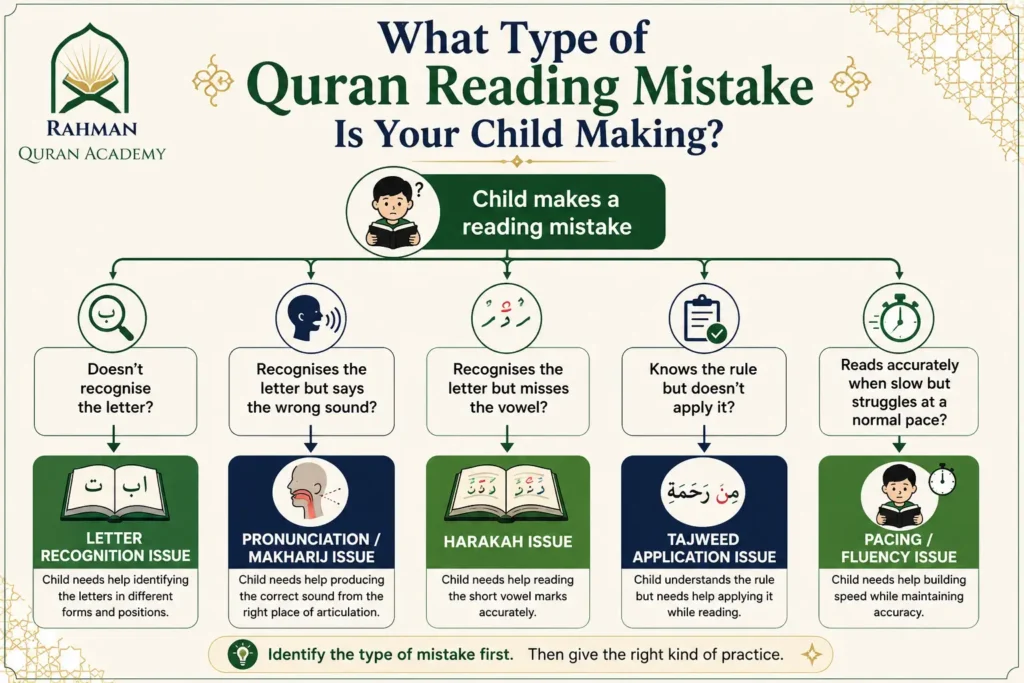
A simple way to work through this:
● Doesn’t recognise the letter at all → letter recognition issue
● Recognises the letter but says the wrong sound → pronunciation / makhraj issue
● Recognises the letter but misses the vowel → harakah issue
● Knows the rule but doesn’t apply it → Tajweed application issue
● Reads accurately when slow but not at a normal pace → pacing issue (see our guide to Quran reading fluency)
Don’t correct the whole page when the problem is really one specific sound. Isolating the exact issue first makes every practice session more effective.
Hypothetical example: a parent notices their child reads the letter ذ as ز every time it appears. Listening closely shows the child recognises the letter correctly but consistently produces the wrong sound a pronunciation issue rather than a recognition one. The parent isolates just that sound for a few short practice sessions, then checks whether it holds in new words a few days later.
How Do You Correct Quran Reading Mistakes?
A simple, repeatable framework helps here more than any single technique:
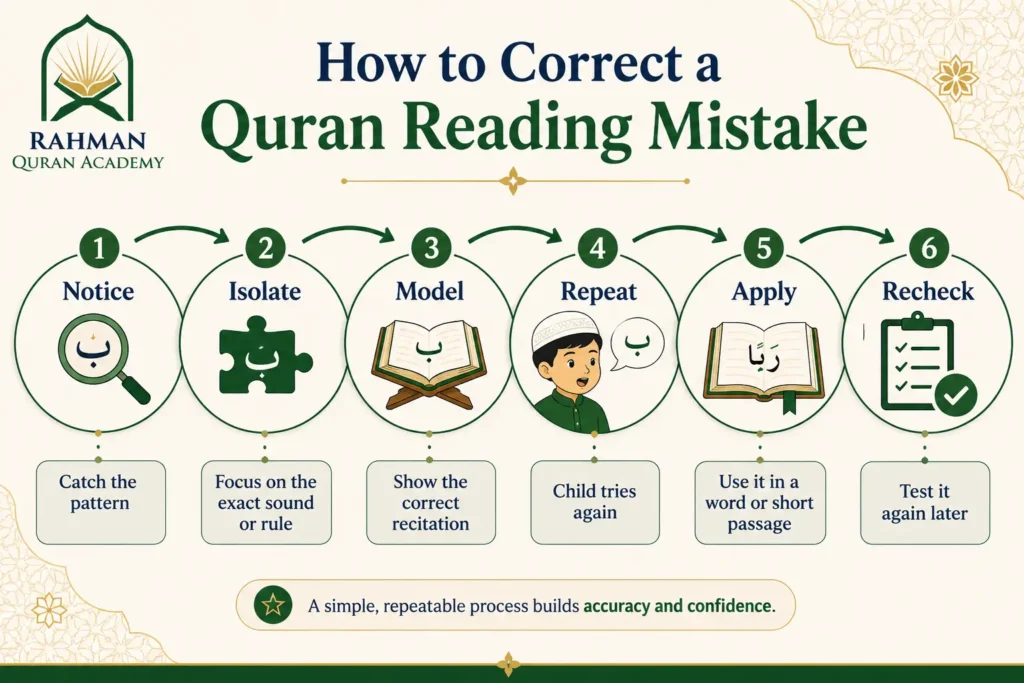
Notice → Isolate → Model → Repeat → Apply → Recheck
Notice
Catch the mistake as it happens, without necessarily interrupting mid-sentence.
Isolate
Pull out the specific sound, word or rule that’s causing the problem, rather than the whole line.
Model
Say the correct version clearly, so the child hears exactly what it should sound like.
Repeat
Let the child say it back, more than once if needed, until it sounds right in isolation.
Apply
Have the child use it again within a word or short passage, not just on its own.
For structured Quran reading practice and correction, see our [Quran Reading Classes].
Recheck
Come back to it later in the session, and again a few days on to see whether the correction has actually stuck.
A 2026 case study on the Yanbu’a teaching method described an approach built around initial-level assessment, direct reading, immediate correction and continuous evaluation in that particular school setting. It’s a single case study rather than universal proof, but the general shape assess, correct immediately, keep checking lines up closely with the cycle above.
What If Your Child Keeps Making the Same Mistake?
A mistake that returns after correction usually means the correction hasn’t fully addressed the cause yet, not that the child isn’t trying.
Check Whether the Child Actually Understands the Correction
Sometimes a child repeats a correction back accurately in the moment without really grasping what changed. Asking them to explain it in their own words can reveal this.
Reduce the Practice Target
Narrow the focus further to one sound, one word, or one short phrase rather than practising the whole passage again.
Look for a Similar Sound or Rule Causing Confusion
A recurring mistake sometimes points to a nearby letter or rule that’s being confused with the one in question.
Revisit It Across Several Lessons
A single successful repeat doesn’t mean the correction has settled. Checking again over several sessions gives a more honest picture.
Get a Teacher to Assess Persistent Pronunciation Problems
If a specific pronunciation error keeps returning despite consistent, targeted practice, it’s worth having a qualified teacher listen and assess it directly, particularly for makhraj issues that can be hard to judge without training.
Our guide on what makes a good Quran teacher for children covers how to find the right fit.
Should You Correct Every Quran Reading Mistake Immediately?
No. Correction should be targeted enough to help the child improve without interrupting every line.
Correct the Most Important Error First
If a child makes several small slips alongside one recurring pronunciation error, it’s usually more useful to focus on the recurring error than to flag everything at once.
Let the Child Finish an Attempt When Appropriate
Constant interruption can make reading feel like a series of stops and starts rather than something the child can build confidence in.
Avoid Overcorrecting Minor Slips
Not every small slip needs to be addressed in the moment; some settle on their own with continued reading.
Revisit Previously Corrected Errors
Set aside a little time to check on mistakes that were corrected earlier, rather than only ever focusing on what’s new.
How Can Parents Help at Home Without Becoming the Quran Teacher?
Parents can support practice and observation, but shouldn’t guess at unfamiliar pronunciation they’re not confident about themselves.
Listen Regularly
Frequent, short listening sessions can make recurring patterns easier to notice than occasional long sessions.
Practise the Exact Error
Once a specific mistake has been identified, ideally with input from the teacher, practise that, rather than re-reading the whole page each time.
Use Short Focused Repetition
A few minutes focused on one sound or word can be easier to manage and more useful than a longer session that isn’t targeted. For a fuller look at building a home practice routine, see our guide on how to start teaching your child the Quran.
Tell the Teacher Which Mistakes Keep Returning
Passing on what you’ve noticed at home helps the teacher focus lesson time on what actually needs it.
What If My Child Becomes Afraid of Making Mistakes?
The goal of correction is to improve recitation, not make the child afraid to attempt it.
Avoid Shame and Comparison
Comparing a child’s reading with a sibling’s or classmate’s, or reacting strongly to mistakes, can make some children more reluctant to read aloud or try again.
Explain the Correction Clearly
A brief explanation of what changed and why helps the correction make sense, rather than feeling arbitrary.
Give the Child Another Attempt
A chance to try again straight away, calmly, reinforces that a mistake is simply something to fix, not something to dwell on.
Praise Improvement Without Pretending Mistakes Don’t Matter
Acknowledging progress doesn’t mean lowering the standard it means recognising effort while still working toward accuracy.
Parent and teacher discussions online often describe harsh correction, comparison between children, and pressure to get things right the first time as real experiences that some families have gone through. These are anecdotal accounts rather than research findings, but they point to a consistent theme: harsh or humiliating correction can make some children more reluctant to read aloud or try again, while calm, specific correction tends to keep them willing to keep attempting.
When Is a Quran Teacher Needed for Reading Mistakes?
Teacher support becomes especially important when a child has persistent pronunciation or Tajweed errors that a parent cannot confidently identify or correct.
For structured support from a qualified teacher, explore our [Kids Quran Classes].
Persistent Pronunciation Problems
A sound that doesn’t improve despite repeated, targeted practice at home is a reasonable point to bring in a teacher’s ear.
Repeated Tajweed Errors
Rules that keep being missed or misapplied, even after they’ve been explained, often benefit from a teacher demonstrating them directly.
For guided Tajweed learning and correction, see our [Tajweed Classes].
Correction Is Not Sticking
If the Notice → Isolate → Model → Repeat → Apply → Recheck cycle isn’t producing lasting change after a reasonable amount of practice, that’s a sign the issue may need more expert attention than home practice alone can give.
The Parent Is Unsure What They Are Hearing
Some pronunciation differences are genuinely difficult to judge without training in Arabic articulation, and there’s no need to guess. For guidance on choosing the right teacher, see what makes a good Quran teacher for children.
How Do You Know if the Mistake Is Actually Improving?
The Same Error Happens Less Often
A drop in frequency, even before it disappears completely, is a genuine sign of progress.
The Child Corrects It With Less Prompting
Needing fewer reminders to get it right is often a better sign of learning than getting it right once.
The Skill Holds in New Words or Verses
If the correction only works in the exact word it was taught in, it hasn’t fully transferred yet. Holding up in new words is a stronger sign it has.
The Error Does Not Return After a Few Days
A short gap followed by a recheck gives you a better indication of whether the correction has genuinely settled, rather than only being remembered in the moment.
How Can You Prevent Quran Reading Mistakes From Becoming Habits?
Build Accurate Foundations
Getting letters and basic sounds right early makes everything that follows easier to build on.
Review Before Moving Too Quickly
Revisiting recent pages before moving on to new ones helps catch small errors before they’re practised into habits.
Practise Difficult Patterns Regularly
Sounds or rules a child finds harder benefit from occasional, ongoing practice rather than being left behind once “corrected”.
Use Feedback Before Errors Become Routine
The sooner a mistake is noticed and addressed, the less practice it’s had to become a habit. This is really the same principle behind the whole approach in this article, applied consistently over time.
Parent Quick Reference
| Situation | What to do |
| One recurring pronunciation error | Isolate and practise it |
| Several small slips in one passage | Let child finish, then review |
| Child doesn’t understand the correction | Model it again, more simply |
| Error keeps returning | Track it and involve the teacher |
| Child becomes distressed | Reduce pressure and adjust correction |
Frequently Asked Questions
Is it normal for children to make mistakes when reading the Quran?
Yes. Mistakes are a normal part of learning to read. What matters is whether a mistake is a one-off or a pattern that keeps repeating.
What is the most common Quran reading mistake children make?
There isn’t strong evidence for a single universal “most common” mistake; it varies by child, home language and stage of learning. Recurring patterns that come up often include confusing similar letters, missing harakat, and reading too quickly for accuracy.
How can parents help correct Quran reading mistakes?
By listening regularly, isolating the specific mistake rather than correcting a whole page at once, practising that exact error in short focused sessions, and letting the teacher know which mistakes keep returning.
Should children learn Tajweed from the beginning?
Basic Tajweed awareness is usually introduced gradually alongside reading, rather than all at once. The right pace depends on the child and is best guided by their teacher.
How much should a child practise Quran reading?
This depends on the child’s age, stage and attention span, so there’s no single figure that fits every family. Short, focused, and consistent practice tends to be more useful than occasional long sessions.
How can I make Quran reading less stressful for my child?
Calm, specific correction, avoiding comparison with other children, and giving another attempt straight after a mistake all help keep reading a low-pressure activity rather than one the child dreads.
Can Quran reading mistakes be corrected without a teacher?
Minor, occasional slips can often be worked on at home using consistent, targeted practice. Persistent pronunciation or Tajweed errors, especially ones a parent isn’t confident identifying, are best reviewed by a qualified teacher.
When should a child get professional Quran reading correction?
When a specific mistake keeps returning despite targeted home practice, when a parent isn’t sure what they’re hearing, or when a Tajweed rule keeps being missed after it’s been explained.
Related reading:
● A complete guide to teaching the Quran to children
● How to start teaching your child the Quran
● Quran reading fluency
● What makes a good Quran teacher for children
Explore our Quran Reading, Tajweed, and Kids Quran Classes services.