What Makes a Good Quran Teacher for Children?
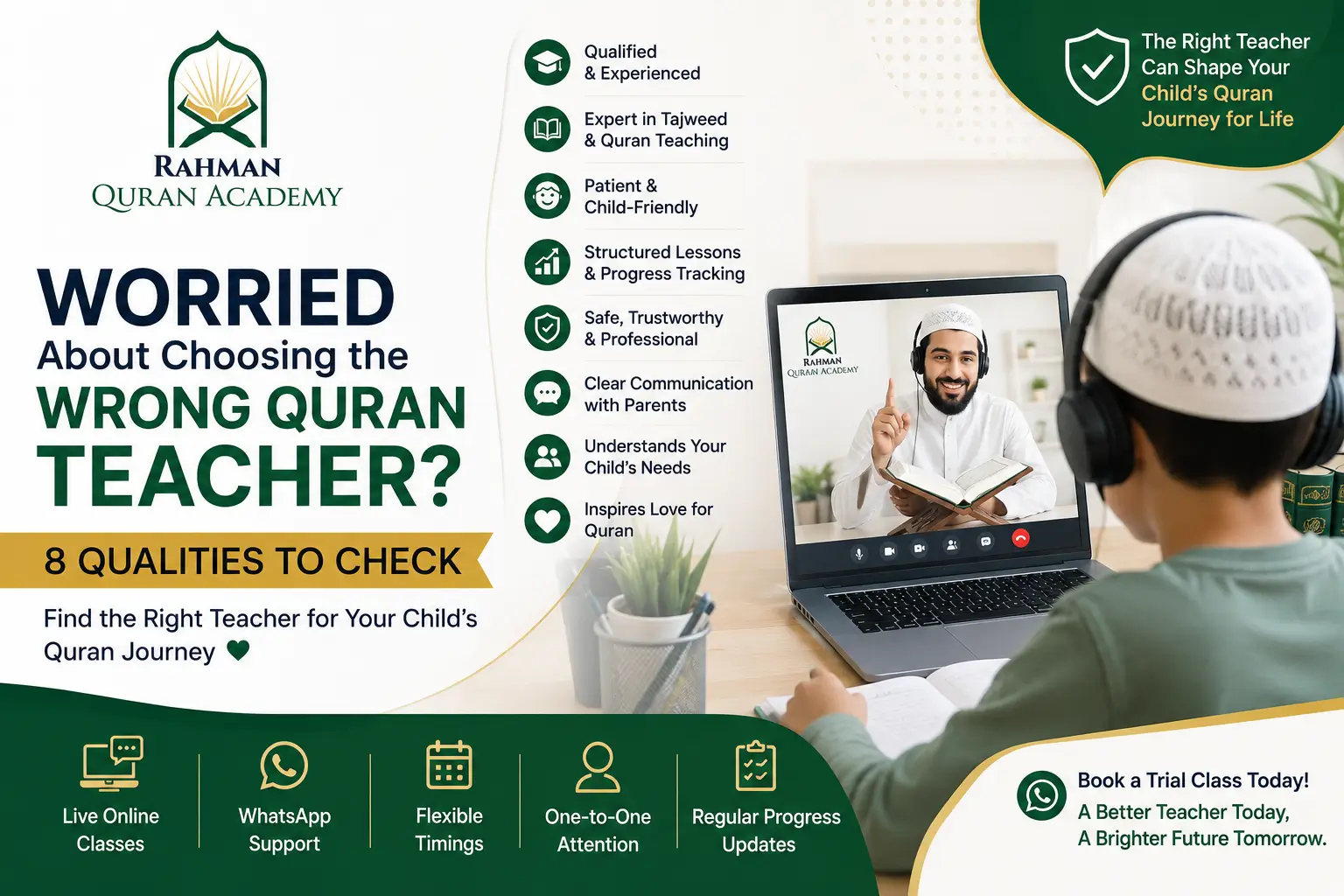
A good Quran teacher for children needs two things together: strong Quranic knowledge and the ability to teach children effectively. They should recite correctly, understand Tajweed, explain clearly, correct gently, adapt to the child’s level and personality, keep lessons engaging, communicate with parents and maintain appropriate safeguarding standards.
For a broader guide to the different stages of teaching children the Quran, see our Teaching the Quran to Children guide.
What Qualities Should a Good Quran Teacher Have?
Knowledge and teaching ability are not the same skill. A teacher needs both to be genuinely effective with a child.
Correct Quran Recitation and Tajweed
The teacher’s own recitation should be accurate, with sound Tajweed and correct Makharij (letter pronunciation points). This is the foundation everything else is built on. See our [Quran Reading Classes] for structured support in developing accurate Quran reading.
Ability to Teach, Not Just Recite
Reciting well is not the same as explaining well. A good teacher can break a rule down, demonstrate it, and check that the child has actually understood it.
Patience and Gentle Correction
Children repeat mistakes. A good teacher expects this and responds each time calmly, rather than treating repetition as defiance.
Understanding Children and Individual Needs
Every child learns at a different pace and responds differently to correction. A good teacher notices this and adjusts rather than applying one method to every child.
Clear, Engaging Communication
Explanations should match the child’s age and comprehension. A concept explained the same way to a six-year-old and a twelve-year-old usually loses one of them.
Structured Lessons and Visible Progress
Good lessons follow a recognisable shape: review, new learning, guided practice, correction, recap. Parents should be able to see what was worked on and why.
Good Parent Communication
Parents need to know what their child is working on, what needs practice at home, and what progress actually looks like.
Appropriate Safeguarding and Professional Boundaries
For UK families, this includes clear policies on child protection, appropriate conduct during online lessons, and a process for raising concerns.
Is a Teacher Who Recites Well Automatically a Good Teacher?
No.
Recitation ability is essential, but it is not the same skill as teaching a child. Teaching also requires explanation, adaptation, patience and the ability to hold a young learner’s attention.
A teacher may hold Hafiz or Qari status and recite beautifully, yet still struggle to explain a simple Tajweed rule to a six-year-old in a way the child can actually apply. Qualifications show what the teacher knows. They do not, on their own, show whether the teacher can pass that knowledge on to a child.
Knowing the Quran vs Teaching the Quran
| Knowing the Quran | Teaching the Quran |
| Correct recitation | Explains clearly for the child’s age |
| Sound Tajweed | Adapts to the child’s level |
| Broad Quranic knowledge | Corrects gently and clearly |
| Formal credentials (Ijazah, Hafiz, Qari) | Keeps the child engaged |
| Measures and explains progress |
How Should a Good Quran Teacher Correct a Child’s Mistakes?
Good correction follows a clear process, rather than interrupting every second word.
For a closer look at recurring reading problems and how to address them, see our guide to Quran reading mistakes.
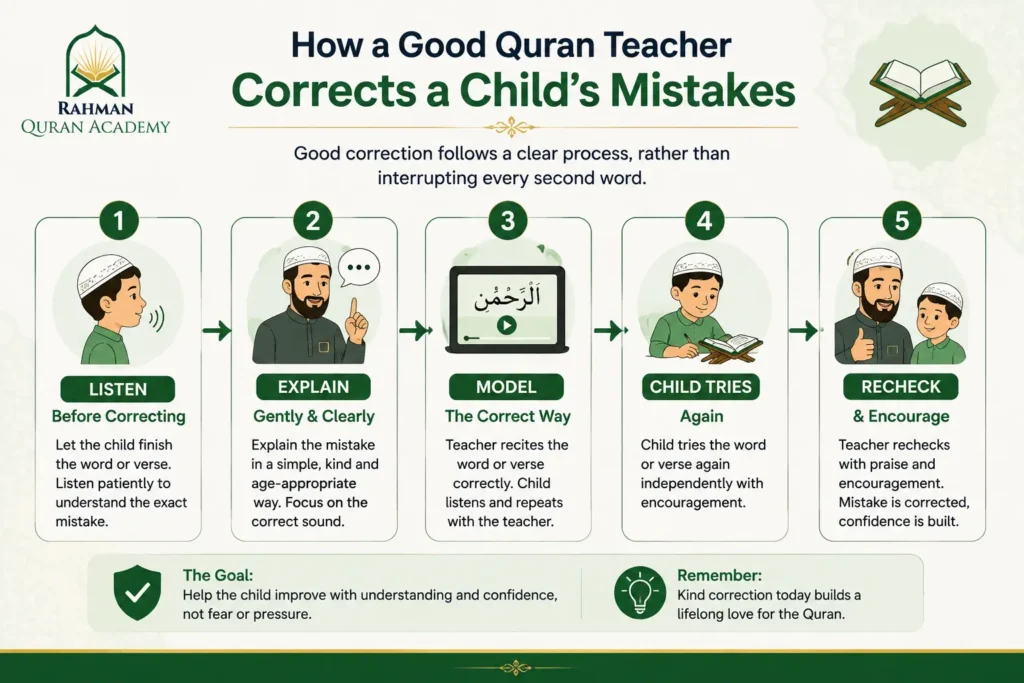
Listen Before Correcting
Let the child finish the phrase or ayah before stepping in, so the correction is specific rather than constant.
Explain the Specific Problem
Name the exact issue: a Makhraj, a Tajweed rule, a missed letter rather than a vague “try again.” For more structured Tajweed practice, see our Tajweed Classes.
Model the Correct Recitation
Demonstrate the correct sound or rule so the child has something concrete to copy.
Let the Child Try Again
Give the child the chance to apply the correction immediately, while it’s fresh.
Recheck Later
A good teacher returns to the same point later in the lesson or in a future lesson to see whether it has actually been retained.
Research on Quran recitation teaching highlights the value of corrective feedback and teacher modelling when developing accurate recitation. A 2013 study of 84 Omani students found that groups receiving immediate corrective-feedback methods performed better than the control group in applying Quranic recitation rules.
How Can a Teacher Make Quran Lessons Work for Different Children?
No single method suits every child. A good teacher adjusts the lesson to the learner in front of them.
Different Quran Levels
A child starting Noorani Qaida needs a very different lesson from a child already reading fluently.
For more on how to begin this stage, see our guide on how to start teaching your child the Quran.
Different Learning Speeds
Some children need more repetition before a rule sticks. A good teacher paces the lesson to the child, not the syllabus.
Shy or Hesitant Children
Some children need more encouragement and a slower build-up to reciting aloud with confidence.
Easily Distracted Children
Shorter, more focused segments and clear structure help maintain attention without frustration.
Children With Additional Learning Needs
Children with SEN or other additional learning needs may need adapted pacing, materials or explanations. A good teacher adjusts their approach without making medical judgements about the child.
Should a Quran Teacher Be Strict or Gentle?
Firm about standards. Gentle in delivery.
Good teaching holds high expectations for accuracy while delivering correction calmly. Gentleness does not mean a lack of discipline, and firmness does not mean harshness; the two work together, not against each other.
The Quran itself points to this balance. Surah Al-Imran (3:159) describes gentleness in how guidance is delivered, and Surah An-Nahl (16:125) speaks of calling to wisdom with good instruction.
During a trial lesson, this is easy to observe: watch how the teacher responds the moment a child makes a mistake. That moment can tell you a great deal about the teacher’s approach, beyond what a profile alone can show.
How Should a Good Quran Lesson Be Structured?
A well-structured lesson gives parents something concrete to check against, not just a vague sense that “the lesson went fine”.
• Quick review
• One clear learning goal
• Guided practice
• Child recitation
• Specific correction
• Short recap
• Clear next step
If a lesson is mostly teacher talk, with very little time for the child to recite, it is worth asking whether the lesson is giving the child enough active practice.
How Can Parents Tell Whether the Teacher Is Helping Their Child Progress?
Progress should be visible in skills, not just in pages completed.
The Child Can Explain What They Are Working On
If a child can explain, in simple terms, what they are practising, that can be a useful sign that the lesson goal has been communicated clearly.
Repeated Errors Are Being Addressed
The same mistake shouldn’t keep recurring without any change in approach.
Reading or Tajweed Is Improving
Accuracy and fluency should be moving in the right direction, even gradually.
For more on helping a child develop smoother Quran reading, see our guide to Quran reading fluency.
Confidence Is Growing
A hesitant child should become more willing to recite over time.
The Teacher Can Explain What Comes Next
A good teacher should be able to answer “what’s the next target?” clearly and specifically.
Progress speed varies between children; there is no fixed rate every child should be expected to match.
How Important Is Parent-Teacher Communication?
Communication is how parents stay involved without sitting in on every lesson.
Can the Teacher Explain the Child’s Current Level?
A vague answer here is a warning sign.
Does the Parent Know What to Practise?
Home practice only works if the parent knows what to focus on.
Are Concerns Taken Seriously?
A good teacher listens to a parent’s concern rather than dismissing it.
Is Progress Communicated Regularly?
A useful question to ask after a trial lesson: “What should my child improve next?” A specific, clear answer is a good sign.
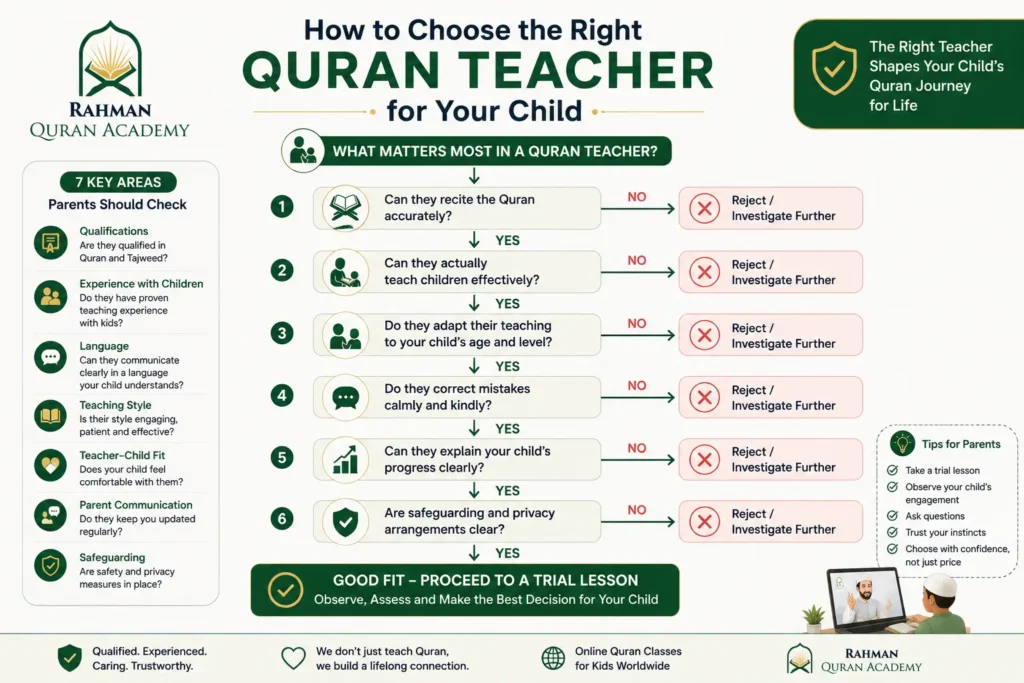
What Should Parents Check Before Choosing a Quran Teacher?
• Qualifications and recitation ability
• Experience teaching children specifically
• Language and communication (English/Urdu, as needed)
• Teaching style and approach to correction
• Teacher-child fit
• How the teacher communicates with parents
• Safeguarding practices
What Should Parents Watch During a Trial Lesson?
A trial lesson can tell you things a profile or list of certificates cannot show on its own.
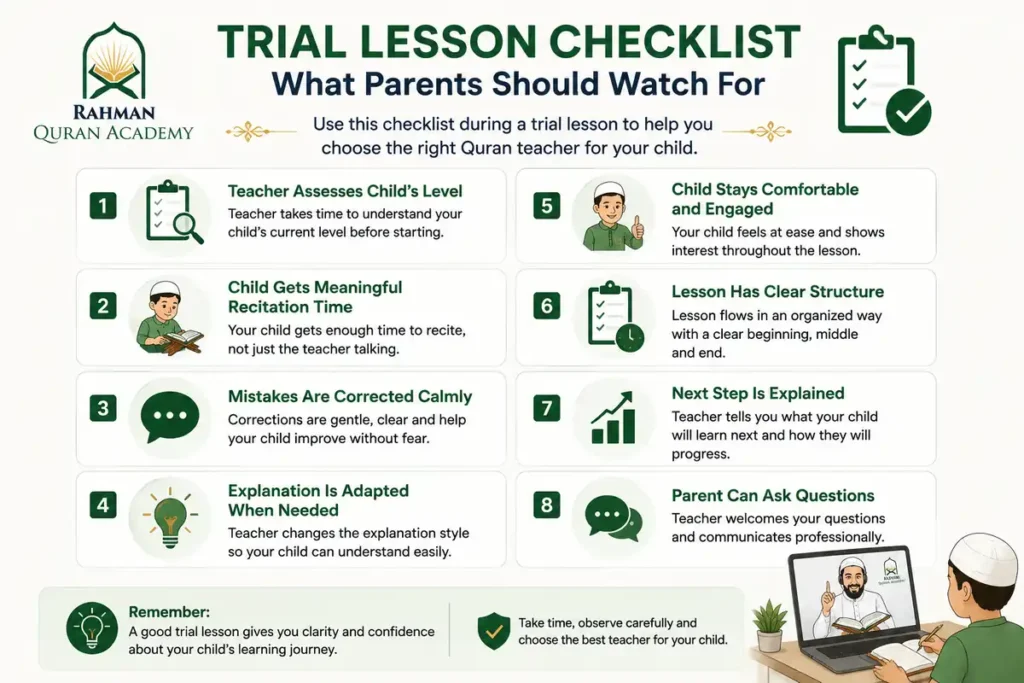
Does the Teacher Assess Your Child’s Level?
A good trial starts by finding out where the child actually is, not assuming a starting point.
How Does the Teacher Respond to Mistakes?
Watch the tone, not just the words, the moment something goes wrong.
Does the Child Get to Read Enough?
The child should be reciting for a meaningful part of the lesson, not just listening.
Does the Teacher Adjust the Explanation?
If the first explanation doesn’t land, a good teacher tries a different approach rather than repeating it louder.
Does Your Child Look Comfortable?
Body language and willingness to try again are strong signals.
Does the Teacher Explain the Next Step?
A trial should end with some sense of what comes next, not just “see you next time.”
Department for Education guidance for parents in England recommends asking questions, checking safeguarding arrangements and meeting or observing the provider before committing to a tutor or out-of-school setting. For one-to-one tuition, parents may also wish to supervise part of a session.
Good Teacher Trial Checklist
☐ Assesses child’s level
☐ Lets child recite
☐ Corrects clearly
☐ Explains patiently
☐ Adapts when child struggles
☐ Keeps child engaged
☐ Gives a clear next step
☐ Communicates with parent
What Are the Red Flags of a Poor Quran Teacher?
These are warning signs parents should take seriously, including concerns raised in parent and learner discussions.
Anger, Humiliation or Physical Punishment
None of these has a place in teaching a child, regardless of the mistake made.
Teacher Ignores the Child’s Learning Needs
Applying the same method regardless of how the child is responding to it.
No Clear Progress or Lesson Structure
Lessons that feel repetitive with no sense of building toward anything.
Parent Concerns Are Dismissed
A teacher who brushes off a parent’s question rather than addressing it.
Unrealistic Workload or Pressure
Homework or expectations that don’t match the child’s age or current level.
Poor Boundaries or Safeguarding Practices
Unclear policies, no complaints process, or inappropriate conduct during lessons.
Repeated Cancellations or Unreliable Communication
Frequent last-minute changes with little explanation.
Good Signs vs Red Flags
| Good Signs | Red Flags |
| Calm, specific correction | Shouting or humiliation |
| Child feels comfortable | Fear-based compliance |
| Structured lessons | No adaptation to the child |
| Clear, regular feedback | No explanation of progress |
| Adapts to the child | Parent concerns dismissed |
| Visible progress over time | Weak safeguarding practices |
For a fuller checklist on keeping your child safe in online Quran lessons, see our online Quran classes safety checklist.
Does the Teacher’s Gender or Language Matter?
It can matter for comfort and communication, but neither gender nor language alone determines teaching quality.
When a Female Teacher May Be the Family’s Preference
Some families, particularly for daughters, prefer a female teacher for comfort. This is a reasonable and common preference, not a requirement. See our female Quran teacher options for families who prefer this arrangement.
When Language Compatibility Matters More
What matters most is that the teacher can communicate at the child’s level of understanding — whether that’s English, Urdu, or a mix of both.
Why Fit Matters More Than a Simple Rule
A good female teacher and a good male teacher can both teach a child well. The deciding factor is fit with the individual child, not a blanket rule about gender.
How Do You Know When a Teacher Is the Right Fit?
The fit is strong when the child is learning accurately, engaging willingly, receiving appropriate correction, and the parent knows what progress looks like.
Your Child Feels Comfortable Trying
Willing to recite and to make mistakes without fear.
The Teacher Understands the Child’s Level
Lessons are pitched at the right point, not too easy or too advanced.
Correction Is Clear and Calm
Mistakes are addressed constructively, every time.
Lessons Have Structure
There’s a visible shape to each session.
Progress Is Visible
Skills are genuinely improving, even gradually.
Parent and Teacher Can Communicate
Questions get clear, specific answers.
If these signals are present, it’s usually worth continuing. If problems repeat without any adaptation, it’s worth reconsidering.
Frequently Asked Questions
What makes a good Quran teacher for children?
A good Quran teacher combines strong Quranic knowledge with strong teaching ability, accurate recitation, sound Tajweed, clear explanation, gentle correction, adaptability to the child, engagement, and appropriate safeguarding.
What qualifications should a Quran teacher have?
Look for accurate recitation, sound Tajweed knowledge and relevant recognised training or an Ijazah in recitation where applicable. Hafiz or Qari status may indicate strong Quranic knowledge, but it does not by itself show that someone can teach children effectively. Qualifications matter, but they should be assessed alongside teaching ability, not instead of it.
Is an Ijazah necessary for a Quran teacher?
An Ijazah can be a valuable indication of recognised recitation training, but it does not by itself confirm that someone can teach children well.
How do I know if a Quran teacher is good with children?
Watch a trial lesson. A teacher who assesses the child’s level, lets them recite, corrects calmly, adapts explanations and ends with a clear next step is generally a good sign.
How should a Quran teacher correct a child’s mistakes?
By listening first, naming the specific issue, modelling the correct recitation, letting the child try again, and rechecking later to see whether it has been retained.
Should a Quran teacher be strict or gentle?
Both. Firm about learning standards, but gentle in how correction is delivered. Fear-based teaching is not the same as effective discipline.
How can I tell if my child’s Quran teacher is helping them progress?
Look for fewer repeated errors, improving recitation or Tajweed, growing confidence, and a teacher who can clearly explain what comes next.
What should I ask a Quran teacher before enrolling my child?
Ask about their approach to correction, how they adapt to different children, how they communicate progress, and what their safeguarding policy covers.
What should I look for in a Quran teacher trial lesson?
Whether the teacher assesses your child’s level, lets them recite, corrects clearly, adjusts their explanation if needed, and ends the lesson with a clear next step.
What are the red flags of a poor Quran teacher?
Shouting, humiliation or physical punishment, dismissing parent concerns, ignoring a child’s learning needs, unrealistic workload, weak safeguarding, and unreliable communication.
Does my child’s Quran teacher need to speak English?
Not necessarily, but the teacher does need to communicate at the child’s comprehension level, whether that’s English, Urdu, or a combination.
Should I choose a male or female Quran teacher for my child?
Either can teach well. Some families prefer a female teacher for daughters for comfort, but fit with the individual child matters more than gender alone.
Still unsure whether a teacher is the right fit for your child? A trial lesson can give you a much better answer than a teacher profile alone. Watch how they assess, teach, correct and communicate before making a longer-term decision. Explore our Kids Quran Classes and arrange a trial lesson for your child.