
Teaching the Quran to Children: A Practical Guide for Parents
Direct answer paragraph:
The best way to teach the Quran to a child is to start at an age-appropriate level, build strong reading foundations, and progress gradually towards Quran reading, Tajweed and memorisation. There is no single timeline for every child; the right approach depends on age, readiness, current ability and consistency. Parents can support learning at home, while a qualified teacher can provide structured instruction and pronunciation correction where needed.
As a parent, knowing when to start, what to teach first, whether to use a teacher, and how to fit Quran learning around school can feel confusing. Every child is different, and the amount of conflicting advice online rarely makes the decision easier.
This guide walks through the complete journey of teaching a child the Quran, from deciding when to begin through to choosing the right ongoing support, so you can make informed decisions rather than guessing.
It explains the main stages of Quran learning, how parents can support each stage, and how to choose an appropriate learning approach for your own child.
What Should Parents Know Before Teaching Their Child the Quran?
Parents should first understand that children learn at different speeds, so Quran teaching needs to be adapted to age, current ability, readiness and consistency rather than followed as a fixed programme.
Source: (Darul Iftaa Leicester)
The 4 Principles of Quran Learning for Children
No single method works for every child, and progress is rarely a straight line. A few principles apply broadly, whichever path you choose:
● Learning is progressive: reading foundations come before Tajweed or memorisation.
● Consistency matters more than intensity; short, regular sessions beat occasional long ones.
● A positive, low-pressure environment helps children stay engaged.
● A qualified teacher can be useful, particularly for pronunciation and structured progress.
A younger child may begin simply through exposure, hearing recitation, repeating short surahs, and becoming familiar with the sounds of Arabic
The rest of this guide works through each of these stages in turn, starting with the question most parents ask first: when should learning actually begin?
When Should Children Start Learning the Quran?
There is no single required age for every child. From an Islamic perspective, children differ in their mental ability and readiness, so parents should consider the individual child rather than following a fixed starting age.
Is There a Right Age to Start?
There is no universal exact age at which every child should start. A younger child may begin simply through exposure, hearing recitation, repeating short surahs, and becoming familiar with the sounds of Arabic. At the same time, structured lessons tend to work better once a child can sit, focus and follow simple instructions. Starting later is not a failure; it just means beginning from wherever your child is now.
Source: IslamQA
→ For a detailed, age-by-age guide, see: What Age Should Children Start Learning the Quran?
→ Related reading: How to Help Your Child Read the Quran More Fluently.
What Are the Signs a Child Is Ready?
A few practical signs suggest a child is ready for more structured lessons:
● Can hold focus for a short period
● Follows simple instructions
● Repeats sounds and words back accurately
● Shows some interest in learning
● Tolerates gentle correction without excessive distress
● Can take part in a short session without significant disruption
If most of these are missing, it usually makes sense to focus on informal exposure a little longer before starting formal lessons.
How Should Quran Learning Change as Children Grow?
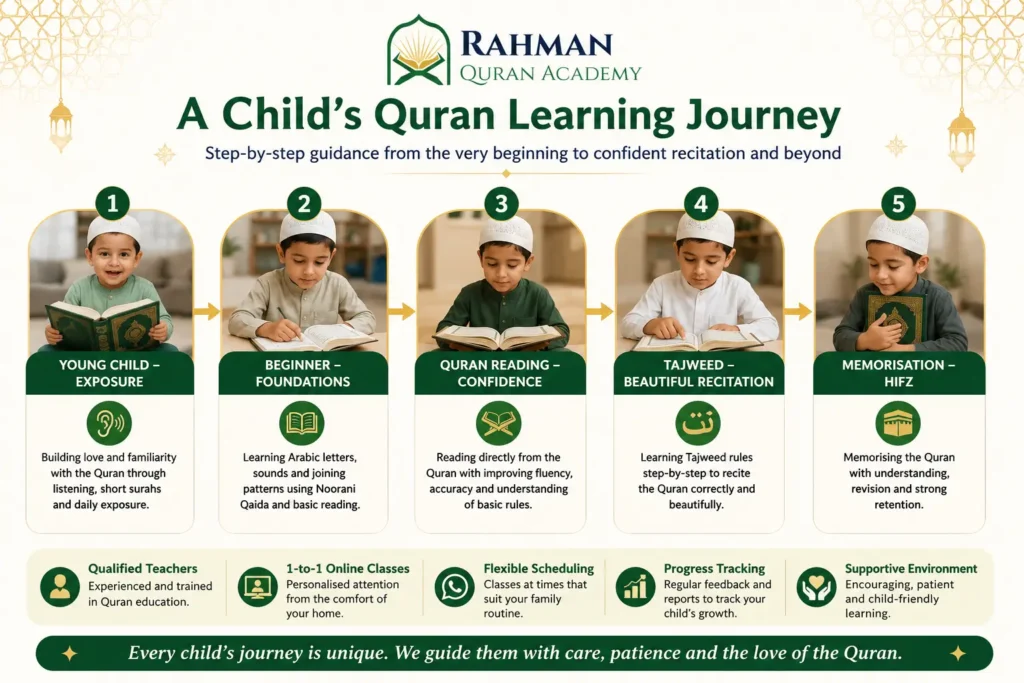
At a high level, learning tends to move through the following stages as a child develops:
● Younger children — exposure and familiarity with sounds and short surahs
● Beginners — Arabic letters and basic reading foundations
● Developing readers — reading directly from the Quran
● Confident readers — Tajweed and improved recitation
● Suitable learners — memorisation, where appropriate for the child
This is only an overview of the journey. Each stage is explained in more detail later in this guide.
Where Should a Beginner Child Start Learning the Quran?
A complete beginner should usually start with Arabic letters and reading foundations before progressing to fluent Quran reading, Tajweed and memorisation.
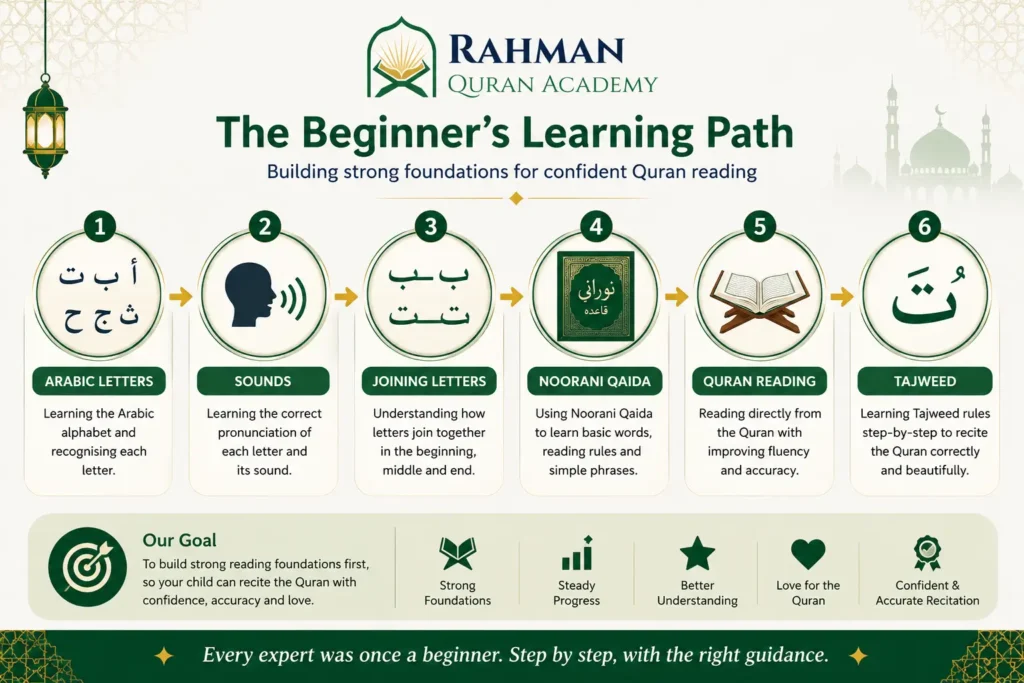
What Should a Child Learn Before Reading the Quran?
The typical sequence runs: Arabic letters, then their sounds, then joining letters together, then basic reading patterns, and finally reading directly from the Quran. Skipping ahead of this sequence tends to create pronunciation habits that are harder to correct later.
What Is Noorani Qaida?
Noorani Qaida is a commonly used beginner resource for building Arabic reading foundations, used to teach Arabic letters, sounds, and the joining and reading patterns a child needs before reading the Quran itself. It is designed specifically to prepare a child for accurate, confident Quran reading.
→ Learn more on our Noorani Qaida page.
When Should a Child Move From Qaida to Quran Reading?
Rather than a fixed number of months, the move tends to make sense once a child recognises letters confidently, reads basic letter combinations, shows improving pronunciation, and can read simple patterns with less prompting from a teacher.
When Does Tajweed Become Relevant?
Tajweed becomes increasingly relevant once a child has a basic ability to read the Quran. It can then be introduced progressively, rather than overwhelming a complete beginner with advanced pronunciation rules from day one.
→ Read more on our Tajweed page.
What Does a Child’s Quran Learning Journey Look Like?
Put together, a typical journey moves through five broad stages. This section gives the roadmap; each destination is covered in more depth elsewhere in this guide and in our supporting articles.
Arabic and Reading Foundations
Learning the Arabic letters, their sounds, basic recognition and early pronunciation the building blocks everything else depends on.
Noorani Qaida
A structured reading foundation that bridges letter recognition and confident, accurate reading of the Quran itself.
Quran Reading
Moving to the Mushaf, building accuracy and fluency, and receiving ongoing correction from a teacher.
Tajweed and Recitation
Learning correct pronunciation rules gradually, leading to clearer, more confident recitation over time.
Memorisation and Further Learning
Where appropriate, memorisation typically starts with short surahs, supported by regular revision. Not every child has the same memorisation goals, and that is entirely normal.
What Teaching Methods Work Well for Children Learning the Quran?
Children generally learn better when lessons are age-appropriate, interactive, repetitive and paced according to their ability.
Age-Appropriate Teaching
Attention span, ability and appropriate lesson complexity all shift significantly between a five-year-old and a ten-year-old, so lesson structure should shift with them.
Visual, Auditory and Interactive Learning
A good teacher typically combines hearing, seeing and guided repetition, rather than relying on one method alone, so the child stays engaged and understanding is reinforced from multiple angles.
Repetition and Gradual Progression
Small chunks, regular revision, and mastering one step before moving to the next all help retention and reduce frustration.
Stories, Examples and Meaning
Bringing in relatable stories and simple meaning alongside recitation helps learning feel purposeful rather than purely mechanical.
Adapting Lessons to the Child
The same overall curriculum does not mean identical pacing for every child. A good teacher adjusts speed, repetition and explanation to the individual learner rather than working through a fixed schedule regardless of progress.
How Can Parents Build a Positive Quran Learning Environment?
Create a Positive Learning Atmosphere
A calm, distraction-free space and a relaxed tone make lessons easier to engage with than a rushed or tense environment.
Build a Consistent Routine
A realistic routine should fit around school, homework, activities and family commitments. Consistency is more sustainable than an ambitious schedule that gets abandoned within weeks.
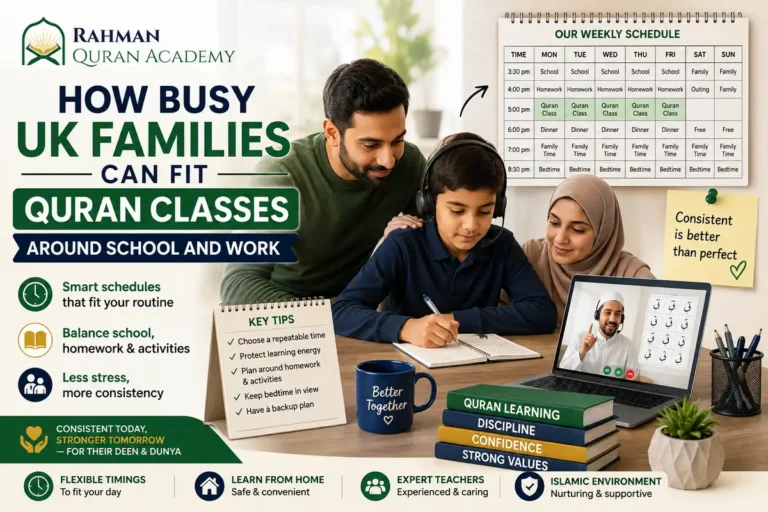
→ For practical tips on this, see: How Busy UK Families Can Fit Quran Classes Around School and Work.
Encourage Without Excessive Pressure
Praise for effort and small improvements tends to build more lasting motivation than pressure to move quickly or match another child’s pace.
Help Your Child Develop a Positive Relationship With the Quran
Where the Quran is associated with patience and encouragement rather than frustration, children are more likely to stay engaged with learning over the long term.
Can Parents Teach Their Child the Quran at Home?
Yes, parents can support significant parts of Quran learning at home, especially listening, revision, basic practice and routine. For structured pronunciation, Tajweed or progression, a qualified teacher can be valuable.
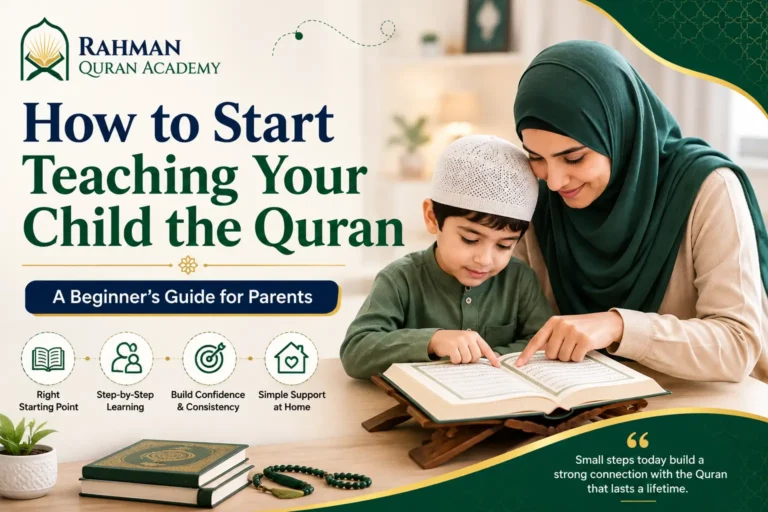
For a practical step-by-step guide, see How to Start Teaching Your Child the Quran.
What Can Parents Teach at Home?
Letters, short surahs, revision, listening practice and general encouragement are all things most parents can support directly, regardless of their own Arabic background.
What If a Parent Does Not Speak Arabic?
You do not need to be an Arabic expert to encourage practice. Parents can listen, supervise and encourage consistency, while a teacher handles structured instruction and correction.
How Can Parents Support Practice Between Lessons?
Regular review, listening to recitation together, asking your child to recite what they have learned, and maintaining the routine between lessons all reinforce a teacher’s work.
One experimental study involving fifth-grade girls found that a 15-minute session of listening to Quranic recitation was associated with better performance on two short-term memory measures compared with a control group. The study was specific to this setting and sample, so it should not be interpreted as proof that a 15-minute daily listening routine improves children’s memory generally. (Hojjati et al., 2014)
When Might a Child Need a Qualified Teacher?
A teacher becomes more important once pronunciation correction, Tajweed or structured progression are needed, or if a child is struggling despite consistent practice at home.
→ Explore our Kids Quran Classes.
Can Children Learn the Quran Online Effectively?
Yes, online Quran learning can work effectively when teaching is personalised, lessons are age-appropriate and the child can engage with the online format.
How Do Online Quran Classes Work for Children?
Typically, a live teacher works one-to-one or in a small group, covering reading, recitation, correction, practice and feedback in real time.
What Are the Benefits of Online Learning?
Flexibility, no travel time, individual attention, a wider choice of teachers, and scheduling that works around UK school hours are the main advantages parents report.
What Challenges Can Online Learning Present?
Maintaining attention on a screen, home distractions and occasional technical issues are common challenges, and not every child learns equally well in this format.
How Can Parents Keep Children Engaged Online?
A quiet, dedicated space, a consistent time slot, minimal distractions nearby, and a short break before lessons all help maintain focus during online sessions.
→ Read the full picture in: Are Online Quran Classes Effective for Children?
What Challenges Can Children Face While Learning the Quran?
Most difficulties fall into a small number of recognisable categories, and each has a practical way forward:
● Pronunciation mistakes — often improve with targeted correction and practice
● Slow or hesitant reading — usually eases with consistent, paced revision
● Short attention span — addressed through shorter, more focused sessions
● Resistance to lessons — often reduced by lowering pressure and rebuilding routine
→ Read more: Why Do Children Make Quran Reading Mistakes and How to Help.
Should Children Focus on Reading, Understanding or Memorisation?
For beginners, strong reading foundations should generally come first; understanding and memorisation can then be introduced progressively according to age, ability and goals.
Building Reading Foundations First
Accurate, confident reading gives a child the tools they need before adding the extra demands of memorisation or deeper study.
Introducing Meaning at an Appropriate Level
Simple, age-appropriate explanations of meaning can be introduced alongside reading, without needing to move into detailed study straight away.
When Memorisation May Be Appropriate
Memorisation generally works best once basic reading is established, and it should be matched to a child’s own readiness rather than a fixed age. Regular revision matters as much as the initial memorisation itself.
Should Parents Teach the Quran Themselves or Use a Qualified Teacher?
Parents can play an important role in daily practice and early exposure, but a qualified teacher can provide structured instruction, pronunciation correction and ongoing assessment.
When Can Parents Support Learning at Home?
Early exposure, revision, listening practice and encouragement are all well suited to parental support.
When Can a Qualified Teacher Help?
Once accurate pronunciation, Tajweed or structured progress tracking are needed, a teacher’s input tends to make a noticeable difference.
What Can a Teacher Provide?
● Structured lessons with a clear progression
● Pronunciation and Tajweed correction
● Ongoing feedback on progress
How Can Parents and Teachers Work Together?
A teacher provides structured instruction; the parent reinforces that learning at home through routine and revision. Together, this tends to produce steadier progress than either approach alone.
How Should Parents Choose a Quran Teacher?
Look for a teacher who has sound Quran knowledge, experience with children, patience, clear communication and the ability to adapt lessons to the child’s level.
What Quran Knowledge Should a Teacher Have?
Solid grounding in Quran reading and Tajweed, ideally with recognised training or certification.
How Important Is Experience With Children?
Teaching children is a different skill from teaching adults; experience with children usually shows in patience and lesson pacing.
→ Read the full guide: What Makes a Good Quran Teacher for Children?
What Type of Quran Learning May Suit Your Child?
Some children benefit from one-to-one lessons, while others may enjoy learning in a group. The best choice depends on attention, confidence, support needs, learning pace and family circumstances.
One-to-one lessons offer more individual attention and a pace matched exactly to the child; group settings can provide peer interaction and a shared learning environment that some children find motivating.
→ Read the full guide: One-to-One vs Group Quran Classes for Children — Which Is Better?
What Should a Good Quran Learning Programme for Children Include?
A good programme should provide structured reading foundations, age-appropriate teaching, progressive Quran skills, suitable memorisation, regular assessment and clear communication with parents.
A Clear Reading Foundation
A defined path from letters through to confident Quran reading, rather than an unstructured mix of activities.
Tajweed and Recitation
Pronunciation rules introduced progressively as reading ability develops.
Age-Appropriate Learning
Lesson content and pace matched to the child’s age and attention span.
Memorisation Where Appropriate
Introduced once a child is ready, with realistic goals rather than a one-size-fits-all target.
Research on tahfiz learning strategies suggests that the way Quran memorisation is structured can influence students’ memorisation performance, supporting the use of organised techniques and regular revision rather than relying on repetition alone. (Hashim, 2015)
Progress Assessment
Regular, honest feedback on how a child is actually progressing, not just attendance records.
Parent Communication
Clear updates that let parents understand progress and support learning at home.
A Suitable Learning Pace
A pace that reflects the individual child rather than a fixed timetable applied to every learner.
How Can Parents Tell If Their Child Is Making Progress?
Progress should be judged by improvement in accuracy, pronunciation, fluency, confidence and consistency and by a child’s ability to work more independently, not simply by how many pages or surahs they have completed.
● Fewer reading errors over time
● Clearer, more accurate pronunciation
● Smoother, more confident reading
● Growing confidence during lessons
● Better retention during revision
Which Learning Environment May Suit Your Child?
Online learning can offer flexibility and individual attention, while a local madrasa can provide in-person community and a shared learning environment. The right choice usually depends on your child’s temperament and your family’s practical circumstances.
→ Read the full comparison: Online Quran vs Local Madrasa: Which Fits a Busy Family?
What Should Parents Look for in a Quran Learning Provider?
Beyond the individual teacher, it is worth checking the wider provider: the quality and clarity of the programme, class format, progress feedback, communication with parents, transparent pricing and, where available, a trial or initial assessment.
Parents should also check the provider’s safeguarding arrangements, teacher checks, communication boundaries and privacy practices before enrolling; our guide on how to check whether online Quran classes are safe for children covers these checks in detail.
→ Read the full guide: How to Choose Online Quran Classes for Your Child in the UK.
Frequently Asked Questions
What Is the Best Age to Start Teaching the Quran to Children?
There is no fixed required age. Many children begin structured learning in the early school years, but readiness, attention, following instructions, and interest matter more than the exact age.
→ See: What Age Should Children Start Learning the Quran?
Can Parents Teach the Quran Without Being Scholars?
Yes. Parents can support exposure, revision and daily practice without specialist knowledge, while leaving structured instruction and correction to a qualified teacher.
What If My Child Does Not Enjoy Quran Lessons?
This is common and often reflects pace, pressure or format rather than the subject itself. Shorter sessions, more encouragement, or a different teacher or format can often help.
Should Children Learn Tajweed From the Beginning?
Not usually. Tajweed tends to work better once a child can already read with a basic level of accuracy, introduced gradually rather than all at once.
→ See our Tajweed page.
Ready to Find the Right Quran Learning Path for Your Child?
Every child starts from a different level. The right approach depends on age, reading ability, learning needs and family schedule.
Want support choosing the right starting point? Explore our Quran Classes for Kids.
● Pricing