What Age Should Children Start Learning the Quran?
There is no single required age for every child. For many families, the early school years can be a practical time to begin structured Quran lessons, but this is a practical guideline rather than an Islamic rule. Younger children can begin gently through exposure, while older children are not too late. What matters most is the child’s readiness, current ability and learning experience rather than a fixed birthday.
This guide explains how the right starting point changes with age, readiness and your child’s current level.
For a broader overview of how children can learn the Quran from their first foundations through reading, Tajweed and memorisation, see our complete guide to teaching the Quran to children
Is There a Perfect Age to Start Learning the Quran?
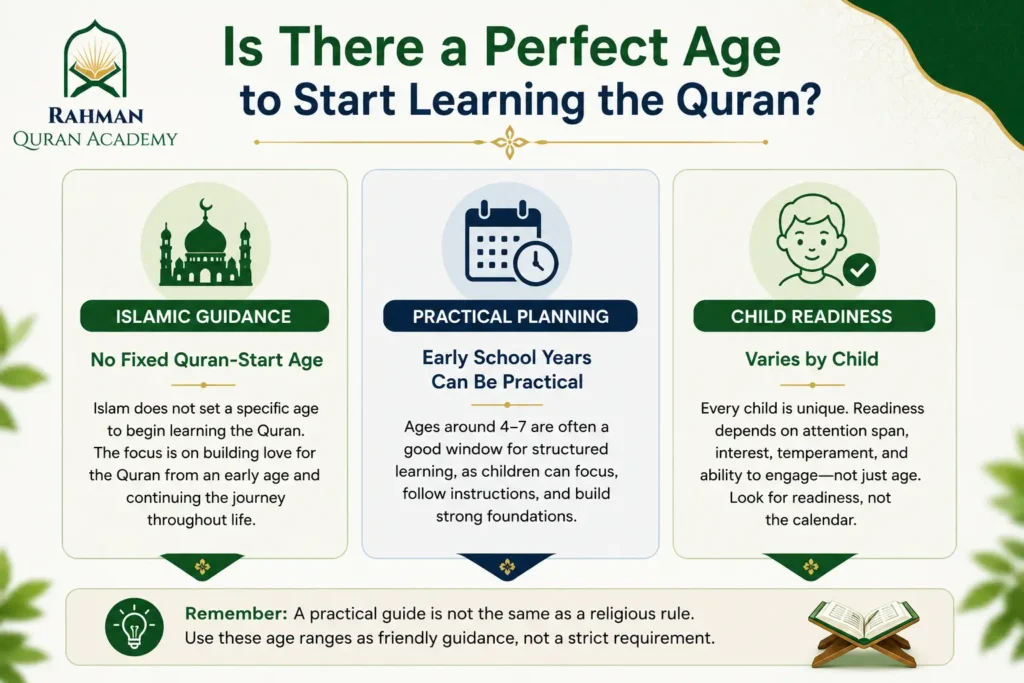
There is no perfect age that applies to every child. It helps to separate three different things that often get blurred together: an Islamic requirement, a practical teaching window, and your own child’s individual readiness.
From an Islamic perspective, there is no fixed age before or after which parents may or may not teach their child the Quran. Scholars such as Mufti Muhammad ibn Adam of Darul Iftaa Leicester note that children differ in mental ability and maturity, so one child may be ready well before another child of the same age.A practical starting range such as the early school years can be useful for planning, but it should not be treated as a religious deadline or a rule that applies to every child.
Does Islam Say Children Must Start at Seven?
No. The often-quoted “age seven” reference comes from a hadith recorded in Sunan Abi Dawud (495), where the Prophet (peace be upon him) instructed that children be told to pray at seven and gently corrected about prayer at ten. This narration concerns learning to pray, not a fixed age for beginning Quran lessons. It’s a common mix-up, but the hadith simply doesn’t set a Quran-learning starting age.
What Does Quran Learning Look Like at Different Ages?
With the Islamic and practical distinction in mind, here’s how a typical learning path tends to look at different ages.
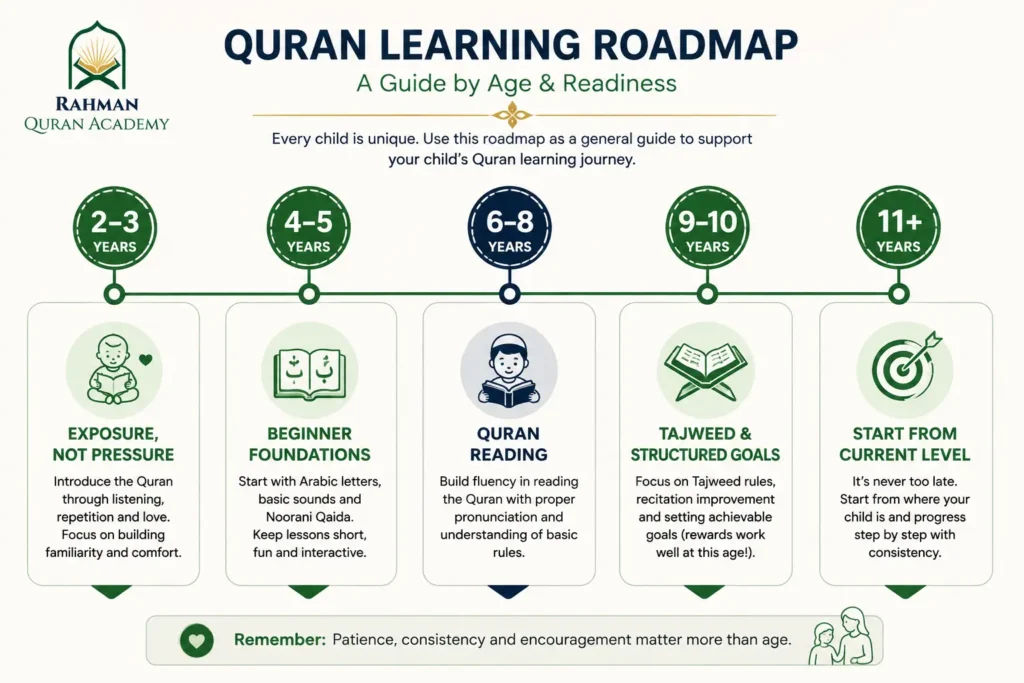
These age ranges are practical learning guidelines, not fixed milestones. A child’s readiness, previous learning, reading ability and learning environment matter more than age alone.
Ages 2–3: Exposure, Not Pressure
At this age, the aim is familiarity rather than formal lessons. Hearing the Quran recited, listening to short surahs and duas, repeating simple phrases and having the Quran present at home can help make the Quran a familiar part of everyday family life without requiring formal lessons. Some families weave this into bedtime or daily routines rather than sitting down for structured teaching. For many toddlers, gentle exposure is more appropriate than lessons that expect them to perform or sit still for long periods.
Ages 4–5: A Practical Starting Point for Beginner Lessons
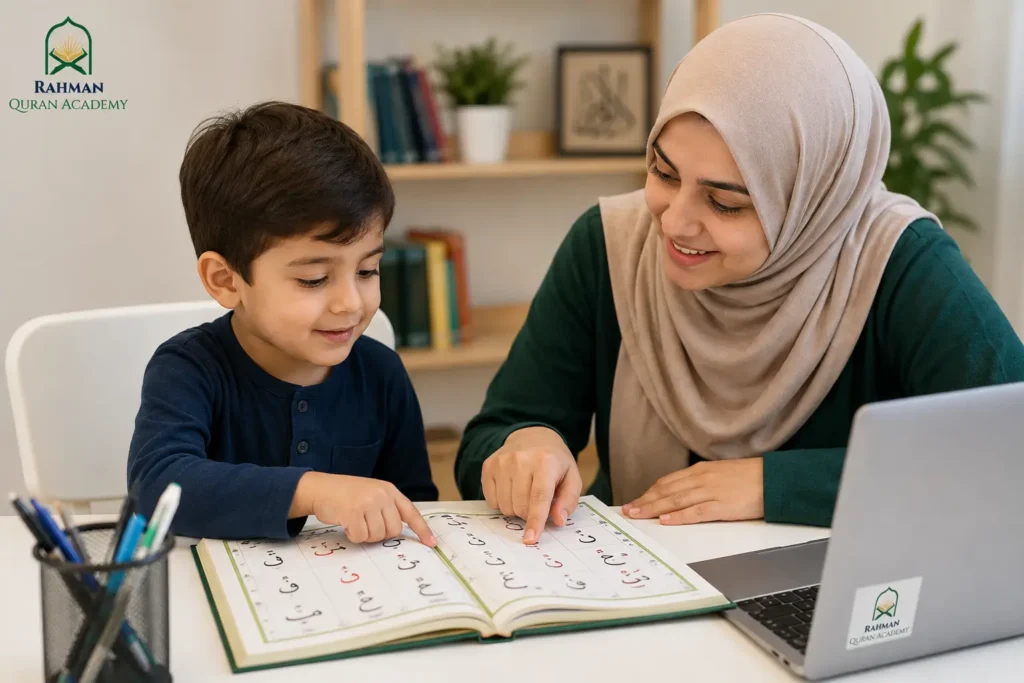
Many children can begin structured beginner learning around four or five, provided they can focus for short periods, follow simple instructions and take part without becoming overly distressed. At this stage, lessons typically cover Arabic letters, beginner Qaida and short surahs, taught through short, playful, repetitive sessions with plenty of parent support.
A 2025 qualitative case study at Madrasah Manbaul Uloom in Malaysia followed 15 children aged 5–6, five tahfiz teachers and ten parents over four months. The researchers described how Quran memorisation teaching for this age group was adapted using flexible lesson duration, short-verse segmentation, structured repetition, visual aids such as Hijaiyah flashcards, a reward system, differentiated pacing between children, and close parent-teacher collaboration. This is a small qualitative case study describing one teaching approach in practice. It does not establish 5–6 as a universal or optimal starting age.
Ages 6–8: Build Strong Quran Reading Foundations
By this stage, many children are ready to move from beginner foundations into more consistent Quran reading, pronunciation work and early Tajweed, alongside finishing Qaida if it isn’t already complete.
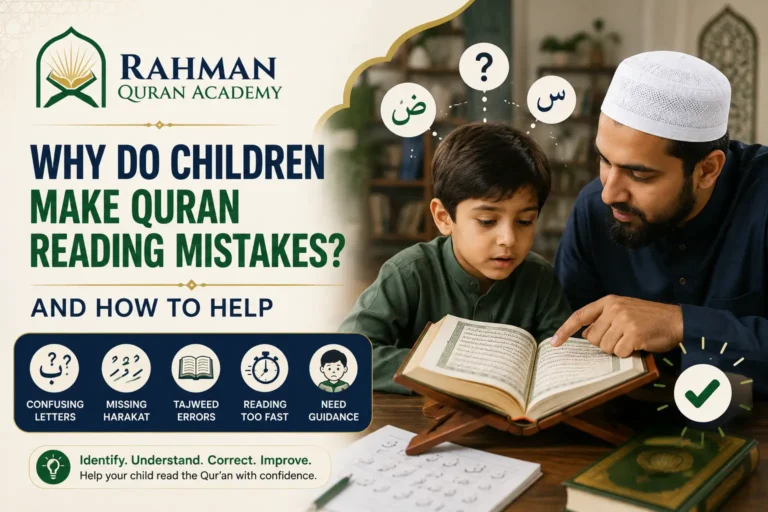
If pronunciation is a sticking point at this stage, see why children make Quran reading mistakes and how to help
And for reading speed, see how to help your child read the Quran more fluently
Ages 9–10: Strengthen Reading and Introduce More Structured Goals
By this stage, some children may be ready for more structured reading, Tajweed and, where appropriate, memorisation, depending on their current level, learning experience and ability to manage the added demands alongside school. This doesn’t mean every child should start Hifz at this age. The right next step still depends on the child’s actual reading level and how they’re managing alongside school.
Age 11 and Above: It Is Not Too Late
Starting at 11, 12 or later is not too late. The key is to begin from your child’s actual reading level rather than trying to rush through everything a younger beginner would have covered. Older beginners may be able to work more independently, but they still need teaching that matches their age as well as their Quran reading level. One-to-one lessons can be useful when an older beginner wants to build foundations without feeling out of place in a class designed for much younger children.
How Do You Know If Your Child Is Ready for Quran Classes?
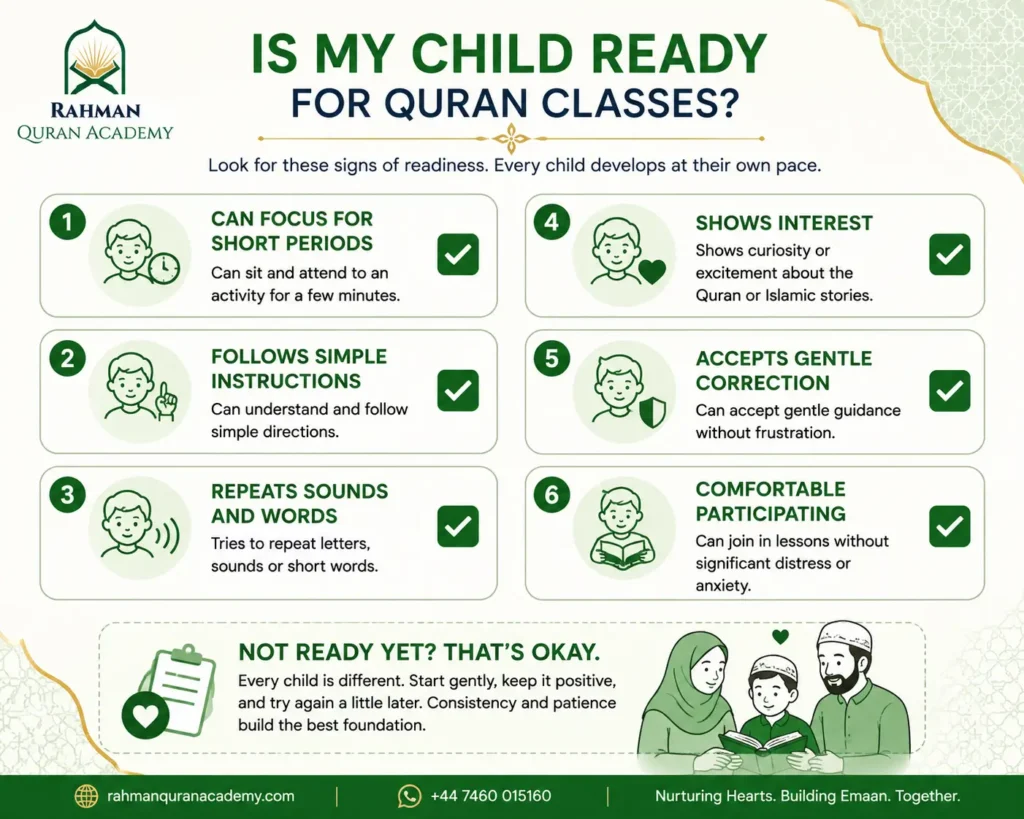
Readiness is more useful than age alone. A child may be ready when they can focus briefly, follow simple instructions, repeat sounds back, and take part without becoming consistently distressed.
Signs Your Child May Be Ready
● Can focus for short periods.
● Follows simple instructions.
● Repeats sounds and words back.
● Shows some interest in learning.
● Tolerates gentle correction.
● Can take part without significant distress.
These are practical indicators rather than an official Quran-specific readiness test.
What If My Child Is Not Ready Yet?
If your child isn’t showing these signs yet, there’s no need to force formal lessons. Continue gentle exposure, try shorter sessions, or revisit structured learning in a few weeks or months. A different teaching approach sometimes helps too.
UK Department for Education user-research guidance gives an estimated 8–12 minute average attention span for four-year-olds in the context of its research guidance. This is not a recommended Quran lesson length. It simply illustrates why expectations for very young children need to remain realistic, whatever they’re learning.
Is Starting Early Always Better?
Starting early can be helpful, but earlier does not automatically mean better. Early exposure can help children become familiar with Quran recitation and sounds without requiring formal lessons. Formal, demanding lessons are a different matter, and their value depends heavily on whether the child is actually ready for them.
Excessive pressure can backfire. One parent described their 3.5-year-old starting to dread 20-minute online Quran sessions held three times a week, and was looking for ways to make the experience more enjoyable rather than simply pushing through with more pressure. This is one parent’s experience, not a scientific finding, but it illustrates why a child’s experience of learning matters, not just how early they started.
What Should a Child Learn First?
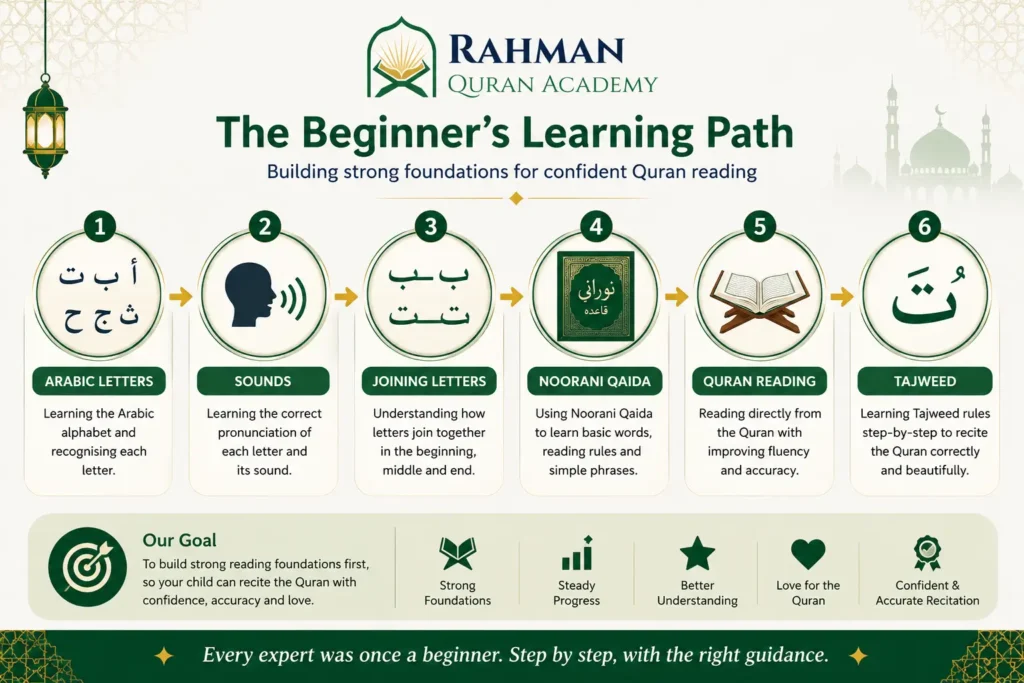
A beginner normally needs a reading foundation before progressing to fluent Quran reading, Tajweed and memorisation. The broad path runs from Arabic letters, to their sounds, to joining letters together, through Noorani Qaida, into Quran reading, then Tajweed, and eventually memorisation where appropriate.
Should My Child Start With Noorani Qaida?
For many beginners, Noorani Qaida or a similar structured reading method can provide the foundation needed before reading directly from the Quran.
See how we teach this stage on our Noorani Qaida page
When Does Tajweed Become Relevant?
Tajweed becomes relevant once a child can read with reasonable confidence, and is then introduced gradually rather than all at once.
When Can Memorisation Begin?
Memorisation tends to work best once a child has a basic reading foundation and can manage regular revision. There’s no fixed age at which every child should start Hifz.
What If My Child Is Already 8, 10 or 12?
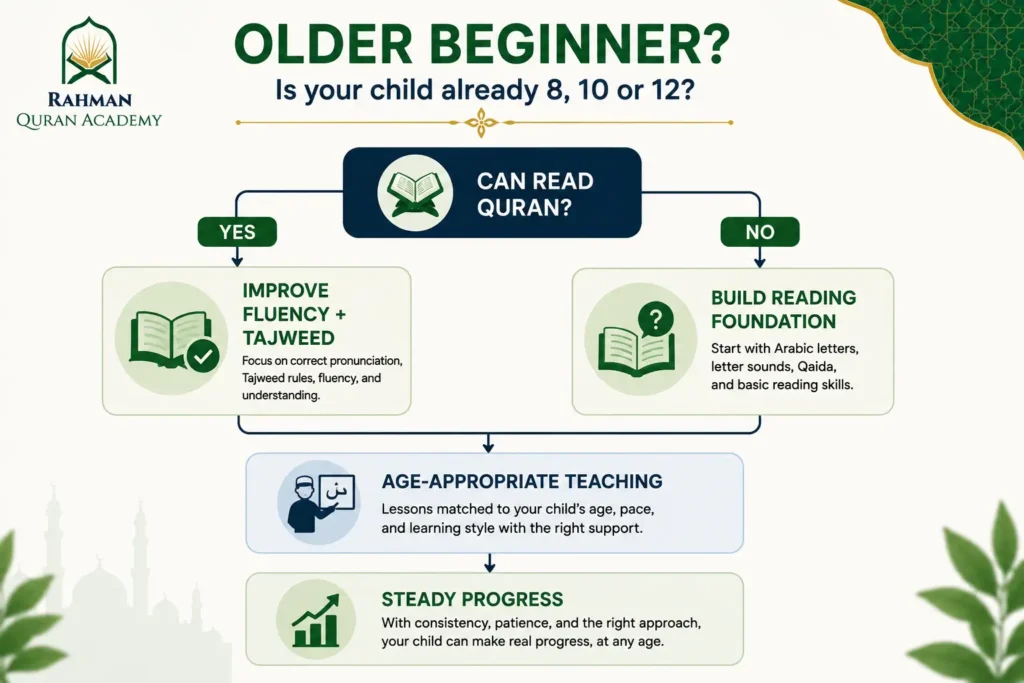
You have not missed the opportunity. The right approach is to start from your child’s current level, not the age at which they “should” have started.
My Child Is 8 and Has Never Learned Quran
A simple catch-up path works well here: a short assessment of current knowledge, followed by targeted foundations, then a steady move into reading practice.
My Child Is 10 or 12 and Cannot Read Quran
The same principle applies. Start from an honest assessment of their real level, build reading foundations properly, then progress into Tajweed as reading becomes more confident.
Should an Older Beginner Join a Children’s Beginner Class?
Not necessarily. Learning level and teaching style are two different things. An older child may be a genuine beginner in terms of reading ability, but they still benefit from age-appropriate teaching rather than a class designed around much younger children.
How Can Parents Make the Start Easier?
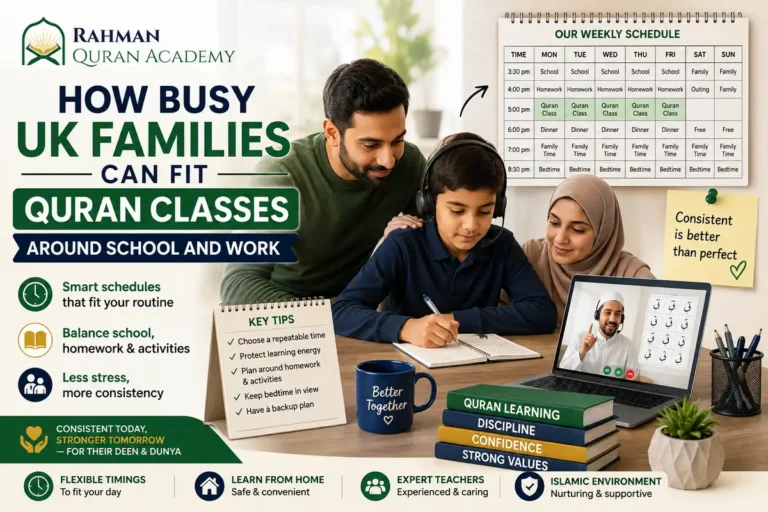
Keep the routine short, predictable and encouraging, and practise little and often rather than turning Quran learning into a daily battle.
Build a Simple Routine
A short, consistent slot in the day is easier to sustain than an ambitious schedule that quickly falls apart.
Encourage Instead of Comparing
Avoid comparing your child’s pace to siblings or other children. Progress at their own speed is still progress.
Practise Together
Listening together, light revision and simple encouragement between lessons all reinforce what a teacher is building.
What If My Child Starts Resisting Lessons?
Resistance often signals that the pace is too fast, lessons are running too long, the child feels pressured, the teaching style doesn’t fit, or the child is simply tired. Reducing pressure, checking the pace with the teacher, or trying a different teaching approach are all reasonable first steps.
For a fuller starting guide once your child is ready to begin, read how to start teaching your child the Quran
What Mistakes Should Parents Avoid When Choosing a Starting Age?
Starting Because Another Child Started
Comparing your child to a sibling, cousin or classmate’s starting age can lead to lessons beginning before your own child is genuinely ready.
Treating Seven as a Quran Deadline
As covered above, the age-seven hadith concerns prayer, not a Quran-learning cut-off. There is no equivalent Quran deadline.
Expecting a Toddler to Learn Like a Schoolchild
Formal, structured lessons designed for a six-year-old rarely suit a two- or three-year-old. Exposure, not instruction, is the right fit at that age.
Delaying Because You Think You Missed the Ideal Age
There is no single ideal age to miss. Starting later simply means starting from a different point, not starting too late.
Starting Memorisation Before Building Reading Skills
Memorisation tends to go more smoothly once basic reading is established, rather than being rushed in before it.
Choosing Lesson Length by Age Alone
A child’s attention, mood and prior experience matter as much as their age when deciding how long a lesson should realistically run.
What If I Need Quran Classes for My Child?
Once you have a sense of your child’s age and current level, the next step is finding a teacher who can start at the right point and adjust the pace to your child, rather than teaching to a fixed curriculum regardless of readiness.
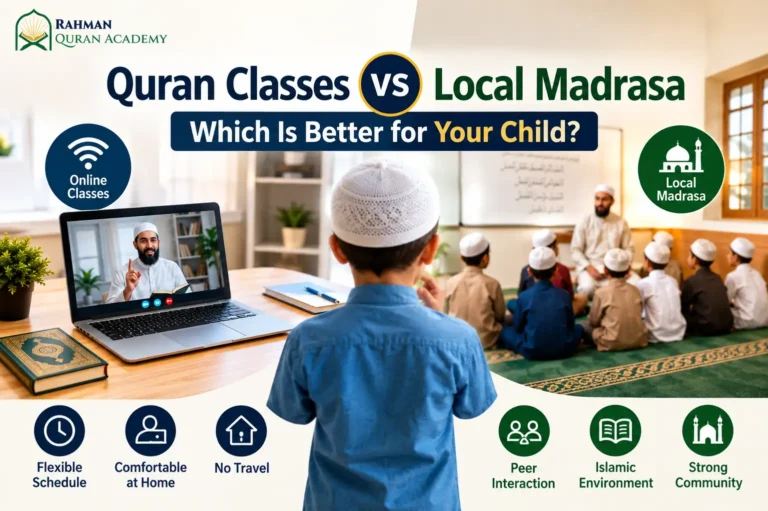
Look for a qualified teacher, age-appropriate teaching, an initial assessment of your child’s level, a suitable learning format, and scheduling that works around a UK routine. Explore our Quran Classes for Kids in the UK
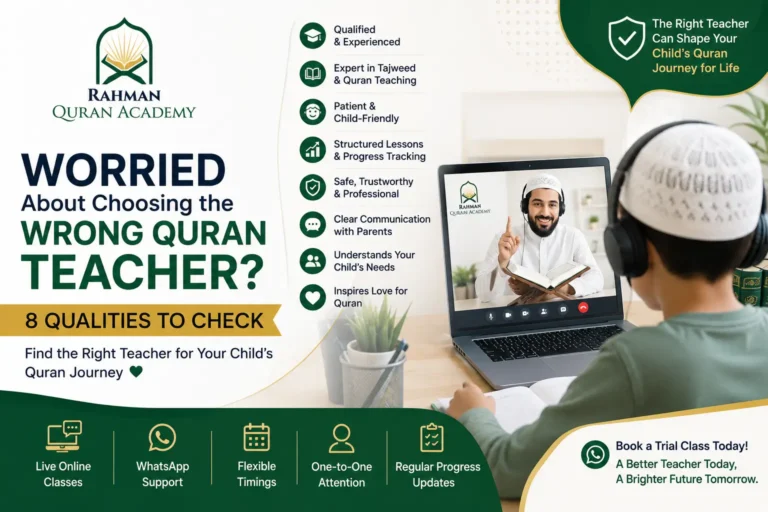
If you’re weighing up teachers, our guide on what makes a good Quran teacher for children
Frequently Asked Questions
What Age Is Appropriate to Start Teaching the Quran?
There is no single appropriate age for every child. Gentle exposure can start early, while structured lessons may suit children once they can focus briefly and follow simple instructions; for some children this may be around four or five, while others may be ready later.
Can a 3-Year-Old Learn the Quran?
A 3-year-old can begin hearing recitation, repeating short phrases and building familiarity, though formal, demanding lessons aren’t usually necessary at this age.
Is 4 Too Young to Start Quran Classes?
Not necessarily. Some four-year-olds are ready for short, playful beginner lessons, while others benefit from a little more time. Readiness varies from child to child.
Is 7 Too Late to Start Learning the Quran?
No. Seven is not too late, and there is no Islamic requirement to have started Quran learning earlier. A child who begins at seven can start from their current level and progress gradually.
Is 10 Too Late to Start Quran Classes?
No. A ten-year-old beginner simply starts from their current level, with age-appropriate teaching rather than a class designed for much younger children.
Can a Teenager Start Learning the Quran From Scratch?
Yes. Teenagers can start from scratch and can make steady progress when lessons are matched to their level and pace.
How Long Does It Take a Child to Learn the Quran?
There is no fixed timeline. It depends on the child’s starting level, lesson frequency, age, how much they practise, and what the family’s goals actually are.
What Age Should Your Child Start Learning the Quran?
Bringing this together, here is a practical decision guide by age:
● 2–3 — gentle exposure through short surahs and duas
● 4–5 — readiness-based beginner learning
● 6–8 — reading foundations and Quran reading
● 9–10 — stronger reading, Tajweed and suitable memorisation
● 11+ — start from your child’s current level; it’s never too late
The right starting point is the one that matches your child’s readiness, current ability and learning needs. For many children, the early school years can be a practical time to begin structured lessons, but there is no fixed Islamic starting age. Younger children can begin gently, and older beginners can still make strong progress.
Ready to find the right starting point for your child? Explore our Quran Classes for Kids