How to Start Teaching Your Child the Quran: A Beginner’s Guide
To start teaching your child the Quran, first assess what they already know, choose the next appropriate reading skill, introduce a small amount of new material, and build a simple cycle of practice and review. Parents can support routine and revision at home, while a qualified teacher can help with pronunciation and structured progression.
If you’re unsure whether your child is ready or what age is appropriate, see our guide to what age children should start learning the Quran
What Should You Check Before Starting Quran Lessons?
Before teaching new material, identify what your child can already recognise, pronounce and read. Skipping this step can lead to lessons starting in the wrong place, either repeating what the child already knows, which can cause boredom, or moving too fast, which can cause frustration.
Does Your Child Recognise Arabic Letters?
Recognition is not the same as reading. A child can often point to a letter correctly on a chart without being able to sound it out fluidly, so check recognition on its own first. Show a handful of familiar letters out of order and ask your child to name them.
Can Your Child Pronounce the Letters?
Recognising a letter visually and pronouncing it correctly are two separate skills, and it’s easy to assume one means the other. Don’t take correct pronunciation for granted just because your child can identify the letter; listen carefully to how each sound is actually produced.
Can Your Child Join Letters Together?
Joining is where many beginners get stuck, because letters change shape depending on their position in a word. Check whether your child can read simple joined combinations, and note exactly where the breakdown happens: is it recognising the joined shape, or blending the sounds together?
Can Your Child Already Read From a Qaida or Quran?
If your child has already made progress, there’s no need to restart from the beginning of a book out of caution. Begin at their actual skill level, not at page one by default; starting too far back is as unhelpful as starting too far ahead.
For a broader overview of how to teach the Quran to children from beginner foundations through reading, Tajweed and memorisation, see our [complete guide to teaching the Quran to children]
Where Should You Start Based on Your Child’s Current Level?
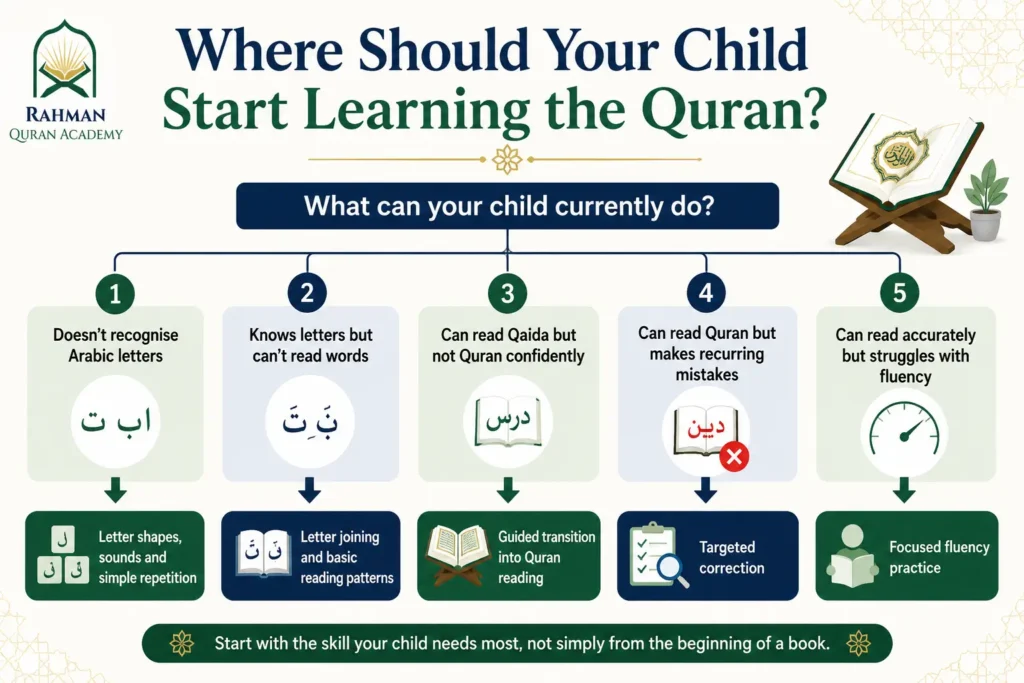
Start with the skill the child is missing, not simply from the beginning of a book. The table below gives a practical starting point based on what you observed in the check above.
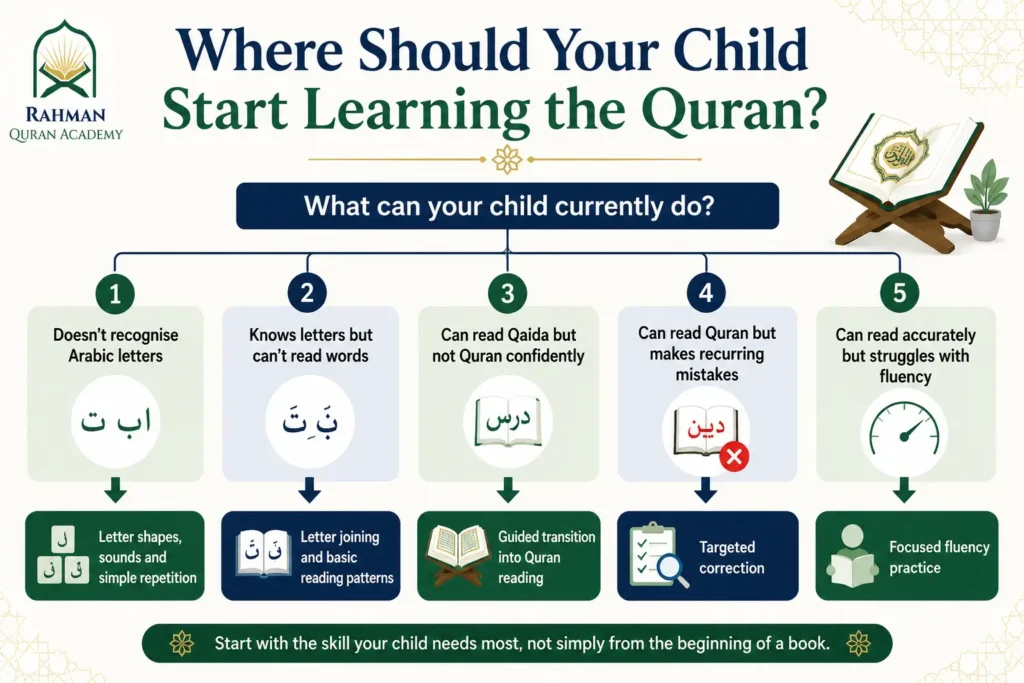
| Current ability | Where to start |
| Doesn’t yet recognise letters | Letter shapes, sounds and simple repetition |
| Knows letters but can’t read words | Letter joining and basic vowel/reading patterns |
| Can read Qaida but not Quran confidently | Guided transition into Quran text, focusing on accuracy |
| Can read Quran but makes recurring mistakes | Targeted correction of recurring errors — see link below |
| Can read accurately but struggles with fluency | Focused fluency practice — see link below |
If frequent mistakes are the issue, our article on Quran reading mistakes
If slow reading is the issue, see Quran reading fluency
This article focuses on identifying the right starting point rather than diagnosing individual pronunciation errors or building a fluency programme; those are covered in the linked guides.
What Should You Teach First?
A beginner normally builds Arabic reading foundations first, then progresses into Quran reading, with Tajweed and memorisation introduced progressively when appropriate.
Arabic Letters and Their Sounds
Start with recognition and sound together, and resist the temptation to introduce too many letters in one sitting. A small, consistent set that’s genuinely learned is more useful than a long list that’s only half-remembered.
Joining Letters and Basic Reading Patterns
Once individual letters are secure, move to blending, starting with simple, controlled combinations rather than full words. For many beginners, joining letters can feel noticeably harder than recognising them individually, so it can benefit from extra practice.
Short Vowels and Basic Reading Patterns
Harakat (short vowel marks) need to be understood at a practical, functional level — what each mark does to a letter’s sound rather than as a grammar lesson. Keep explanations tied to reading, not to Arabic grammar theory.
Noorani Qaida or a Similar Structured Reading Method
A structured beginner reading method can give parents and teachers a clear sequence for building recognition, pronunciation and reading skills, rather than improvising an order.
You can read more about our structured approach in our Noorani Qaida
Moving Into Quran Reading
The move into Quran text should happen when the foundation is functional and consistent, not simply because a certain number of Qaida pages have been completed. Page count is a rough guide at best, and a slower, sturdier foundation pays off later.
For more on the transition into reading the Quran itself, see our Quran reading
What Should a First Quran Lesson Look Like?
A good beginner lesson should revisit something familiar, introduce one manageable new skill, give the child time to practise it, provide correction, and finish with a short review.
Start With a Quick Review
A short review at the start reinforces what was covered previously and quickly reveals anything that’s been forgotten, before new material is added on top of it.
Introduce One Small New Skill
One new concept per lesson is usually enough for a beginner. Introducing several new letters or rules at once tends to blur together rather than stick.
Let the Child Attempt It
Give the child space to try the new skill with minimal prompting. Jumping in with every answer removes the chance to see where the actual difficulty lies.
Correct Without Overloading Them
Focus correction on the most important error rather than interrupting for every small slip. Constant interruption can make it harder for a child to read aloud confidently, so focus correction on the most important errors first.
Finish With Review and a Simple Practice Task
End the lesson by being specific about what should be practised before the next one, so the parent knows exactly what to reinforce at home.
Example (illustrative): a child recognises Alif, Baa and Taa but struggles to join them. Rather than introducing ten new letters, the lesson stays with joining those three known letters in a few controlled combinations until it’s secure.
How Can Parents Practise Between Quran Lessons?
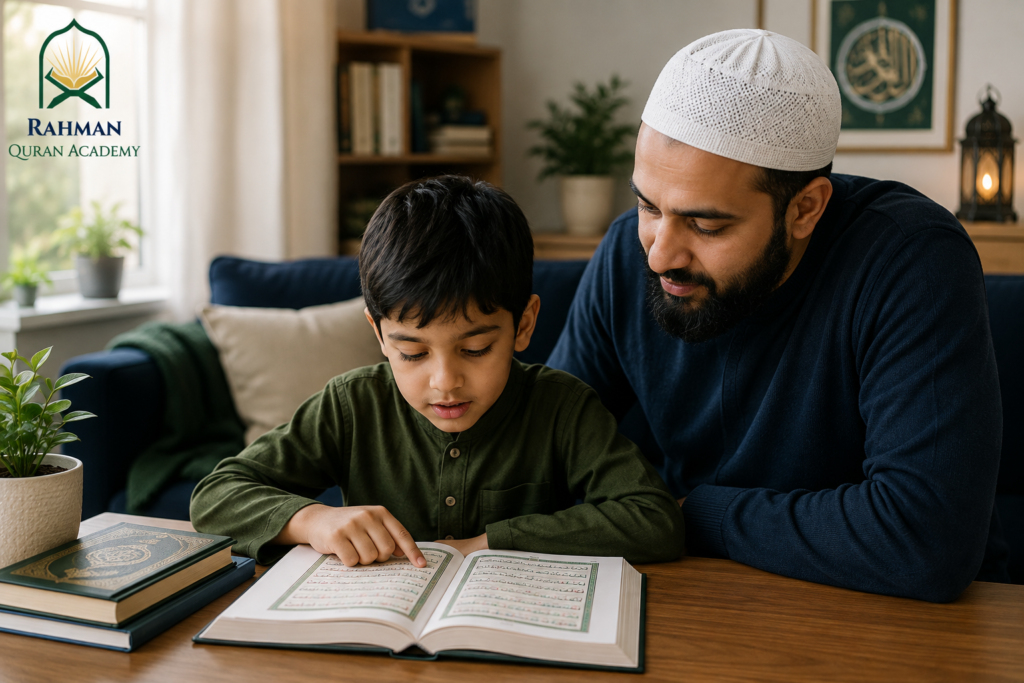
The most useful home practice reinforces what the child has already been taught, rather than introducing lots of new material independently.
A 2026 systematic review of 20 studies on early-childhood Quran reading highlighted the importance of continued learning support at home alongside formal instruction.
Review Before Adding More
Go over the previous material first, and only move to anything new once that’s solid.
Listen and Repeat Together
A simple listen-and-repeat routine: you say it, your child repeats it, and you observe can reinforce a lesson without needing to introduce new content yourself.
Keep Practice Purposeful
Avoid piling on random worksheets or trying to cover several unrelated things in one sitting. A short, focused practice session tends to achieve more than a long, scattered one.
Tell the Teacher Where Your Child Is Struggling
Reporting specific letters, sections, hesitations or recurring mistakes back to the teacher closes the loop between home practice and the next lesson, so the teacher can adjust rather than guess.
Parent communities frequently raise concerns about homework volume and uncertainty over how to reinforce lessons at home. This reflects common parent experience rather than formal research, but it’s a genuine and recurring concern worth planning around.
Can Parents Teach the Quran If They Don’t Speak Arabic?
Parents do not need to be Arabic scholars to support Quran learning, but they should not guess at pronunciation they are unsure about.
What Parents Can Confidently Do
• Establish a consistent routine
• Listen while the child reads or recites
• Prompt repetition of familiar material
• Revise previously covered content
• Encourage and build confidence
• Communicate progress and difficulties to the teacher
What Parents Should Not Guess
• Pronunciation they are unfamiliar with
• Advanced Tajweed rules
• Persistent, unexplained pronunciation errors
When a Teacher Should Correct Pronunciation
Once an error is unfamiliar, persistent, or outside what a parent can confidently judge, it’s a signal to hand correction to a qualified teacher rather than guessing at home.
For more on what to look for, see what makes a good Quran teacher for children.
How Do You Know When to Move to the Next Stage?
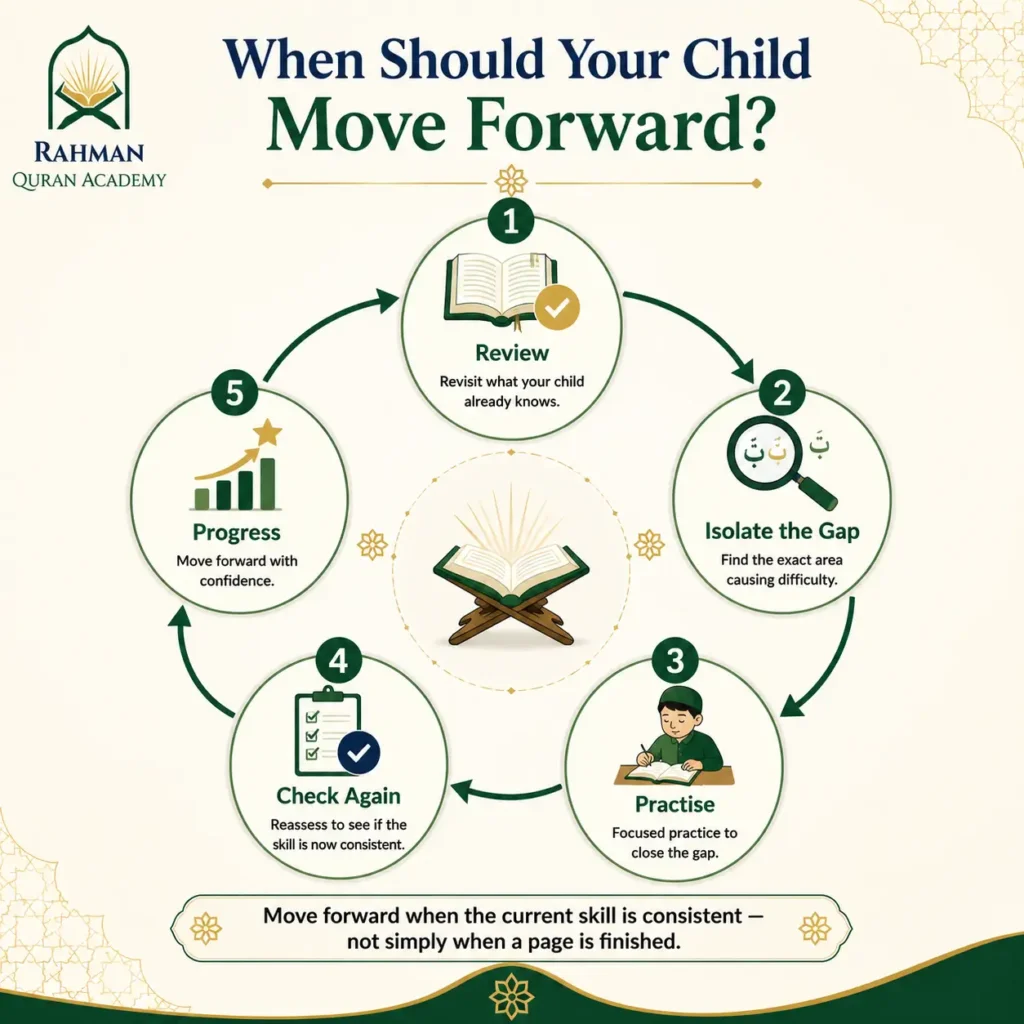
Don’t move forward simply because a page or lesson is finished; move forward when the child can perform the current skill with reasonable consistency.
Don’t Move Forward Just Because You Finished a Page
Finishing a page tells you the lesson is over, not that the skill is secure.
Look for Consistent Recognition and Pronunciation
Consistency across several attempts, not a single correct read, is the better sign of readiness.
Check Whether Previous Skills Are Retained
Briefly revisit older material before assuming it’s been retained; skills that looked solid a few lessons ago can fade without review.
What If Your Child Keeps Forgetting?
Use a simple, repeatable loop rather than pushing ahead regardless:
1. Review
2. Isolate the specific gap
3. Practise it directly
4. Check it again
5. Progress only once it holds
If a child keeps confusing two particular sounds, for example, it’s usually more effective to keep that pair in active revision than to add several new patterns on top of it.
What If Your Child Keeps Making Quran Reading Mistakes?
Repeated mistakes usually need targeted correction rather than simply more pages.
What If Your Child Reads the Quran Very Slowly?
Slow reading should be improved through focused, accurate practice rather than simply rushing through more text.
What If Your Child Starts Resisting Quran Lessons?
Resistance is worth investigating rather than treating automatically as laziness or lack of commitment.
Check the Lesson Length
A session that runs longer than a young child can realistically sustain often shows up as resistance rather than a direct complaint about length.
Check How Much New Material You’re Giving
Too much new content in one lesson can be exhausting rather than motivating, particularly for younger children.
Check How Corrections Are Delivered
Frequent, sharp correction tends to reduce a child’s willingness to attempt reading aloud at all.
Check the Teacher-Child Relationship
Even a well-structured lesson can feel unwelcoming if the relationship between teacher and child isn’t a comfortable one.
Change One Thing at a Time
Adjust a single variable length, pace, correction style, or teacher fit before concluding the problem is bigger than it is, so you can tell what actually helped.
Anecdotally, some parents have described a young child beginning to dread lessons after sessions of around twenty minutes ran without a break. This is one family’s reported experience, not a general rule, but it illustrates why lesson length is worth checking first.
How Can You Make Quran Learning Part of Daily Life?
Quran learning becomes easier to sustain when it is reinforced naturally through small, regular moments rather than depending only on formal lessons.
• A short recitation or review after salah
• A brief revision moment at bedtime
• Listening to familiar recitation during ordinary family routines
• Repeating recently learned material in passing, without turning it into a formal session
This is about everyday reinforcement, not a school timetable. Fitting Quran learning around a busy UK school and work schedule is covered separately.
See our guide on fitting Quran classes around school and work
When Should You Involve a Qualified Quran Teacher?
A qualified teacher becomes especially useful when you need accurate pronunciation correction, structured progression or consistent feedback.
A 2026 qualitative study of the Sorogan approach described individual Quran recitation followed by immediate, specific teacher feedback on makhraj and Tajweed, showing how teacher-led correction can help identify and address specific reading difficulties.
• You are unsure about pronunciation yourself
• Progress has stalled despite regular practice
• You keep correcting the same mistake without it improving
• You need a structured, sequenced learning path rather than an ad hoc one
Should Parents Teach at Home or Use a Teacher?
Parents can reinforce learning at home, while a qualified teacher can provide structured instruction and correction. Many families benefit from combining both roles rather than treating them as alternatives.
| Parents can support | Teacher can lead |
| Routine | Structured progression |
| Revision | Pronunciation correction |
| Listening | Tajweed |
| Encouragement | Assessment |
| Practice | Targeted correction |
What Does a Simple Beginner Learning Cycle Look Like?
The steps above come together into one repeatable cycle for a beginner:
1. Assess
2. Teach
3. Practise
4. Review
5. Check
6. Progress
This is an implementation loop you can return to at every stage, not a one-off roadmap, and not tied to a particular age.
Frequently Asked Questions
How Do I Start Teaching My Child the Quran at Home?
Assess what your child already knows, choose the appropriate starting point from the table above, introduce one small new skill at a time, and build a short, consistent review-and-practice routine around it.
What Should I Teach My Child First?
Most beginners start with Arabic letter recognition and sounds, then move into joining letters and basic reading patterns, before progressing into Quran reading itself.
Can I Teach My Child the Quran If I Don’t Speak Arabic?
Yes you can support routine, listening, revision and encouragement without speaking Arabic. Leave unfamiliar pronunciation and advanced Tajweed rules to a qualified teacher.
Do I Need Noorani Qaida to Start?
You don’t strictly need Noorani Qaida, but a structured reading method such as Noorani Qaida can give parents and teachers a clear sequence for building reading foundations rather than improvising an order yourself.
How Long Should a Beginner Quran Lesson Be?
There’s no single figure that suits every child; younger or newer learners generally need shorter sessions. If a child seems restless or resistant, checking lesson length is a reasonable first step.
How Often Should My Child Practise?
Short, regular practice is often easier to sustain than infrequent, longer sessions. Consistency matters more than following one rigid schedule.
What If My Child Keeps Forgetting Previous Lessons?
Use the review-isolate-practise-check-progress loop rather than pushing ahead. Keep the specific gap in active revision until it’s consistently secure.
When Should I Get a Quran Teacher?
A teacher is especially useful once you’re unsure about pronunciation, progress has stalled, the same mistake keeps recurring, or you want a structured, sequenced learning path.
Ready to Start Your Child’s Quran Learning Journey?
You now have a practical starting point: how to assess your child’s current level, what to teach first, how to structure a first lesson, how to practise and review at home, how to tell when to move forward, and when a qualified teacher can help.
When you’re ready for structured, one-to-one support, explore our Quran Classes for Kids