

How Busy UK Families Can Fit Quran Classes Around School and Work
The easiest way to fit Quran classes into a busy UK family routine is not to search for the “perfect” time. It’s to choose a repeatable window when your child is settled enough to learn, and one the family can realistically protect. Build the slot around school, homework, activities, prayer and meals, then adjust it during exams and holidays instead of abandoning it altogether.
No single timetable works for every household. A family with two working parents and three children in different schools needs a different rhythm from a household with one parent working from home. What matters is consistency, not perfection: a routine you can keep for months, not one that looks ideal on paper for a single week.
For a broader guide to teaching the Quran at different stages, see our Teaching the Quran to Children guide.
What Makes a Quran Class Schedule Sustainable for a Busy Family?
A schedule survives a busy term when it’s built around the family’s actual constraints, not an idealised version of the week. Four things tend to separate routines that last from routines that quietly fall apart by half-term.
Choose a Time You Can Repeat
A single slot that happens the same two or three days a week, at roughly the same time, is easier for a child to adjust to than a schedule that moves daily. Children, especially younger ones, learn routines through repetition. If Quran class shifts between 4 pm, 6 pm, and 7:30 pm depending on the day, the child never settles into a rhythm, and parents end up renegotiating the timetable every week.
Protect Learning Energy, Not Just Free Time
An empty slot in the calendar isn’t automatically a good learning slot. A child who is free at 5 pm but mentally drained from a full school day may retain less than a child learning for 20 fewer minutes at a time when they’re more alert. Energy matters as much as availability.
Leave Space for Schoolwork and Family Life
A workable Quran routine doesn’t compete with homework, dinner or basic downtime; it sits alongside them. Families who schedule Quran class immediately before a homework deadline, or right up against bedtime with no buffer, tend to see more resistance from the child over time.
Build a Backup Plan for Busy Weeks
Sports fixtures move. Deadlines land unexpectedly. A parent’s shift changes at short notice. Families who keep a nominated backup slot, even a short 10-minute review instead of a full lesson, tend to stay more consistent than families with only one fixed option and no fallback.
How Do You Choose the Right Quran Class Time After School?
The right after-school slot depends on how your child actually transitions out of the school day, not just what time they walk through the door.
Check When Your Child Gets Home
Pick-up and drop-off times vary widely across the UK. Many state primary and secondary schools run a compulsory week of at least 32.5 hours, which in practice often works out to a school day of roughly 8.45 am to 3.15 pm, though this varies by school and isn’t a legal requirement; schools set their own hours within Department for Education guidance. A child arriving home at 3.30 pm has a very different evening shape to one who finishes an after-school club at 5 pm.
Allow Time to Reset
Most children need a short buffer between the end of school and the start of any structured learning. Even 15–20 minutes for a snack, a change of clothes, or simply sitting down can make the difference between a child who’s ready to focus and one who’s still winding down from the school day.
Work Around Homework
Homework load varies by school and by year group, and there’s no single UK-wide standard for how much should be set. Rather than fixing Quran class at a time that assumes homework will be finished, many families find it easier to check the actual pattern for their child’s school and year group, then build around it.
Consider Sports and Other Activities
If your child does football, swimming, Cubs or another regular activity, it’s usually easier to fix those days first and place Quran class around them, rather than trying to fit an existing sports schedule around Quran class after the fact.
Keep Bedtime in View
The NHS recommends 9–12 hours of sleep a night for children aged 6–12, and 8–10 hours for teenagers aged 13–18. Scheduling Quran class too close to bedtime can shorten that window or leave a child too alert to settle, particularly if the lesson involves concentrated reading or memorisation.

Should Quran Classes Be Before or After Homework?
There’s no universal winner here; it depends on your child’s concentration pattern and how much homework they typically have.
When Before Homework May Work
Some children focus better earlier in the evening, before school fatigue fully sets in. Doing Quran class first can also mean it doesn’t get pushed aside if homework runs long or a deadline is looming.
When After Homework May Work
Other children find it easier to get schoolwork “out of the way” first, so they’re not thinking about an unfinished assignment during their lesson. This can work well on lighter homework nights, but risks Quran class being rushed or dropped on heavier ones.
How to Decide Which One Fits Your Child
A practical approach is to try both for a couple of weeks and watch two things: how focused your child is during the lesson, and whether homework is still getting done properly. If Quran class before homework leaves your child too tired to concentrate on schoolwork, or homework first means Quran class is always squeezed, that’s your answer for this child; it may be different for a sibling.

What If Your Child Is Too Tired After School?
Fatigue after school is common, and it doesn’t automatically mean the whole routine needs an overhaul.
Signs the Timing Is Too Demanding
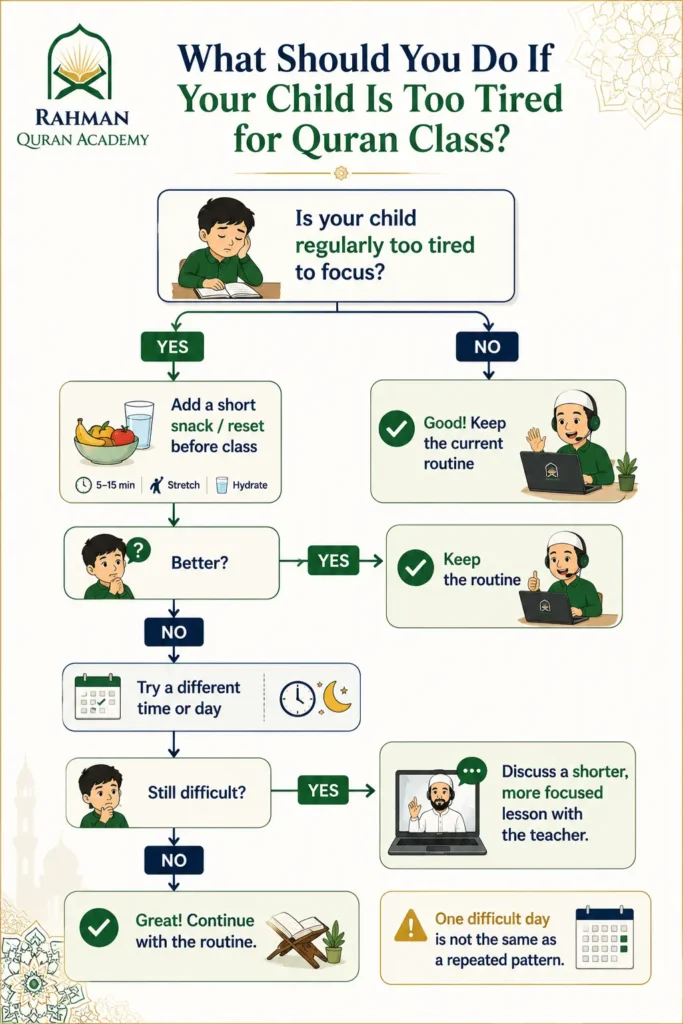
Watch for a child who is regularly distracted, irritable, or asking to stop partway through as opposed to an occasional off day. A pattern across several weeks, rather than one difficult afternoon, is the better signal to act on.
Give a Short Transition Before Class
A brief pause a drink, a snack, five minutes of quiet before starting can noticeably improve focus, especially for children who go straight from a full school day into another structured activity.
Try a Different Window Before Changing the Whole Routine
If tiredness is a recurring issue, testing a different time (a weekend slot, or moving from immediately-after-school to early evening) is usually a smaller, more manageable change than scrapping the entire schedule.
When a Shorter Lesson May Make More Sense
For a child who’s consistently fatigued on weekdays, a shorter, more focused lesson can sometimes achieve more than a longer one where attention drifts halfway through. This is worth discussing directly with your child’s teacher. Our online Quran reading classes and Noorani Qaida course are structured in stages precisely so pacing can be adjusted to the child, rather than the child being pushed to match a fixed lesson length.
How Many Quran Classes Can a Busy Child Realistically Manage?
There’s no single correct number of classes per week; it depends on the child’s goal, current level, and how much practice happens outside class.
Start With the Child’s Goal
A child working through Noorani Qaida to build reading foundations has different weekly needs than a child progressing through Hifz (memorisation) or refining Tajweed (pronunciation rules). Memorisation in particular tends to benefit from more frequent, shorter sessions rather than fewer long ones, since consistent repetition matters more than total hours.
Consider Current Level
A beginner may need more frequent contact with a teacher to build correct habits early, while a more advanced student with solid reading skills might manage well with fewer weekly classes supported by independent practice.
For children who need a more personalised pace, one-to-one Quran classes for children may also be worth considering.
Consider Available Home Practice
Classes are only part of the picture. A child who reviews for even five to ten minutes most days between lessons can often progress well on two classes a week, while a child with no home practice at all may need more frequent teacher contact to make the same progress.
Choose What the Family Can Sustain
As an illustration, not a rule: some busy families find two fixed weekday classes plus one short weekend review works well; others prefer three shorter weekday sessions with no formal weekend slot. What both examples share is that the number was chosen to fit the family’s actual week, not an ideal week that doesn’t exist. You can compare formats across our Quran recitation, Tajweed and Hifz classes to see how frequency typically differs by focus area.
How Can Working Parents Fit Quran Classes Into the Week?
For parents balancing work schedules, the challenge is usually less about finding time and more about protecting the time that’s already there.
For more on whether online learning works well for children, see our guide to online Quran classes for children.
Use Fixed Weekly Slots
Choosing set days, for example, every Monday, Wednesday and Friday at the same time removes the need to renegotiate the schedule each week, which is often the biggest source of missed classes in busy households.
Choose Around Work’s Real End Time
It’s worth being honest about when work actually finishes, including commute or wind-down time, rather than scheduling around an official finish time that rarely holds in practice.
Keep One Backup Window
A single alternative slot, even a shorter one, gives the family somewhere to move a class to when work runs over, instead of simply cancelling it.
Plan for Shift or Irregular Work
For parents on rotating or unpredictable shifts, a rigid single-slot approach often breaks down quickly. Many families in this position find it easier to set two or three possible windows across the week and confirm which one applies a day or two in advance, rather than committing to one fixed time that regularly has to be cancelled. Online formats, such as our online female Quran teacher classes, can also add flexibility since lessons don’t depend on travel time either way.
If you’re comparing different options, our guide on how to choose online Quran classes for your child in the UK can help you evaluate what to look for.
How Can You Fit Quran Classes Around Sports and Other Activities?
Busy evenings are common in UK households with school-age children, and the goal isn’t to eliminate other activities; it’s to sequence everything sensibly.
List Fixed Activities First
Start with the commitments that can’t move: school pick-up times, sports training, siblings’ activities. These form the frame the rest of the week has to fit around.
Identify the Protected Quran Windows
Once fixed activities are mapped, the genuinely free slots become clear, and these are the ones worth protecting specifically for Quran class, rather than leaving them open to whatever comes up.
Don’t Schedule Every Evening
Filling every remaining evening slot with structured activity tends to backfire over a term, leading to fatigue and resistance from the child. Leaving at least one or two evenings genuinely unscheduled tends to make the structured days easier to sustain.
Keep Some Unscheduled Family Time
Family time that isn’t tied to a specific task dinner together, a walk, simply being in the same room supports a child’s wider wellbeing and, in turn, their ability to engage properly with structured learning elsewhere in the week.
What Is Better for Busy Families: Weekday or Weekend Quran Classes?
There’s no universal winner. UK-based families currently use both weekday-evening and weekend-block models successfully, and the right choice depends on the shape of your week.
For families deciding between online learning and a local madrasa, our comparison of online Quran classes vs local madrasa may also help you choose the option that fits your routine. KD09
When Weekday Classes Work Better
Shorter, more frequent weekday sessions suit families who want regular contact with a teacher and can protect a consistent evening slot. This model often suits younger children or those newer to structured Quran learning, since frequent repetition helps build habits.
When Weekend Classes Work Better
Weekend classes suit families with unpredictable weekday evenings, irregular work shifts, multiple after-school activities, or long commutes. A longer weekend session can sometimes cover more ground than several short, interrupted weekday slots, provided some short home review happens during the week to keep progress from stalling.
When a Mix of Both Makes Sense
Some families combine a shorter weekday session for consistency with a longer weekend session for deeper progress, for example, memorisation review. This isn’t the right fit for every household, but it’s a genuine option worth considering if neither a purely weekday nor purely weekend model fits well on its own.
How Do You Build a Quran Routine That Survives Busy Weeks?
A routine that only works in an easy week isn’t really a routine; it’s a plan that hasn’t been tested yet. Building in resilience from the start matters more than getting the “ideal” schedule on the first attempt.
Keep the Core Slot Fixed
Even when everything else in the week shifts, keeping one anchor slot fixed the same day, the same time gives the child and the family something stable to return to.
Use Short Home Review
Five to ten minutes of review between classes, even informally, tends to reduce the amount of relearning needed at the next lesson, which keeps momentum even when the week has been disrupted.
Have a Missed-Class Plan
Deciding in advance what happens when a class is missed move it, replace it with a short review, or simply resume at the next scheduled slot prevents one missed week from spiralling into the routine being abandoned.
Don’t Rebuild the Schedule Every Week
Constantly redesigning the timetable from scratch is exhausting and tends to produce worse consistency than sticking with an imperfect but familiar routine. Small adjustments are usually better than a full rebuild.
What Should You Do During Exams and School Holidays?
UK school holidays vary by nation, local authority and sometimes by individual school — England, Scotland, Wales and Northern Ireland each run different calendars, and even neighbouring schools can have different half-term dates, so it’s worth checking your own school’s term dates rather than assuming a fixed national pattern.
Normal Term-Time Routine
During a standard term, the fixed weekly slot described earlier is usually the most sustainable option, adjusted only for one-off disruptions like INSET days or school trips.
Exam-Season Adjustments
During SATs, GCSEs or other exam periods, many families temporarily reduce class frequency or shorten sessions rather than pausing entirely, so the routine doesn’t have to be rebuilt from nothing once exams finish.
Half-Term
A week off school often gives more flexibility on timing, but less on structure. Daily rhythms change, so it can help to agree a temporary time for that specific week rather than trying to force the term-time slot to work unchanged.
Summer Holidays
The six-week summer break is long enough that many families choose a genuinely different summer schedule: sometimes more frequent shorter sessions when there’s more daytime availability, sometimes fewer sessions if the family is travelling. Either way, returning to the term-time slot a week or so before school restarts can ease the transition back into the school routine.
How Can Families Adjust Quran Classes During Ramadan?
Ramadan changes the shape of the day for many Muslim households: later meals, earlier wake times for suhoor, and often less sleep, so it’s sensible to treat it as a season that needs its own temporary routine, not a month to push through on the normal schedule.
Review Sleep and Energy
With NHS-recommended sleep needs already substantial for school-age children, a disrupted sleep pattern during Ramadan is worth factoring into when and how long Quran classes run, particularly on school nights.
Avoid Overloading Evenings
Evenings in Ramadan are often already busier with family time, iftar and prayers. Adding a full-length Quran class on top of an already packed evening can leave both the child and the routine overstretched.
Keep the Routine Manageable
Shorter sessions, or shifting classes to a time of day that doesn’t compete with fasting-related fatigue, tend to work better than trying to maintain an unchanged term-time schedule throughout the month.
Adjust Temporarily Rather Than Abandoning It
The aim isn’t to run Ramadan and term-time schedules identically; it’s to keep some form of consistent learning going through the month, even if it looks different, and then return to the normal routine once Ramadan ends.
How Can Parents Manage Quran Classes for Multiple Children?
Households with more than one child learning the Quran face a different scheduling problem: not just fitting one child’s classes into the week, but coordinating several without the evening becoming unmanageable.
Start With the Whole Family Calendar
Mapping every child’s school hours, activities and homework load together rather than planning each child’s Quran schedule in isolation makes it easier to spot genuinely free windows and avoid overloading any single evening.
Use Shared Preparation Time
Even if children attend separate classes, a shared 10-minute “get ready” routine beforehand settling down, having a drink, putting devices away can make transitions between siblings’ classes smoother.
Don’t Force Identical Timings
Children at different ages and levels often concentrate differently and need different amounts of teacher time. Forcing every child into the same time slot or lesson length usually serves the schedule better than it serves the children.
Keep Each Child’s Learning Needs Separate
A younger child working through Noorani Qaida and an older sibling progressing through Hifz are working on different skills at different paces. Treating their classes as genuinely separate rather than one routine applied twice tends to produce better outcomes for both.
What Should a Simple Weekly Quran Schedule Look Like?
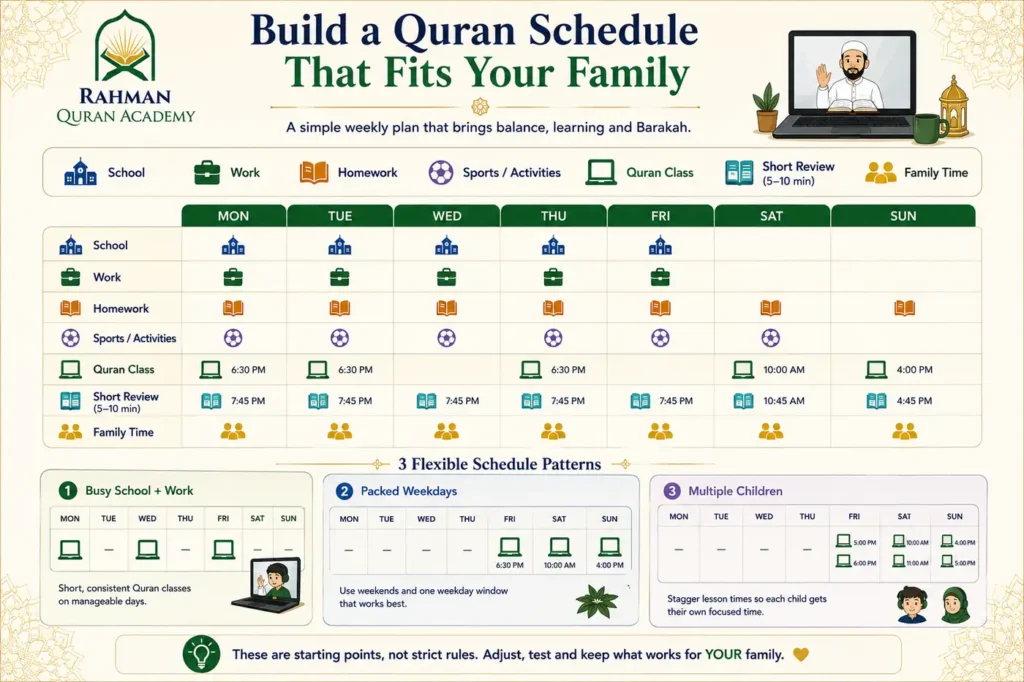
These are illustrative examples, not recommendations for every family. Use them as a starting point to adapt, not a template to copy exactly.
Schedule A: Busy School + Work Family
| Day | Activity |
| Monday | Quran class |
| Tuesday | Homework/activity |
| Wednesday | Quran class |
| Thursday | Short home review |
| Friday | Quran class |
| Weekend | Family time / light revision |
Schedule B: Packed Weekdays
| Day | Activity |
| Saturday | Quran class |
| Sunday | Quran class |
| Weekdays | 5–10 minute review |
Schedule C: Multiple Children
A shared family routine with staggered class times, for example, a younger child’s shorter Noorani Qaida session earlier in the evening, followed by an older sibling’s longer Hifz or Tajweed session once homework is finished, both anchored to the same two or three fixed weekdays.
None of these is the “correct” schedule. The right one is whichever version your family can actually repeat most weeks.
How Do You Know If Your Quran Schedule Is Actually Working?
This is the practical test that matters more than any fixed timetable: a schedule is working if it holds up in real weeks, not just on paper.
Your Child Arrives Ready to Learn
If your child is regularly alert and settled at the start of class rather than exhausted or distracted, the timing is broadly right.
Lessons Are Attended Consistently
A schedule that’s frequently disrupted or cancelled isn’t sustainable, regardless of how good it looks in theory.
Home Practice Is Manageable
If review time between classes feels like an additional burden rather than a short, manageable habit, the frequency or length of classes may need adjusting.
Schoolwork Is Not Being Regularly Disrupted
Occasional overlap is normal. A pattern of homework consistently suffering because of the Quran schedule is a sign something needs to shift.
The Child Is Progressing
Progress doesn’t have to be fast, but it should be visible over weeks and months through your child’s own sense of achievement and your teacher’s feedback.
The Routine Doesn’t Constantly Cause Family Conflict
If getting to class regularly involves arguments, rushing or stress, that’s a sign the slot doesn’t fit the family’s actual rhythm, even if it looks reasonable on the calendar.
A schedule that looks perfect on paper but keeps failing in real life needs changing. Reviewing our teachers’ approach and reading results and reviews from other families can also help you judge whether what you’re seeing at home is typical or a sign to adjust.
Frequently Asked Questions
How long should a Quran class be for a busy child? This depends on the child’s age, level and how tired they typically are on a given day, rather than a fixed rule. Shorter, more frequent sessions often suit younger or more fatigued children better than a single long class.
Is it better to do Quran class every day or a few times a week? There’s no universal answer. Some children progress well with two or three focused weekly sessions supported by short home review; others benefit from brief daily contact. What matters most is consistency over the chosen frequency.
What if my child keeps falling asleep or losing focus during class? This is usually a timing or fatigue issue rather than a sign the child can’t manage Quran learning. Trying a different time of day, adding a short transition before class, or shortening the session are worth testing before assuming the whole routine needs to change.
Should Quran classes stop completely during exam periods? Not necessarily. Many families reduce frequency or shorten sessions during exams rather than stopping altogether, which makes it easier to pick the routine back up once exams are finished.
How do online Quran classes help busy UK families specifically? Removing travel time on both ends of a lesson can make a meaningful difference to households already stretched between school, work and other commitments. It also makes it easier to keep a fixed time slot, since the class isn’t dependent on traffic or transport.
Do UK school holidays affect Quran class scheduling nationally? Yes, since school holiday dates are set locally and vary by nation, local authority, and sometimes by individual school, families in different parts of the UK will need to adjust their Quran schedules around different weeks, even within the same city.
Need help finding a Quran learning routine that fits your family’s week? A trial lesson can help you see what schedule and learning pace may be realistic for your child.