

How to Choose Online Quran Classes for Your Child in the UK
Start with your child’s current Quran level, learning goal, age and attention span, and how lessons will fit into your family’s week. Only then compare the teacher, the course, the class format, how progress is measured, the safeguarding basics, the reviews, the price and the trial lesson itself. The academy that looks the most impressive on its homepage is not automatically the right one; the right one is the one that fits your child.
This guide walks through each decision point in order, so you can compare two or three academies properly before you commit. For the wider picture of teaching your child the Quran, rather than just choosing a provider, see our complete guide to teaching the Quran to children.
What Should You Decide Before Looking at Quran Academies?
Most parents start by searching for academies. It works better the other way round: decide what your child needs first, then use that as your filter for comparing providers.
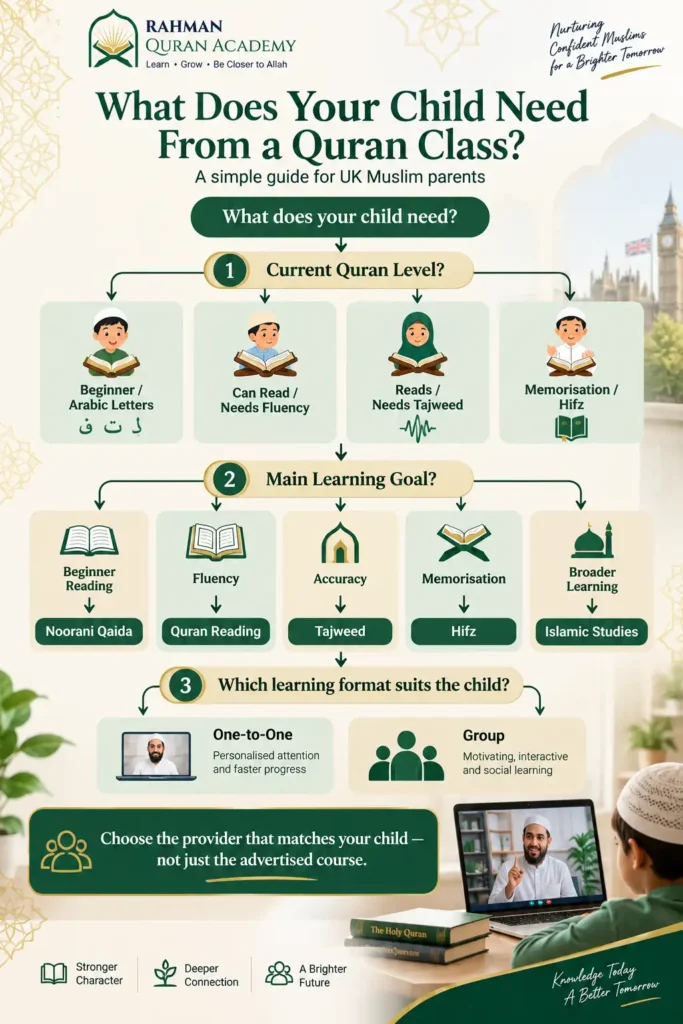
Your Child’s Current Quran Level
Is your child starting from the Arabic alphabet, already reading with some fluency, working on Tajweed, or memorising? An academy that’s excellent for complete beginners isn’t automatically right for a child who already reads confidently and needs correction rather than repetition.
If you’re not sure where your child currently stands, a proper assessment during the first lesson (see the trial lesson section below) should tell you.
What Do You Want Your Child to Learn?
Reading fluency, correct Tajweed, memorisation (Hifz), or a broader grounding in Islamic Studies are different goals, and they call for different course structures and pacing. Naming the goal before you start comparing academies stops you from being swayed by whichever course happens to be marketed hardest.
What Type of Learning Suits Your Child?
Some children settle into online lessons quickly. Others need more structure, a slower pace, or find it harder to stay focused on a screen without someone in the room with them. Neither pattern means online learning is generally right or wrong; it depends on your child’s age, attention span, and how the teacher structures the lesson.
If you’re still weighing up online lessons against a local madrasa or an in-person tutor, our comparison of online Quran classes versus a local madrasa covers that decision in more depth.
How Should Parents Choose the Right Quran Teacher?
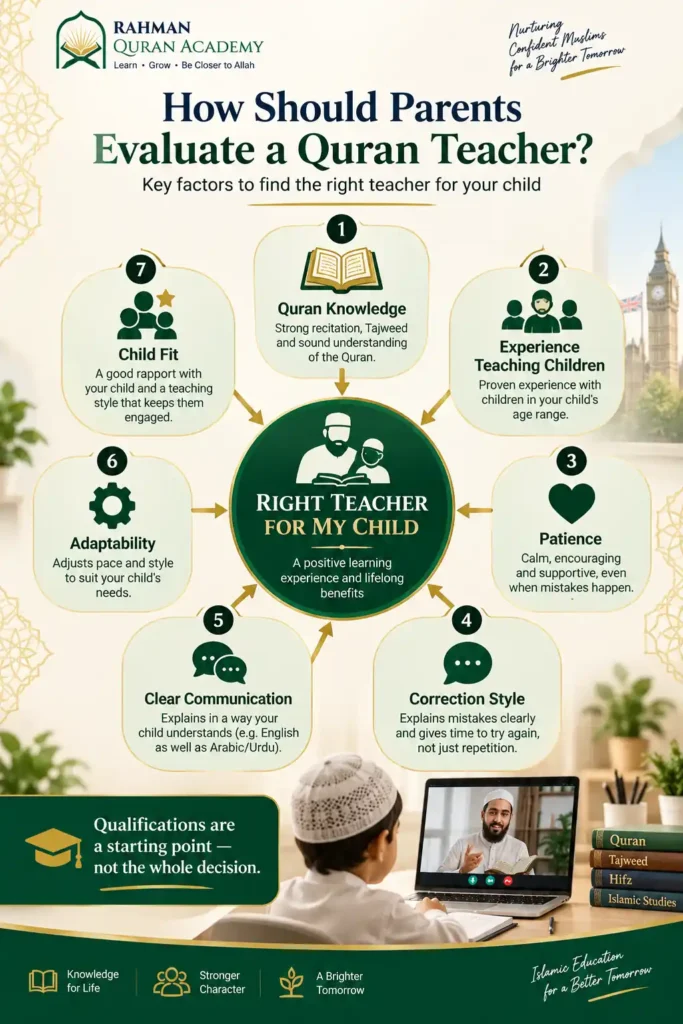
The teacher matters more than the platform, the app, or the branding. A transparent academy should be able to answer reasonable questions about the teacher clearly and specifically; vague or evasive answers about who will actually teach your child are a sign to look elsewhere.
Check Quran Qualifications
An Ijazah can indicate formal recognition of a teacher’s Quranic recitation or teaching proficiency, while being a Hafiz indicates that the teacher has memorised the Quran. Neither, on its own, tells you how well they teach children. It doesn’t, on its own, tell you whether that teacher can hold a five-year-old’s attention or explain a Tajweed rule three different ways until it clicks. Treat qualifications as the entry requirement, not the whole decision.
Look for Experience Teaching Children
Teaching adults and teaching children are different skills. Ask specifically how many years of experience the teacher has with children in your child’s age range, not just how many years they’ve taught overall.
Assess Patience and Correction Style
Watch how a teacher corrects a mistake during the trial lesson. Do they explain the correction and let the child try again, or simply ask for repetition until it’s right? Watch whether the teacher explains mistakes clearly and gives the child another chance to try, rather than relying on repetition alone. This can help you judge whether the teaching style suits your child.
Consider Language and Teacher Gender
Some families need a teacher who can explain things clearly in English as well as Arabic or Urdu, so their child fully understands instructions and corrections. Some families also have a preference for a male or female teacher for their child. Both are legitimate things to ask about upfront; a good academy should be able to confirm availability before you enrol, rather than leaving you to work it out after the first lesson.
For a deeper look at what separates a good children’s Quran teacher from an average one, see what makes a good Quran teacher for children.
Does the Course Match Your Child’s Level and Goal?
Course names vary between academies, but they generally map onto a handful of stages. Match the course to the level and goal you identified earlier, rather than picking whichever course happens to be listed first.
Noorani Qaida and Beginner Reading
Covers Arabic letters, basic pronunciation rules, and reading readiness. Appropriate for children with little or no prior exposure to Arabic script.
Quran Reading and Fluency
Builds on Noorani Qaida to develop confident, accurate reading of the Quran itself.
Tajweed and Recitation
Focuses on the rules that govern correct pronunciation and recitation, for children who can already read but need accuracy and polish.
Hifz and Memorisation
Structured memorisation with a revision system, usually requiring more frequent, shorter sessions and a teacher experienced specifically in Hifz supervision.
Islamic Studies Where Relevant
Some families want broader Islamic education alongside Quran lessons. Check whether this is offered as a separate course or folded into existing lessons, since that affects both price and lesson time.
One-to-One or Group Quran Classes: Which Fits Your Child?
One-to-one lessons give a teacher’s full attention to your child’s specific mistakes and pace. Group lessons can suit a confident child who enjoys learning alongside siblings or peers, and are often priced lower. Neither format is universally better; it depends on your child’s confidence, attention span, and whether they focus better with individual attention or find a group setting more motivating.
For a fuller comparison of both formats, including how each affects pace, cost and correction time, see one-to-one vs group Quran classes for children.
Can the Schedule Actually Work Around UK Family Life?
A course can look ideal on paper and still fail in practice if the timing doesn’t survive a normal UK week of school runs, homework and bedtime routines.
After-School and Evening Timing
Confirm lesson times are shown clearly in UK time, not just the teacher’s local time zone, and that evening slots are genuinely available rather than only mid-morning ones.
Lesson Frequency
For some younger children, shorter and more frequent sessions may be easier to sustain than a single longer session, but the right frequency depends on the child’s age, concentration and learning goals. Ask what the academy recommends for your child’s age and goal, and why.
School Holidays and Schedule Changes
Ask directly what happens during UK school holidays and half-terms, whether lessons pause, continue as normal, or need to be rebooked.
Missed Classes and Make-Up Policy
Ask what happens when your child is unwell or a lesson is missed for another reason, and whether the same teacher stays consistent for make-up sessions. Recent UK reviews of online Quran academies repeatedly mention flexible rescheduling as one of the things that made ongoing lessons workable for busy families, so it’s reasonable to expect a clear, specific answer rather than a vague one.
For a full look at fitting Quran lessons around school and work commitments, see how busy UK families can fit Quran classes around school and work.
How Should Parents Judge an Academy’s Teaching Quality?
This is where a lot of academies sound similar on their website and turn out to be very different in practice.
Does the Academy Assess the Child First?
A proper starting assessment, checking what your child already knows before placing them in a course, is a good sign. Being placed straight into a generic course without any assessment is not.
Is There a Clear Learning Path?
Ask what your child will be working on in three months and what the next milestone looks like. An academy that can answer this specifically is more likely to be tracking progress properly than one that gives a general answer about improving over time.
How Is Progress Measured?
Progress is more than pages completed. It includes reading accuracy, pronunciation, fluency, confidence, and how well your child performs without prompting. Ask how the academy reports on these, and how often.
Does the Teacher Adapt When a Child Struggles?
Ask what happens if your child finds a particular rule or section difficult. A teacher with a specific answer slowing the pace, revisiting fundamentals, using a different explanation is more reassuring than one who says the child will pick it up eventually.
What Should Parents Check During a Trial Lesson?
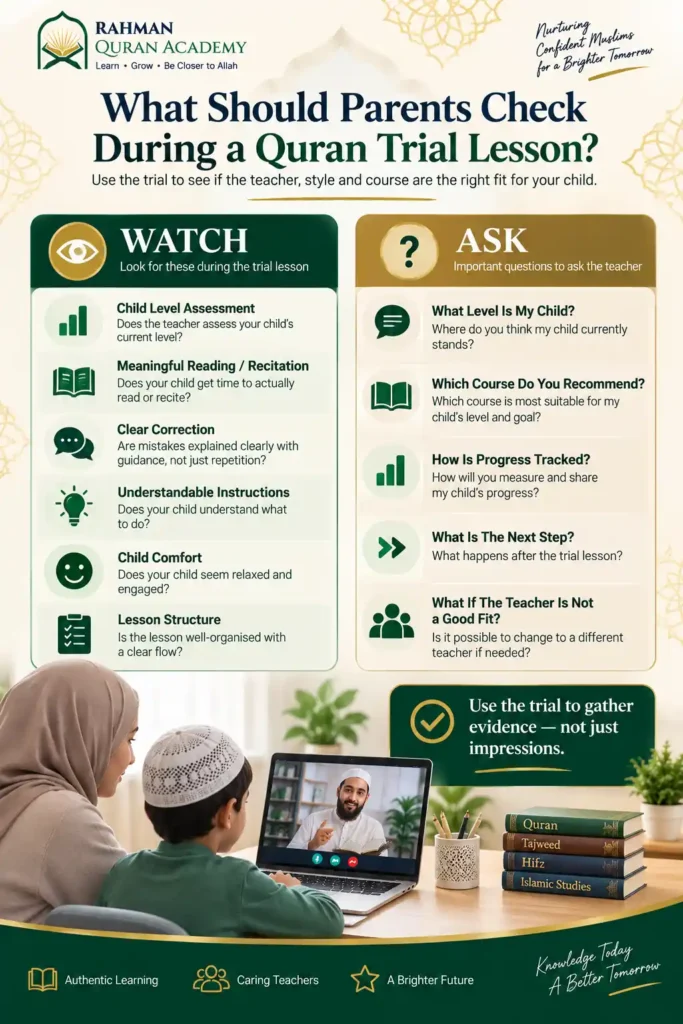
Treat the trial as evidence-gathering, not a formality to get through before enrolling. A useful trial should tell you something concrete about fit, not just leave you with a general impression.
What the Teacher Does
Notice whether the teacher assesses your child’s actual level, gives your child meaningful time to read or recite rather than mostly listening to the teacher talk, corrects mistakes clearly, and checks that your child understands instructions.
What Your Child Does
Notice whether your child participates comfortably, asks or answers questions, and seems at ease rather than anxious or lost. Their reaction afterwards is often more telling than the lesson itself; ask them directly what they thought.
What the Academy Explains Afterwards
A good trial ends with a clear next step: what level your child is at, what course is recommended, and how a first term or block of lessons would be structured. If the academy moves straight to a sales pitch without addressing any of this, that’s worth noting.
How Should Parents Judge Reviews and Reputation?
Star ratings alone tell you very little. Read the actual text of several reviews before deciding what a rating means.
Look for Independent Reviews
Independent review platforms such as Trustpilot or Google Reviews can provide a broader view than testimonials selected and published on an academy’s own website, although they should still be read critically.
Read the Details, Not Just the Stars
Specific reviews mentioning a named teacher, a particular course, or a concrete outcome carry more weight than generic five-star comments with no detail.
Look for Recurring Patterns
One isolated complaint about a missed lesson or a connection issue isn’t unusual for any online service. A pattern of the same complaint across multiple, recent, independent reviews is more significant. Current UK reviews for several online Quran providers mention occasional technical or connectivity issues alongside otherwise positive experiences — a normal trade-off of online delivery rather than evidence that online Quran platforms are generally unreliable.
Treat Academy Testimonials Differently
Testimonials on an academy’s own website have been selected by that academy. They can still be genuine, but they should be read as marketing material, not independent evidence, and weighed alongside, not instead of, independent reviews.
What Should Parents Check About Safety and Communication?
Safety deserves its own check before enrolling, without needing to become the whole decision.
Basic Safeguarding Arrangements
Ask what safeguarding arrangements the academy has for teachers working with children, and ask to see them rather than accepting a general assurance. In England and Wales, GOV.UK guidance on DBS checks is clear that a family hiring a self-employed tutor directly cannot request a DBS check on the tutor’s behalf — the tutor applies for their own certificate, and the parent should ask to view it. It’s reasonable to ask an academy how it handles this for its teachers.
Teacher-Parent Communication
Check how the academy expects you to communicate with the teacher, whether that’s a messaging app, a dedicated portal, or something else, and whether you can reach someone if you have a concern about a lesson.
Online Lesson Setup
Ask what platform is used, how simple it is for your child to join a lesson, and what happens if the connection drops mid-lesson.
This section covers the basics needed to choose a provider. For a full checklist on evaluating child safety in online Quran classes, including safeguarding and what to ask before enrolling, see our safety checklist for parents.
How Should You Compare Price and Value?
Price alone tells you very little without knowing what it buys.

Compare Like-for-Like
Two prices are only comparable once you know the lesson frequency, lesson duration, and whether it’s one-to-one or group.
As a hypothetical example: Academy A charges £20 a month for two 30-minute lessons a week, while Academy B charges £35 a month for four 30-minute lessons a week. On the surface, Academy B looks more expensive, but it provides roughly double the live teaching time, which may work out to better value per hour of actual instruction.
These figures are illustrative only, used to show how to compare offers, not average UK market prices.
What’s Included in the Fee?
Ask whether the fee includes progress reports, parent updates, revision support, or additional materials, or whether these cost extra.
Cancellation, Make-Up Classes and Sibling Pricing
Ask about the notice period for cancelling, whether missed lessons are made up, and whether sibling discounts are available if you’re enrolling more than one child.
Don’t Choose on Price Alone
The cheapest option isn’t automatically poor value, and the most expensive isn’t automatically the best. Weigh price against teacher fit, lesson time, curriculum and support together, using the framework above.
How Can Parents Compare Two or Three Academies Side by Side?
Once you’ve gathered the information above for each academy you’re considering, put it side by side. This is the single most useful step in the whole process; most parents skip it and rely on memory and general impressions instead.
| Criterion | Academy A | Academy B | Academy C |
| Child level assessed? | |||
| Teacher qualifications | |||
| Experience teaching children | |||
| Teacher fit (from trial) | |||
| Course fit | |||
| Class format (1:1 / group) | |||
| Schedule fit | |||
| Progress tracking | |||
| Safeguarding answered clearly? | |||
| Independent reviews | |||
| Price/value | |||
| Trial experience |
Copy this table, fill it in for each academy you trial, and compare the completed rows rather than the sales pages.
What Red Flags Should Make You Pause?
None of these alone should rule an academy out, but more than one together is worth taking seriously.
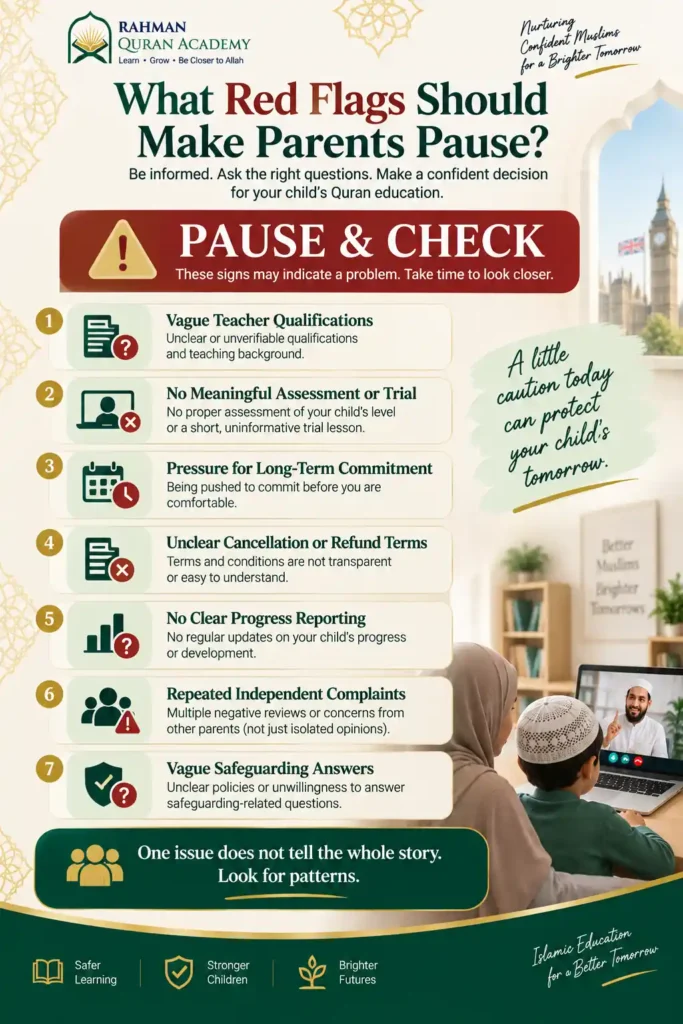
● Vague or unverifiable claims about a teacher’s qualifications
● No opportunity to assess the teaching before you’re expected to make a significant commitment
● Pressure to sign up for a long-term package before you’ve met the teacher
● Unclear or evasive answers about cancellation and refund terms
● No clear explanation of how progress is tracked or reported
● A pattern of the same complaint repeated across multiple recent, independent reviews
● Vague answers about safeguarding arrangements when you ask directly
Don’t rule out an academy because of a single negative review — check whether it reflects a pattern or a one-off.
What Should You Ask Before Enrolling?
Use this as a copy-paste list for your trial call or first message to an academy:
● What is my child’s current level, based on the trial or assessment?
● Which course do you recommend, and why?
● Can I request a specific teacher, or a male/female teacher preference?
● How many years has the teacher taught children specifically?
● How is progress measured and reported to parents?
● What happens if my child and the teacher aren’t a good fit can we switch?
● What are your UK lesson times, and are evening slots available?
● What happens during school holidays?
● What is your policy on missed lessons and make-up classes?
● What exactly is included in the monthly fee?
● What is the cancellation and refund policy?
● What safeguarding arrangements do you have for your teachers?
Final Parent Decision Checklist
☐ Identified your child’s current level and learning goal
☐ Decided whether one-to-one or group suits your child
☐ Checked teacher qualifications and experience with children
☐ Confirmed language and any gender preference can be met
☐ Confirmed lesson timing works with UK school and family life
☐ Understood how progress is tracked and reported
☐ Completed a trial lesson and asked your child for their honest opinion
☐ Read several detailed, independent, recent reviews
☐ Asked about safeguarding arrangements directly
☐ Compared price against lesson time and what’s included, not price alone
☐ Filled in the comparison scorecard for at least two academies
Frequently Asked Questions
How do I choose the best online Quran classes for my child?
Start with your child’s current level, learning goal, age and family schedule. Then compare the teacher, course, class format, progress tracking, safety arrangements, reviews, price and the trial lesson before enrolling, using the same criteria across every academy you consider.
What qualifications should an online Quran teacher have?
Look for a recognised qualification such as an Ijazah or Hafiz certification, but treat it as a starting point rather than the whole answer; it confirms knowledge of correct recitation, not necessarily the ability to teach children well.
How do I know if a Quran teacher is good with children?
Ask specifically about their experience teaching children in your child’s age range, and watch how they correct mistakes and hold your child’s attention during the trial lesson.
Should my child have one-to-one or group Quran classes?
It depends on your child’s confidence and attention span. One-to-one gives full individual attention; group classes can suit a child who’s motivated by learning alongside others and are often cheaper.
What should I ask during a Quran trial lesson?
Ask how your child’s level was assessed, what course is recommended next, and how progress will be measured, then ask your child directly what they thought of the teacher.
How much do online Quran classes cost in the UK?
Prices vary depending on lesson frequency, duration, and whether lessons are one-to-one or group, so there’s no single reliable average figure. Compare total live teaching time and what’s included in the fee rather than the monthly price alone.
How can I tell whether my child is making progress?
Look beyond pages completed to reading accuracy, pronunciation, fluency and confidence, and ask the academy how, and how often, they report on these to parents.
How can I check whether an online Quran academy is trustworthy?
Read detailed, recent, independent reviews rather than relying on star ratings alone, ask directly about safeguarding arrangements, and use a trial lesson to check the teacher is a genuine fit for your child before committing to a package.
The Next Step
Once you’ve compared the teacher, course, schedule, safeguarding arrangements, reviews and value for two or three academies, you can then explore our Quran classes for kids to see the available learning options for children. The final step is simply matching what you’ve found against your child’s needs from the start of this guide. That comparison, done properly, matters far more than any single feature or price point.