Are Online Quran Classes Effective for Children?
Online Quran classes can be effective for children, but the format itself does not guarantee good results. They work best when lessons are live and interactive, the teacher matches the child’s level, the child receives regular correction and revision, and parents support learning between lessons. Some children may still learn better in person, so effectiveness is better judged by the child’s engagement and progress than by the delivery format alone.
For a broader guide to teaching the Quran to children, see our complete guide to teaching the Quran to children.
What Does “Effective” Actually Mean in an Online Quran Class?
An online Quran class is effective when a child is actively learning, receiving accurate correction, retaining previous material and making observable progress appropriate to their level. That’s a more useful test than simply asking whether a lesson took place.
Better Reading Accuracy
The child reads letters, words or verses correctly more often than before, with fewer guesses.
More Accurate Pronunciation
Sounds are produced correctly and consistently, not just recognised on the page.
Fewer Recurring Mistakes
Errors that used to repeat lesson after lesson start to reduce. If they don’t, that’s worth investigating.
For more on this, see Quran reading mistakes
Better Retention
Material covered weeks ago remains when it’s revisited, rather than needing to be retaught from scratch.
Greater Confidence and Independence
The child attempts new material with less hesitation and needs less prompting over time.
None of this means every child progresses at the same speed; it means progress should be visible in these areas, even if gradually.
What Does the Evidence Say About Online Quran Classes for Children?
The honest answer is: it depends on how the class is run, and the research reflects that.
A study published during the COVID-19 pandemic compared Quran reading performance between online and face-to-face classes in Indonesia, drawing on data from 923 students. [Online Learning in the Quran Reading Class during Covid-19 Pandemic] It found no significant difference in reading performance between the two formats, and reported that most students and instructors were generally accepting of online delivery. The researchers also noted real limitations: the comparison groups didn’t start at the same performance level, and there wasn’t enough data to know how students with very limited existing Quran-reading skills fared online.
It’s worth being clear about what this study can and can’t tell a UK parent. Its participants were higher-education students, not young children, and it was conducted during pandemic conditions rather than as a considered long-term choice. It’s still useful evidence that online delivery isn’t inherently worse, but it doesn’t prove that any online class works for any child. Other research and practical discussions also highlight that online Quran learning brings both potential advantages and challenges, including engagement, technical setup and teacher readiness, but so do real challenges around student engagement, technical setup and teacher readiness, which is exactly why the quality of the class matters more than the format itself.
What Makes an Online Quran Class Actually Effective?
These are the main conditions that can make an online Quran class more or less effective for a child.
Live Teacher Interaction
The child is being taught in real time by a teacher who can hear them, not working through pre-recorded material alone.
Correct Level and Placement
The lesson matches what the child can currently do: not too easy to hold attention, not too hard to follow.
Active Recitation and Feedback
The child is actually reciting during the lesson and receiving specific correction on what they read, not just listening.
Structured Lessons and Revision
Each lesson connects to the last one, with previous material reviewed rather than dropped as soon as it’s “covered”.
Child-Friendly Pace
The lesson moves at a pace the child can actually keep up with, rather than a fixed pace set for convenience.
Clear Parent Communication
Parents know what was covered, what needs practice, and how their child is progressing, not just that a lesson happened.
For more on the qualities to look for in a children’s Quran teacher, see what makes a good Quran teacher for children.
| What to look for | Why it matters |
| Live interaction | The child actively participates rather than passively watching |
| Correct level | The lesson isn’t too easy or too hard |
| Actual recitation | The teacher can hear the child’s real reading, not just talk at them |
| Specific correction | Errors are identified and addressed, not glossed over |
| Revision | Previous learning is retained, not just moved past |
| Parent feedback | Practice can continue at home between lessons |
Can Children Learn Quran Reading Online?
Yes, provided the teacher can hear the recitation clearly, correct errors, and adapt the material to the child’s level. This applies at every stage from early letter recognition through to reading Quran text, as long as the interaction stays live and responsive.
For how to begin this process at home, see how to start teaching your child the Quran
For structured Quran reading lessons, see our Quran reading classes.
Can Children Learn Tajweed Online?
Yes, basic Tajweed and pronunciation can be taught online when the teacher listens carefully and provides immediate correction. In practice, this usually looks like: the teacher models the correct pronunciation, the child repeats it, the teacher corrects what’s off, and the child tries again. This works over a screen provided the audio is clear, and the teacher is genuinely listening rather than talking over the child.
For structured Tajweed instruction, see our Tajweed classes.
Can Children Memorise the Quran Online?
Yes, online Hifz is possible, but effectiveness depends heavily on structured revision, teacher feedback and consistency. New memorisation needs to be checked carefully by the teacher, previously memorised portions need regular, planned revision so they aren’t lost, and parents play a real role in reinforcing daily repetition between sessions. Without consistent revision, memorised material can be harder to retain, regardless of whether teaching happens online or offline.
For structured Quran memorisation support, see our Hifz classes.
When Do Online Quran Classes Work Best?
When the Child Benefits From One-to-One Attention
Individual attention lets the teacher respond directly to how a specific child reads and reacts.
For a fuller look at one-to-one versus group formats, see one-to-one vs group Quran classes
When the Child Can Engage With the Screen
Some children settle into screen-based learning quickly; others need more time or support to do so.
When the Teacher Adapts the Lesson
A teacher who adjusts pace, tone and material to the individual child gets more out of the online format than one running a fixed script.
When Parents Can Support the Routine
A consistent time, a quiet space and light encouragement from home all help online lessons land better.
When the Child Has a Suitable Learning Environment
A calm, distraction-free space makes a noticeable difference to how much a child actually takes in.
When Might Online Quran Classes Not Work Well?
It’s worth being honest here rather than only listing advantages. In some circumstances, the online format may not currently be a good fit, or the class design may need changing.
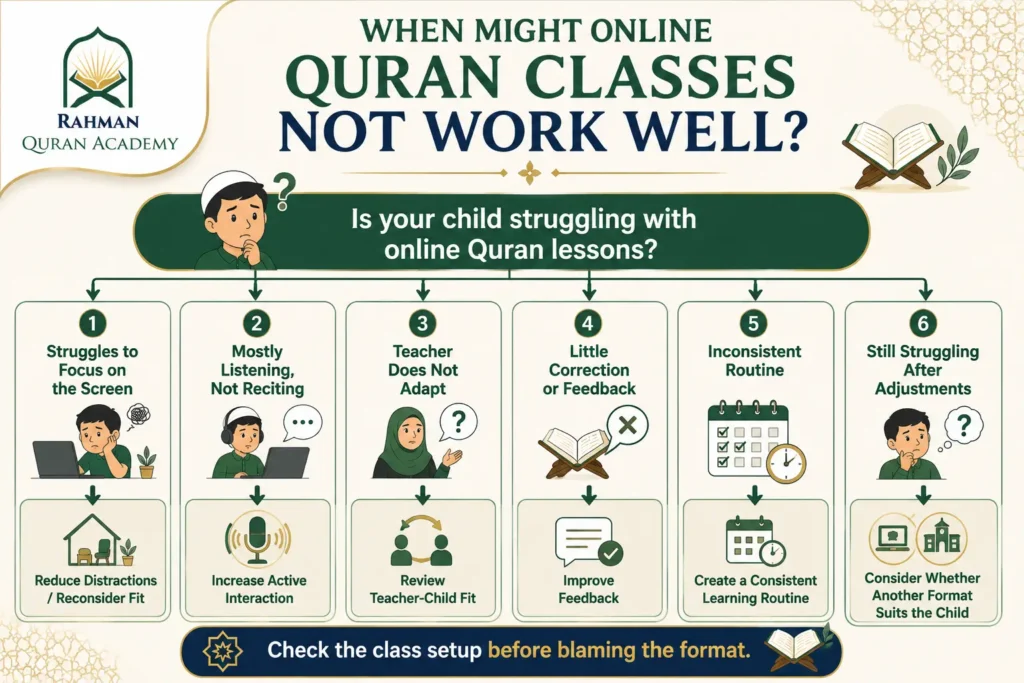
The Child Struggles to Focus on Screen
Persistent difficulty concentrating during screen-based lessons is worth taking seriously rather than pushing through.
The Lesson Is Too Passive
If the child is mostly listening rather than reciting and being corrected, less learning is actually happening than the lesson length suggests.
The Teacher Does Not Adapt
A lesson that doesn’t flex to the child’s pace or level limits progress regardless of delivery format.
There Is Little Correction or Feedback
Without specific, regular correction, mistakes are more likely to become habits.
The Routine Is Inconsistent
Irregular timing or frequent rescheduling makes it harder for learning to build lesson on lesson.
The Home Environment Is Too Distracting
A noisy or shared space can undermine even a well-taught lesson.
How Can Parents Tell If Online Quran Classes Are Actually Working?
This is one of the most practical questions a parent can ask, and it has concrete answers.
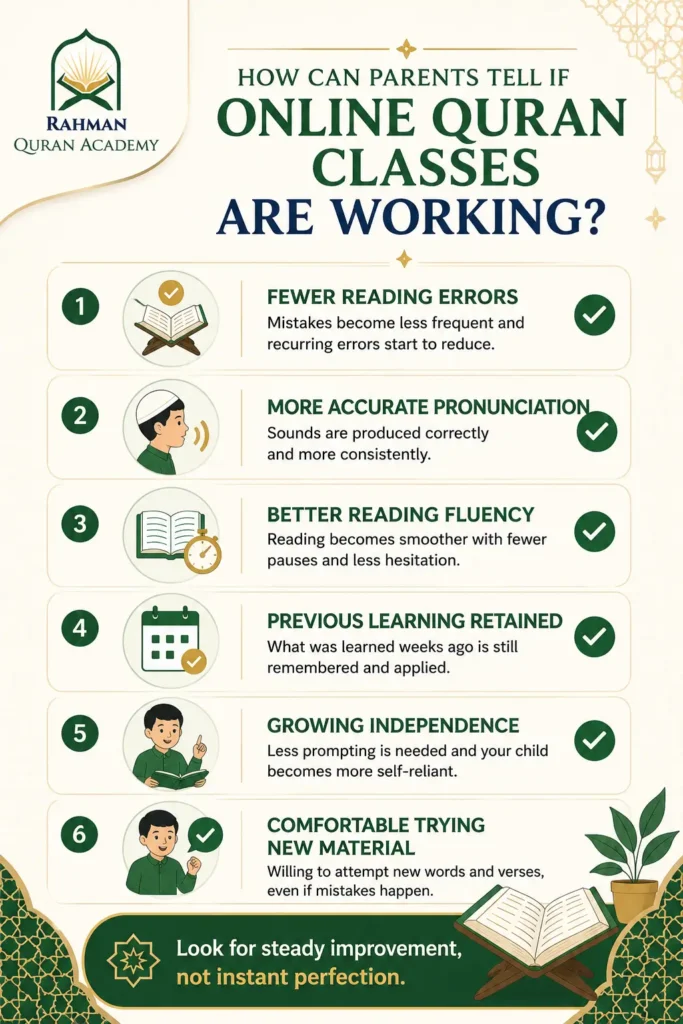
Is the Child Making Fewer Reading Errors?
A few mistakes are normal while a child is learning, but recurring errors should gradually become less frequent with practice and correction. If the same reading problems keep appearing, it is worth identifying the specific issue rather than simply moving through more material.
Is Pronunciation Becoming More Accurate?
Listen for sounds that were previously inconsistent or incorrect and check whether the child is producing them more accurately over time. Progress does not mean perfect pronunciation immediately; it means the same sounds are becoming more reliable with feedback and practice.
Is Reading Becoming More Fluent?
Fluency means the child can read with fewer long pauses, less hesitation and a more natural flow, while still maintaining accuracy. The aim is not simply to read faster, but to become more confident and consistent without sacrificing correct pronunciation.
Is Previous Learning Being Retained?
Ask your child to read something covered a few weeks ago rather than checking only the latest lesson. If previously learned material is still reasonably accurate, it is a useful sign that learning is being retained rather than quickly forgotten.
Is the Child Becoming More Independent?
A child may initially need frequent prompts, but over time they should need less help to begin reading, recognise familiar material and correct simple mistakes. Growing independence is a useful sign that learning is moving beyond memorising a lesson for that day.
Does the Child Feel Comfortable Trying?
A willingness to attempt new material, even with mistakes, usually matters more day-to-day than getting everything right the first time.
A simple way to think about this progression:
Practice → Review → Improvement in accuracy, pronunciation, retention and fluency → Growing confidence and independence
What Role Do Parents Play in Online Quran Classes?
Parents don’t need to become Quran teachers themselves, but a few things noticeably help.
• Prepare a quiet learning space with as few distractions as possible
• Help younger children join the lesson and manage the technology
• Support short, focused revision between lessons
• Listen to teacher feedback and note what needs reinforcing
• Avoid turning every lesson into pressure or a source of tension
What If My Child Doesn’t Enjoy Online Quran Lessons?
Worth investigating rather than assuming the child simply isn’t interested.
Check Attention and Screen Fatigue
A child who is otherwise tired of screens by the time the lesson happens may struggle regardless of how good the teaching is.
Check Lesson Pace
A pace that’s too fast or too slow for the child can show up as disengagement rather than a direct complaint.
Check Teacher-Child Interaction
A mismatch in teaching style or personality can affect how a lesson feels, even when the content is right.
Check Whether the Child Is Being Asked to Recite Enough
A lesson where the child mostly listens gives fewer opportunities for the teacher to hear, correct and respond to their recitation.
Consider Whether Another Format Suits Better
Some children genuinely do better with in-person contact, and that’s a reasonable conclusion to reach after ruling out the points above.
Parent communities have described young children losing enthusiasm for online lessons when sessions ran too long without variation. This reflects reported parent experience rather than formal research, but it’s a genuine and common concern worth checking for.
What Should an Effective Online Quran Lesson Look Like?
Regardless of provider, a well-run online lesson tends to follow a recognisable flow:
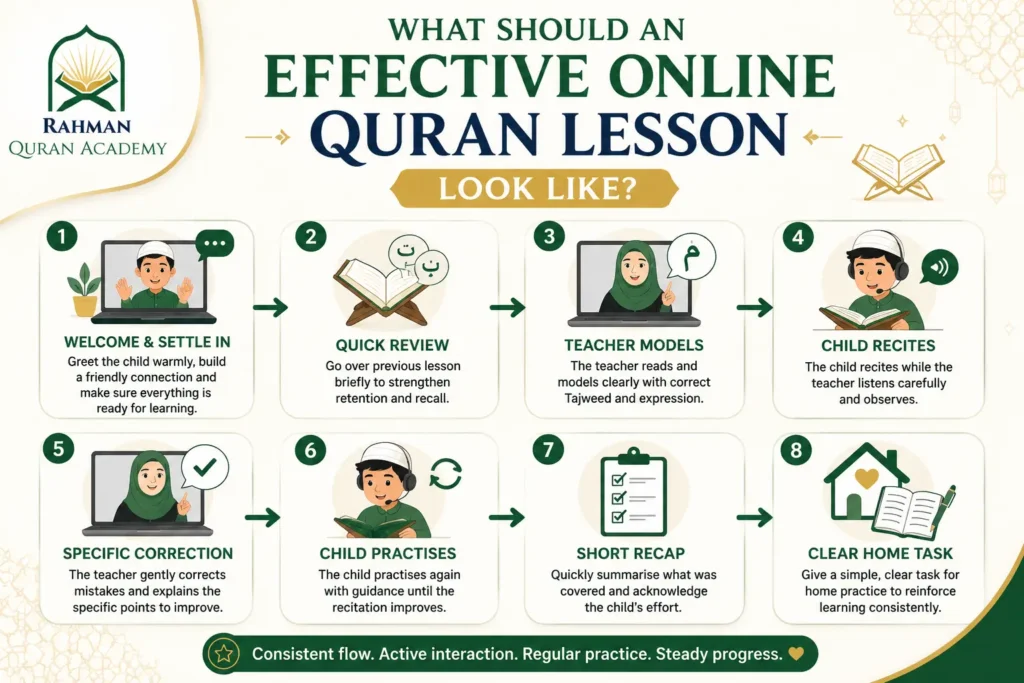
1. Welcome and settle in
2. Quick review of previous material
3. Teacher models the target reading or sound
4. Child recites
5. Teacher gives specific correction
6. Child practises the correction
7. Short recap of what was covered
8. Clear home task before the next lesson
Online vs In-Person Quran Learning: What Matters More?
This is a common comparison, but the short version is that fit usually matters more than format.
Where Online Learning Can Help
Flexibility, access to a wider pool of qualified teachers, and convenience for busy households.
Where In-Person Learning May Be Better
Some children focus better with in-person presence, particularly younger children or those who find screens distracting.
Which Is More Important: Format or Fit?
A well-taught online lesson usually beats a poorly taught in-person one, and vice versa. The format matters less than whether the specific class suits the specific child.
For a fuller comparison, see online Quran classes vs local madrasa
Are Online Quran Classes Worth Trying Before Paying?
If a provider offers a trial or assessment lesson, it’s worth using it to judge the teacher-child interaction specifically, not just whether the child “liked” the session.
Questions worth asking yourself afterwards:
• Did the child actually recite during the lesson?
• Was correction specific, rather than general encouragement?
• Was the lesson genuinely interactive?
• Did the teacher assess the child’s level accurately?
• Was the next step made clear?
For a fuller guide to choosing a provider, see how to choose online Quran classes for your child in the UK
Final Answer: Are Online Quran Classes Effective for Children?
They can be, but effectiveness comes from the learning system, not the screen itself. What actually determines whether an online Quran class works is a combination of a qualified, responsive teacher, genuine interaction, correct level placement, specific feedback, consistent revision, an engaged child and reasonable parent support at home. Where those are in place, online classes are a genuinely effective way for children to learn. Where they’re missing, the format alone won’t make up for it.
Frequently Asked Questions
Are Online Quran Classes Really Effective for Kids?
They can be, provided the class is live and interactive, correction is specific, the level is right, and revision happens consistently. The format alone doesn’t determine the outcome.
Can Children Learn Quran Reading Online?
Yes, as long as the teacher can hear the child’s recitation clearly and correct it in real time.
Can Children Learn Tajweed Online?
Yes, basic Tajweed and pronunciation can be taught through a model-repeat-correct cycle, provided audio quality is good and the teacher is actively listening.
Can Children Memorise Quran Online?
Yes, though online Hifz relies heavily on structured, consistent revision and teacher feedback; without that, memorisation tends to fade regardless of format.
Why Do Some Online Quran Classes Not Work?
Usually because the lesson is too passive, the level is wrong, correction is vague or infrequent, or the routine is inconsistent not because online delivery is inherently ineffective.
How Can I Tell If My Child Is Making Progress Online?
Look for fewer recurring mistakes, more accurate pronunciation, better retention of older material, smoother reading, and growing confidence and independence.
Are Online Quran Classes Better for Beginners?
There’s no general rule either way; what matters more is whether the lesson is correctly matched to the child’s current level and delivered with real interaction.
Should I Try Online Quran Classes Before Enrolling?
If a trial or assessment lesson is available, it’s a useful way to judge teacher-child interaction and correction quality before committing.
Explore our Quran Classes for Kids